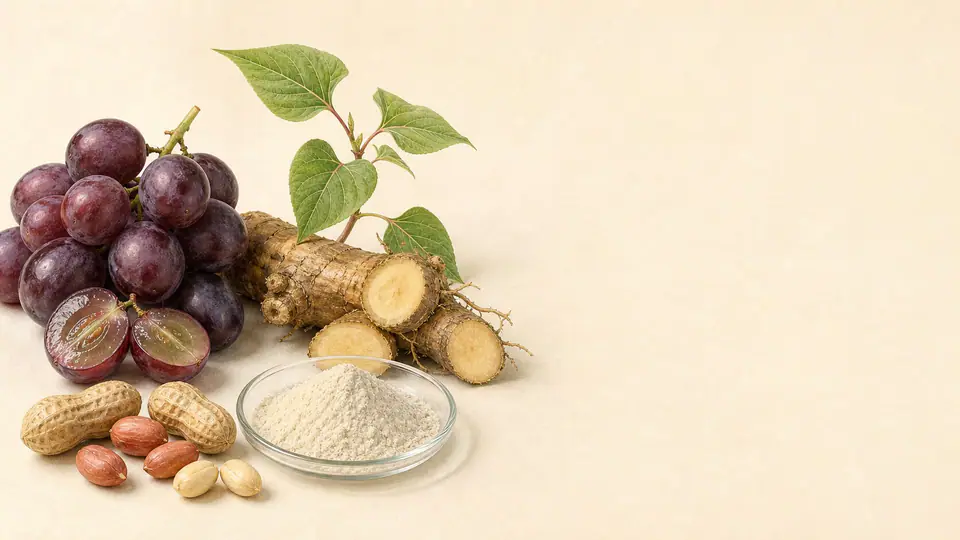
An Isomer Hidden Behind Grape Skins
Can I take resveratrol for blood glucose or aging management? To answer briefly, it is more accurate to say that there is currently no decisive evidence to justify replacing prescription medications. However, behind the word 'none' lies a complex clinical landscape where product forms, dosages, target diseases, and concurrent medications all vary. It is essential to distinguish these gaps.
Resveratrol is a component classified by PubChem as a stilbene-type polyphenolic phytoalexin. It is one of the substances plants produce in response to external stress, and it exists as cis and trans isomers. Foods such as grapes or peanuts, plant extracts, and isolated trans-resveratrol supplements all fall under the name 'resveratrol,' but the actual form and amount of exposure differ.
Where the questions begin
Questions about resveratrol usually stem from two directions. One starts from the food image associated with grapes, especially red wine. The other starts from functional expectations regarding antioxidant, anti-aging, blood glucose, and blood pressure management. When these two paths meet, a natural inference arises: 'Since it is found in food, it must be safe, and something must have been scientifically proven.' However, for this inference to hold, exposure in food, extracts, and high-dose single ingredients must be under the same conditions. In reality, they are not. So, what exactly is different?
Identity of the Ingredient: Isomers and Names
Resveratrol has cis and trans isomers, and isolated trans-resveratrol is sometimes used in supplements. PubChem's classification only explains this chemical identity; it does not imply therapeutic efficacy for a specific disease. It must first be remembered that a mechanism or an antioxidant image does not prove the treatment effect for a specific disease.
Why Expectations Exist: Between Mechanism and Image
Resveratrol is accompanied by an antioxidant image of polyphenols and various explanations of mechanisms. A 2024 systematic review of clinical trials on isolated resveratrol covered approximately 200 trials and more than 24 areas of application. However, it concluded that there is no decisive clinical evidence to recommend it in any medical setting. A high number of trials does not mean a single positive biomarker can be expanded to anti-aging or the treatment of various diseases, as the diseases, subjects, dosages, and outcome measures varied too significantly.
Differences in Product Form: Same Name, Different Conditions
Resveratrol in food and high-dose single supplements are called by the same name but exist under different conditions. It is important not to directly transfer the experience of consuming food to the safety of concentrated extracts or high-dose single ingredients. Just because you have eaten it as food, can you conclude that a high concentration in capsule form is accepted in the same way?
Evidence in Humans: Examples of Blood Pressure and Blood Glucose
A 2018 meta-analysis of 17 randomized trials on blood pressure showed that the overall effect was not significant. Signals appeared only in high-dose groups or diabetic subgroups, and these cannot be generalized as a preventive effect for healthy individuals. The fact that changes in blood glucose or blood pressure were observed in some analyses of diabetic patients does not prove a preventive effect for healthy people or a replacement for prescription treatment. In other words, changes in biomarkers and the treatment of disease or longevity are in different categories.
When taking with medications
High-dose resveratrol may interact with various CYP enzymes. Therefore, when taking it with prescription medications, it is necessary to inform your medical provider or pharmacist about the product and dosage. You must not arbitrarily reduce or stop prescription medications just because blood glucose or blood pressure levels have changed. Even if a supplement temporarily shifts these levels, it does not provide a basis for replacing prescription treatment.
Safety: Tolerated Dose vs. Recommended Dose
A 2024 review of clinical trials summarized that doses up to 1 g per day were generally well tolerated. However, there are no agreed-upon dosages by indication or standards for long-term treatment. There is a gap between the fact that a dose 'could be tolerated' and the statement 'this dose is recommended.' The judgment varies depending on the purpose and the planned duration of use.
Differences from Similar Ingredients: cis, trans, Food, Supplements
When comparing resveratrol, there are three axes. First, the difference between cis and trans forms. Second, the difference between resveratrol in food and high-dose single supplements. Third, the difference in goals between biomarker changes and disease treatment or longevity. Unless these three axes are viewed simultaneously, only simple evaluations like 'resveratrol is good' or 'resveratrol is bad' remain.
Criteria to Check Today
If you are considering resveratrol, first check three things: whether the product is grape/food, an extract, or isolated trans-resveratrol; what prescription medications you are currently taking; and what levels or symptoms you are trying to change, and how long you plan to use a high dose. Rather than converting the image of grapes and longevity into efficacy, the realistic standard for judging this ingredient is to first check the product form, dosage, evidence by target disease, and the gaps in long-term data and current medications.
References
- PubChem: Resveratrol.
- Resveratrol for the management of human health: systematic review of clinical trials.
- Resveratrol and blood pressure: systematic review and meta-analysis.
- Drug interaction potential of resveratrol.
This text explains the origin of the raw materials, the scope of research, and precautions before consumption. As this cannot replace individual diagnosis or treatment, please consult a medical professional if you are taking medication or if symptoms persist. If sudden and severe symptoms such as difficulty breathing or decreased consciousness occur after consumption, seek help from 119 or the emergency room.

Medical Staff Review
Director Choi Yeon-seung
Chief Director of Baekrokdam Korean Medicine ClinicResveratrol Dictionary Entry, reviewed the safety of expressions and the scope of verification before administration.
Review scope: Ingredient origin, human subject research, concomitant medications, intake safety · Last reviewed 2026-08-16
- Graduated from Kyung Hee University College of Korean Medicine
- Providing Korean medicine treatment since 2010
- Consultations for Gongjindan, Gyeongokgo, Nokyong (Deer Antler) restorative medicine, and customized restorative herbal medicine