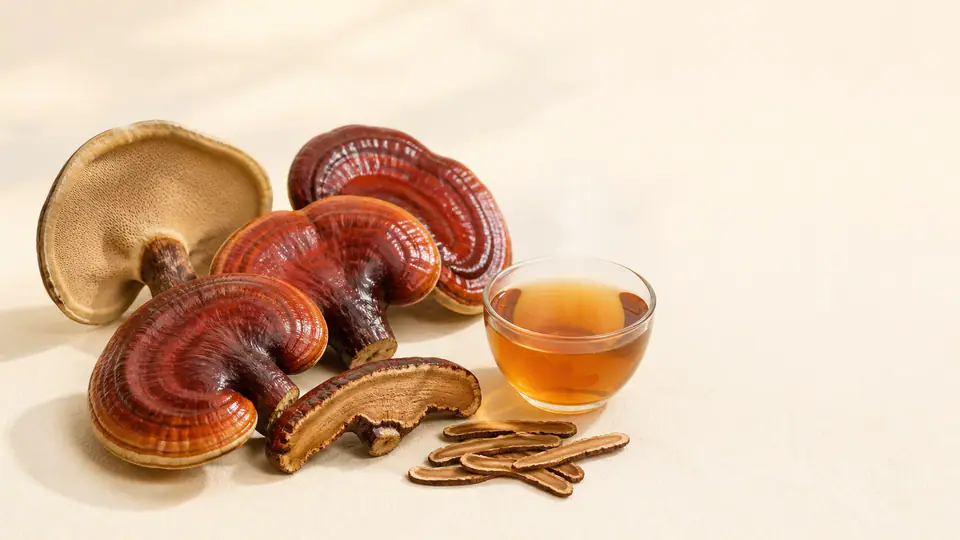
Three Layers Hidden Behind the Name 'Elixir of Life'
Is it okay to consume Reishi mushroom decoctions or powders for immunity or cancer treatment? This question recurs as mushrooms long used in Korea and East Asia have transitioned into modern supplements. In short, this does not mean Reishi mushrooms are harmful. However, human-based evidence for immunity, cancer, diabetes, or blood pressure is not as robust as expected, and because the parts used and extraction methods vary by product, it is difficult to apply the results of one product directly to another.
So, what should you look for? We will explore what kind of raw material Reishi mushroom is and what to check first when choosing one, by following the name, body, formulation, concurrent use, safety signals, and limitations of evidence.
1. Name: Even if labeled as G. lucidum, it may not be the same species
Reishi is a commercial and traditional name referring to mushrooms of the Ganoderma genus with shiny caps. Reishi cultivated in Korea and East Asia has commonly been labeled as Ganoderma lucidum, but in reality, they are often classified as the G. lingzhi lineage, which differs from the narrow G. lucidum found in Europe. Molecular phylogenetic studies on Korean-cultivated Reishi have also reported that strains traditionally called G. lucidum group with East Asian G. lingzhi and differ from the narrow G. lucidum of Europe and North America.
It is difficult to guarantee a match between the actual species and the researched product based solely on the names reishi, lingzhi, or G. lucidum on product labels. Because research literature itself uses the names G. lucidum and G. lingzhi interchangeably, the discrepancy between product species and formulation becomes an additional limitation in interpreting the evidence.
2. Body: Fruiting bodies, mycelium, and spore powder are different raw materials
The components and dosages of Reishi fruiting bodies, mycelium, spore powder, and hot water or alcohol extracts differ. Even for the same Reishi, the types and concentrations of ingredients vary depending on which part is used and whether it was boiled in water or extracted with alcohol. Fruiting body decoctions, powders, spore powders, mycelium, and polysaccharide or triterpene extracts are different formulations.
This difference is not simply a matter of processing methods, but is also the reason why research results cannot be applied to other products. The results of one formulation cannot be transferred to another product.
3. Why expectations exist: Test tubes and humans are different scenarios
One reason for the expectations regarding immunity and anti-cancer effects of Reishi is that changes in immune cell counts or antioxidant and anti-cancer actions have been observed in test tubes. However, a change in immune cell counts or test-tube indicators is a different result from a reduction in a patient's tumor or an increase in survival. The former only provides clues about the mechanism of action, while the latter is the stage of confirming therapeutic effect.
Because this gap is large, human-based studies on Reishi often fall short of expectations.
4. Evidence in humans: Limitations shown by meta-analyses and Cochrane reviews
In a 2025 meta-analysis of 971 people across 17 randomized trials, Reishi supplementation showed no significant effect on blood pressure, fasting blood glucose, lipids, inflammatory markers, or liver enzymes, and small changes in BMI and heart rate varied by subject and dose. A Cochrane review on cardiovascular risk factors in patients with type 2 diabetes concluded that evidence from a small number of trials did not support the treatment of blood glucose, blood pressure, or lipids.
A Cochrane review on cancer treatment found that the methodology and reporting quality of 5 trials were insufficient, no trials recorded long-term survival, and Reishi alone did not show the same tumor response as standard treatment. In other words, there is currently insufficient evidence to say that Reishi can treat cancer or replace standard treatment.
5. Concurrent use: Do not replace medication; notify your medical team
The first thing to check before starting Reishi is your current medications and the purpose of your treatment. Do not replace chemotherapy, immunosuppressants, anticoagulants, blood pressure, or diabetes medications with Reishi; instead, notify your medical team about concurrent use. Whether you intend to replace cancer treatment or diabetes/blood pressure medication, or use it as a supplement, are entirely different situations.
People with liver disease or those using alcohol, medications, or multiple supplements together must consult a medical professional about the entire product before starting use. For those scheduled for surgery or who are pregnant or breastfeeding, it is reasonable to avoid using arbitrary concentrated products due to a lack of safety data and variations in products.
6. Safety Signals: Rare, but caution regarding the liver is necessary
Data on adverse reactions to Reishi products are limited, and gastrointestinal discomfort, dry mouth, and rashes may be reported. There have also been reported cases of acute or fatal liver injury after using Reishi powder. However, NLM LiverTox evaluates that clinical liver injury appears to be very rare given the global volume of use, and the causal attribution is weak because other causes were not sufficiently excluded in many existing reports. This means that frequency and causality cannot be determined by case reports alone.
People with liver disease or those using multiple substances together should be especially cautious. If jaundice, dark urine, severe fatigue, or pain in the upper right abdomen occurs, use should be discontinued and a medical evaluation should be sought.
7. Similar Names, Different Products: The criteria for comparison vary
When comparing Reishi with other products, three levels must be distinguished. First, East Asian G. lingzhi and the narrow European G. lucidum may be sold under the same label name but can be different lineages. Second, the fruiting body, mycelium, spore powder, and hot water or alcohol extracts have different components. Third, immune cells and test indicators are different outcomes from tumor response, survival, and disease treatment.
In other words, just because the name is the same and the mushrooms look similar does not mean they are the same raw material or that the same effects can be expected.
8. Criteria to Check Today: Species, part, extraction method, and purpose rather than the name
Rather than names like 'elixir of life' or 'immune mushroom,' you should first check the actual species, the part used, the extraction method, the standardized amount, the existence of small or low-quality clinical evidence, whether it is intended to replace a treatment, and any liver symptoms or current medications. Specifically, you must determine whether it is a decoction of the fruiting body, powder, spore powder, mycelium, or a polysaccharide or triterpene extract; whether it is intended to replace or supplement cancer treatment or diabetes/blood pressure medication; and whether there is liver disease, alcohol consumption, scheduled surgery, or concurrent use of anticoagulants or multiple supplements.
It is true that Reishi mushroom is a special ingredient. However, that specialness does not automatically translate to increased immunity or cancer treatment. When you choose by understanding the confusion of species hidden behind names and tradition, the differences in formulation, and the limitations of evidence in humans, this ingredient becomes a concrete option rather than an imaginary 'elixir of life'.
References
- Taxonomic position of cultivated Korean Yeongji.
- Commercial Ganoderma lucidum and Ganoderma lingzhi distinctions.
- Ganoderma supplementation: GRADE systematic review and meta-analysis.
- Ganoderma for cardiovascular risk factors: Cochrane review.
- Ganoderma lucidum for cancer treatment: Cochrane review.
- NLM LiverTox: Lingzhi, Reishi.
- Fatal fulminant hepatitis associated with Ganoderma powder.
This text explains the origin of the raw materials, the scope of research, and precautions before consumption. As this cannot replace individual diagnosis or treatment, please consult a medical professional if you are taking medication or if symptoms persist. If sudden and severe symptoms such as difficulty breathing or decreased consciousness occur after consumption, seek help from 119 or the emergency room.

Medical Staff Review
Director Choi Yeon-seung
Chief Director of Baekrokdam Korean Medicine ClinicReishi Mushroom Dictionary Entry, reviewed the safety of expressions and the scope of verification before administration.
Review scope: Ingredient origin, human studies, concomitant medications, safety of intake · Last reviewed 2026-08-17
- Graduated from Kyung Hee University College of Korean Medicine
- Providing Korean medicine treatment since 2010
- Consultations for Gongjindan, Gyeongokgo, Nokyong (Deer Antler) restorative medicine, and customized restorative herbal medicine