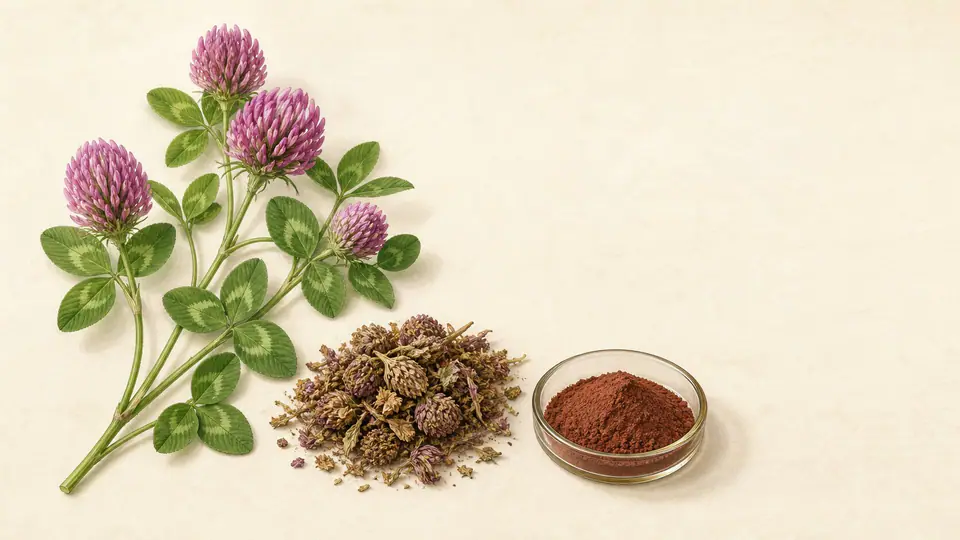
Red Flowers of the Meadow Become Menopausal Capsules
Can I take red clover for menopausal hot flashes? Is it safer than female hormone medications because it is plant-based? This question begins with the biggest misconception surrounding red clover.
Just because it comes from a plant does not mean it has no hormonal action; conversely, the name phytoestrogen does not mean it has the same effect as prescribed hormones. In short, red clover is an ingredient with two faces: a flower of the legume family and an isoflavone extract. You must first identify which face you are looking at and whether that face is appropriate for your specific situation.
Where the Question Begins: Hot Flashes and the 'Plant-Based' Label
Many people encounter red clover while searching for ways to reduce menopausal heat, especially hot flashes. The name itself, 'red clover,' and the image of a plant growing in a field seem to reduce the perceived burden. However, there is a difference in exposure levels and research evidence between plant materials consumed as flowers or teas and extracts where isoflavones such as biochanin A and formononetin are quantified. The fact that what is actually contained differs under the same name is the first gap that must be addressed.
Identity of the Ingredient: From Legumes to Women's Health Ingredients
Kew classifies red clover, namely Trifolium pratenseas a recognized species of the legume family, referred to as red clover in English. Originally, it was a legume widely grown for fodder and green manure. Its image as a women's health ingredient strengthened as isoflavone extracts entered the market. While the flower itself and the extract in capsules come from the same plant, most research has measured the standardized extracts. Where, then, is the boundary between the raw material and the extract?
Reason for Expectations: The Name Phytoestrogen
The reason hope is placed in red clover is phytoestrogens, or plant-based estrogens. This name was given because its structure and receptor action partially resemble estrogen. However, this name can lead to misunderstandings. Resemblance does not mean it possesses the same potency, effect, or risk as female hormone medications. Therefore, the expectation that it is 'safer because it is plant-based' and the expectation that it is 'effective enough to replace hormone therapy' must each be verified separately.
Between Flowers/Teas and Capsules: Same Name, Different Exposure
Raw red clover and standardized isoflavones are objects that must be compared. Across different studies, the total amount of isoflavones in the extract, the ratio of biochanin A, and the frequency of hot flashes in subjects varied. Therefore, it is difficult to apply the results of one product to all teas, powders, and capsules. Tea brewed from flowers and quantified capsules differ in daily exposure levels, and research has largely verified the latter. When choosing a product, the first step is to check whether it is a flower, tea, or powder, or a standardized extract, and what the daily isoflavone amount and composition are.
| Category | Points to Check |
|---|---|
| Raw Material, Tea, Powder | Whether isoflavones are quantified and whether the daily exposure amount is known |
| Standardized Extract, Capsule | Total isoflavone amount and biochanin A/formononetin composition |
What the Research Shows: Between Hot Flash Frequency and Quality of Life
A 2021 meta-analysis of 8 randomized trials reported an average reduction of 1.73 hot flashes per day. However, there were significant differences between studies, and results depended on specific dosages, durations, and subgroups. The NCCIH concludes that results for hot flashes are inconsistent and that some studies have issues with quality and risk of bias; therefore, definitive benefits have not been proven for any health condition. A numerical decrease in hot flash frequency does not equate to an overall improvement in menopausal quality of life. Additionally, a 2020 lipid meta-analysis reported small changes in total cholesterol, but changes in LDL, HDL, and triglycerides were not significant, and these results do not prove the prevention of cardiovascular events. In other words, the average number of hot flashes alone cannot provide answers regarding an individual's sleep, quality of life, or long-term safety.
When Taken with Medications: Where Hormones and the Coagulation System Intersect
When using red clover alongside other treatments, hormone-related therapies and anticoagulants or antiplatelet agents are the key considerations. You must consult a healthcare provider with the product in hand when combining it with hormone medications, tamoxifen, or other similar drugs. The same applies when using it with anticoagulants or antiplatelet agents. This does not mean an interaction will inevitably occur, but rather that a professional must determine the possibility of concurrent use. Avoid supplements during pregnancy or breastfeeding, and do not use them arbitrarily if you have a history of hormone-sensitive diseases such as breast or endometrial cancer, or if you are undergoing evaluation for abnormal bleeding.
Individual Circumstances and Safety Signals: Warnings from the Body
While there is data showing it was relatively well-tolerated for up to approximately 2 years in clinical trials, long-term safety during pregnancy, breastfeeding, and for hormone-sensitive diseases has not been established. Short-term tolerability and long-term safety for hormone-sensitive tissues are different issues. If abnormal vaginal bleeding, severe hives, difficulty breathing, swelling in one leg, or sudden chest pain occurs during use, you must receive a prompt medical evaluation immediately. These symptoms are not necessarily specific reactions to red clover, but are signals that require verification while considering possibilities related to hormones, bleeding, or thrombosis.
Differences from Similar Ingredients: Phytoestrogens vs. Prescribed Hormone Therapy
Comparing red clover to female hormone medications is like asking about the difference between phytoestrogens and prescribed hormone therapy. The former are plant-derived compounds, while the latter are medical hormones. Just because the structures are partially similar does not mean the therapeutic effects or risk profiles are the same. There is also a difference between hot flash frequency and overall menopausal quality of life. A reduction in the frequency of one symptom does not mean all menopausal symptoms are resolved.
Criteria to Check Today: Extracts, Medical History, and Level of Expectation
There are three things to check before choosing or taking red clover. First, whether it is a flower, tea, or powder, or a standardized extract, and what the daily dose and composition of isoflavones are. Second, whether the goal is to address hot flashes, sleep, vaginal dryness, bone health, or cholesterol, and whether changes will be tracked with a symptom diary. Third, whether there is a history of hormone-sensitive diseases such as breast or endometrial cancer, risk of thrombosis or bleeding, pregnancy, breastfeeding, or the use of hormone or anticoagulant medications. Rather than relying on the nickname 'plant-based female hormone,' the realistic approach to this ingredient is to verify the exact extract and isoflavone amount, check current treatments and hormone/bleeding-related medical history, and avoid generalizing short and inconsistent hot flash studies as universal effects.
References
- Kew Plants of the World Online: Trifolium pratense.
- NCCIH: Red Clover—Usefulness and Safety.
- Red clover for hot flushes: systematic review and meta-analysis.
- Red clover and lipid profile: systematic review and meta-analysis.
This text explains the origin of the raw materials, the scope of research, and precautions before consumption. As this cannot replace individual diagnosis or treatment, please consult a medical professional if you are taking medication or if symptoms persist. If sudden and severe symptoms such as difficulty breathing or decreased consciousness occur after consumption, seek help from 119 or the emergency room.

Medical Staff Review
Director Choi Yeon-seung
Chief Director of Baekrokdam Korean Medicine ClinicRed Clover Glossary, reviewed the safety of expressions and the scope of verification before administration.
Review scope: Ingredient origin, human studies, concomitant medications, safety of intake · Last reviewed 2026-08-17
- Graduated from Kyung Hee University College of Korean Medicine
- Providing Korean medicine treatment since 2010
- Consultations for Gongjindan, Gyeongokgo, Nokyong (Deer Antler) restorative medicine, and customized restorative herbal medicine