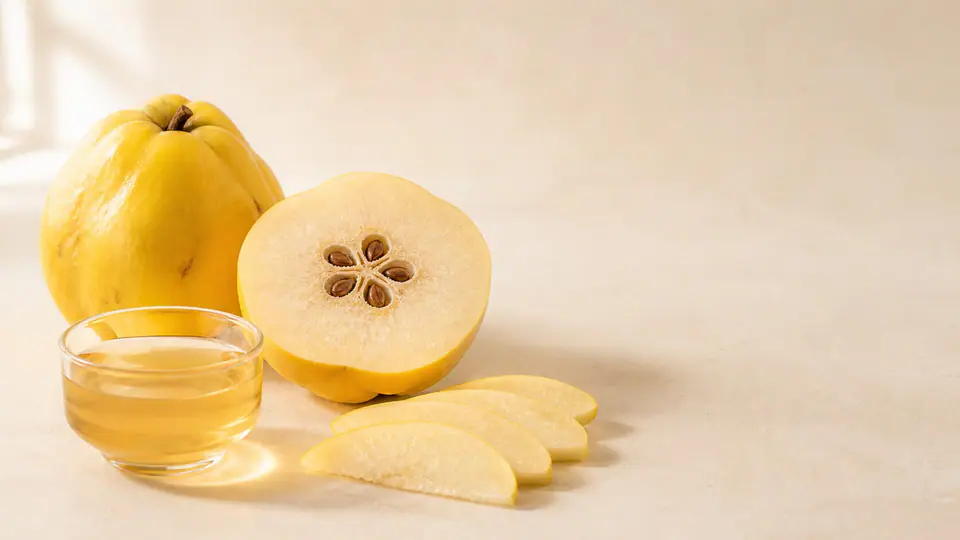
The aroma is deep, but various fruits are mixed under one name
Would drinking Mogwa-cha (quince tea) help when I have a scratchy throat or a cough? Is it the same fruit as the 'quince' mentioned in Western papers?
In short, the Mogwa used for Mogwa-cha and Mogwa-cheong in Korea is not the same species as the Western quince. There is still a lack of robust clinical evidence in humans regarding its effects on coughs or blood sugar. However, while it has a strong aroma, it is difficult to eat raw, so it has long been used as an edible fruit in the form of syrups and teas. The core issue with this ingredient is that different species and different studies are frequently conflated under the same name.
Same Name, Different Tree
The scientific name of Korean Mogwa is Pseudocydonia sinensis. Kew recognizes this name as the valid scientific name, and Chaenomeles sinensisand Cydonia sinensisis listed as a synonym. The genetic resource information from the Rural Development Administration also records the Chinese quince as Chaenomeles sinensis, meaning that past classification names for the same plant are still in circulation. Having multiple names merely reflects taxonomic changes; it does not mean that its efficacy has been proven multiple times.
Mogwa is similar to the Western quince Cydonia oblongaand the flowering quince Chaenomeles spp., but they are different plants. A 2024 literature review Cydonia·Chaenomeles·Pseudocydonia points out that the fruit is often confused even in professional literature due to its appearance and name. Therefore, it is difficult to directly apply research labeled simply as 'quince' to Mogwa-cha. This is precisely why it is difficult to interpret research without the scientific name and the specific part of the plant used.
Strong Aroma, Firm Flesh
While Mogwa has a strong aroma, its flesh is firm and has a sour and astringent taste, so it is more commonly encountered as a sugar syrup, tea, or preserve rather than as raw fruit. Because of these characteristics, people become familiar with it in processed forms rather than raw. However, the processing method changes what we actually ingest. Syrups preserved in sugar and honey bring the influence of added sugars along with the components of the fruit flesh.
Raw Material, Syrup, Tea, Concentrate, and Extract are Different Products
The forms of Mogwa are divided into raw material, syrup, tea, concentrate, and extract. When the form differs, it can be difficult to view them as the same Mogwa. This is why the safety of seeds, leaves, or highly concentrated extracts is not considered the same as the dietary experience of the flesh or diluted tea.
| Category | Points to Check |
|---|---|
| Raw Material | Scientific Name Pseudocydonia sinensis Status, part used |
| Syrup | Sugar/honey content, serving size |
| Tea | Dilution ratio, whether it is a syrup (cheong) or a sugar-free decoction |
| Concentrate · Extract | Application area, concentration, and combined ingredients |
On the label Pseudocydonia sinensisis written on the label is the first step in distinguishing it from Western quince or flowering quince varieties.
The True Composition of a Cup of Quince Syrup
The actual nutritional and blood glucose impact of one cup of quince syrup (cheong) depends more on the amount of sugar or honey added to the product and the dilution ratio than on the fruit components. If you have diabetes or are restricting sugar, you should check the sugar content and serving size of the product rather than calculating quince syrup as if it were a sugar-free tea. Syrup (cheong) is a different product category from fruit decoctions. Sugar-free fruit decoctions and sugar/honey quince syrups should not be treated as the same.
Then, what should you look for? The raw ingredients listed on the label, whether it is a syrup (cheong) or a tea, whether it is a concentrate or an extract, and the serving size and sugar content.
Why expectations arise: The gap between components and research
There is abundant research on the components of quince. The fact that there are polyphenols and in vitro antioxidant activity does not mean that quince tea treats coughs, blood sugar, or joint diseases in humans. In other words, the presence of certain components does not prove that specific symptoms will improve. There is a lack of robust clinical evidence in humans confirming whether Korean quince tea improves cough, blood sugar, or joint symptoms.
Component and in vitro research are at a different stage than results for human coughs or metabolic diseases. Activity observed in a test tube does not automatically translate to the same concentration, the same area, or the same duration within the human body. Expectations for quince are often formed by skipping these steps.
Similar names, different ingredients
There are three points of comparison. Korean quince Pseudocydonia sinensisand Western quince Cydonia oblonga, flowering quince Chaenomeles spp. and Korean quince (mogwa) trees; sugar-free fruit decoctions and sugar/honey quince syrups; and component/in vitro research versus human results for coughs and metabolic diseases. If these four pairs are not distinguished, one might apply the results of Western quince papers to Korean quince tea, or dilute the sugars in the syrup with the water in the tea when thinking about it.
Combined Intake and Individual Circumstances
Specific interactions with medications or supplements are not specified within the reviewed evidence. However, individual circumstances must be considered practically. If you have an allergy to Rosaceae fruits, monitor for itching of the lips and mouth, hives, or swelling. The safety of seeds, leaves, or highly concentrated extracts should not be assumed to be the same as the experience of eating the pulp or drinking diluted tea.
If a cough persists or is accompanied by shortness of breath, chest pain, high fever, or blood-streaked sputum, seek medical evaluation instead of delaying treatment with quince tea. For difficulty breathing, sudden swelling of the throat or face, or decreased consciousness, seek help from 119 or the emergency room.
Criteria to Check Today
The final criteria for judging this ingredient are to not rely solely on the Korean name 'Mogwa' but to verify the scientific name, part used, processing method, and sugar content, and to avoid attributing the results of other quince species or in vitro research as therapeutic effects. The comfort of a cup of tea may lie in its aroma and warmth. However, to accept the claim that the tea reduces throat inflammation or lowers blood sugar, Pseudocydonia sinensisMore human-based research under this name is required.
References
- Kew Plants of the World Online: Pseudocydonia sinensis.
- Rural Development Administration Seed Bank: Chinese quince and Chaenomeles sinensis.
- Quinces of Cydonia, Chaenomeles and Pseudocydonia: current state of knowledge.
This text explains the origin of the raw materials, the scope of research, and precautions before consumption. As this cannot replace individual diagnosis or treatment, please consult a medical professional if you are taking medication or if symptoms persist. If sudden and severe symptoms such as difficulty breathing or decreased consciousness occur after consumption, seek help from 119 or the emergency room.

Medical Staff Review
Director Choi Yeon-seung
Chief Director of Baekrokdam Korean Medicine ClinicQuince Dictionary Entry, reviewed the safety of expressions and the scope of verification before administration.
Review scope: Ingredient origin, human studies, concomitant medications, safety of intake · Last reviewed 2026-08-17
- Graduated from Kyung Hee University College of Korean Medicine
- Providing Korean medicine treatment since 2010
- Consultations for Gongjindan, Gyeongokgo, Nokyong (Deer Antler) restorative medicine, and customized restorative herbal medicine