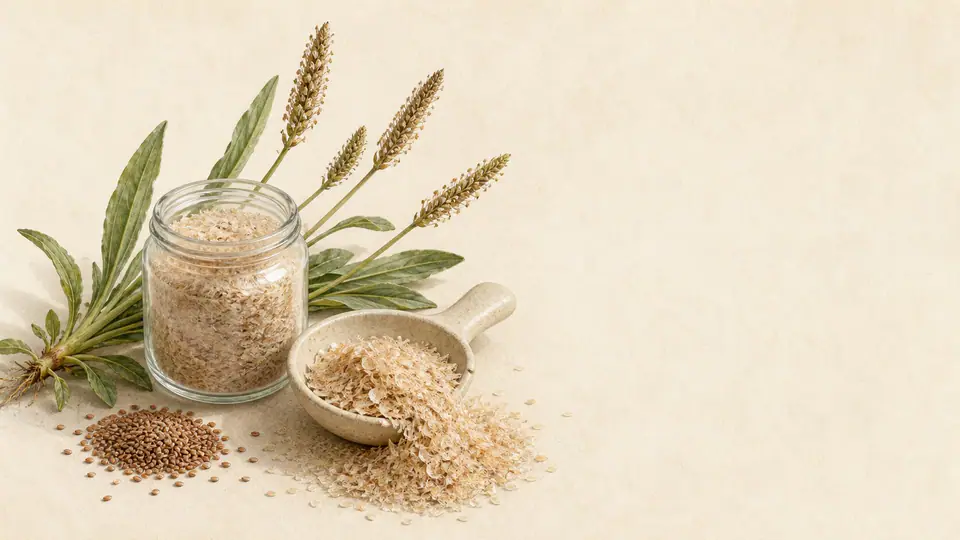
Psyllium Husk: Small husks that swell when they meet water
Can I take psyllium husk for constipation or cholesterol? The answer is "it depends on the case."
Psyllium husk has long been used as a bulk-forming laxative to relieve constipation, and some research exists regarding its effect on cholesterol and blood sugar. However, the very property that drives its effectiveness, the ability to absorb water and increase volume, can also be the cause of risk. Therefore, when choosing this ingredient, you should check the product form, amount of water, concurrent medications, and personal medical history before considering its efficacy.
Why questions arise: Two expectations, constipation and cholesterol
People usually seek psyllium husk for one of two reasons. One is to resolve constipation in the short term, and the other is as a dietary fiber supplement to lower LDL cholesterol or fasting blood glucose. Both purposes sound reasonable, but the duration of use and evaluation criteria differ. Constipation relief is closer to short-term symptom improvement, while lipid and blood sugar research deals with numerical changes based on long-term supplementation. Even for the same ingredient, the indicators to monitor should differ depending on the purpose. So, by what criteria should we categorize them?
What this ingredient is: Swelling fibers from seed husks
Psyllium husk is obtained from the seed husks of a plant in the Plantaginaceae family. Plantago ovataKew classifies this plant as a recognized species of the genus Plantago. MedlinePlus describes psyllium husk as a bulk-forming laxative that absorbs water in the intestines to swell and pass stool. The key is that it "swells." This property is the reason for constipation relief, but it is also why taking it without water can cause blockages in the throat or esophagus. The moment the small seed husk meets water and expands significantly, both the effect and the risk of this ingredient begin simultaneously.
Why there are expectations: Studies on LDL and blood sugar levels
The perception that psyllium husk has effects on cholesterol and blood sugar mainly stems from meta-analyses. In a 2025 study analyzing 41 randomized trials and 2049 people, LDL was lower by an average of 8.55 mg/dL and total cholesterol by 9.05 mg/dL. However, there was very high heterogeneity between studies, and HDL and triglycerides did not change significantly. In a 2024 study reviewing 19 trials and 962 people, some improvements in fasting blood glucose and glycated hemoglobin were observed, but results varied depending on dosage, duration, and subject.
There is an important distinction here. These average numerical changes are not direct evidence that this can replace lipid-lowering agents or diabetes medications, or prevent complications. This means that a slight decrease in numbers is not a basis for reducing or stopping medication. Research only shows the possibility that "some values improved in some people." In other words, it is still a stretch to view psyllium husk as a replacement for medication.
What different product forms mean: Actual fiber content in powder, granules, and capsules
Psyllium husk products come in various forms, such as powder, granules, capsules, and mixed constipation products. Depending on the form, the amount of fiber per dose, additive ingredients, and the required amount of water vary. For powder or granules, it is common to mix them with at least 240 mL of water immediately before consumption. Capsules are easier to swallow, but the actual amount of psyllium husk inside the capsule and the amount of water that must be drunk with it vary by product.
Even with the same ingredient, if you choose based only on the name "psyllium husk," you may miss the actual amount of fiber ingested or the required amount of water. Therefore, when selecting a product, it is best to first check "what the actual amount of psyllium husk per dose is."
Water is a requirement for use, not an optional addition
Psyllium husk is a fiber that absorbs water to increase in volume. Therefore, sufficient water is a requirement for use, not an option. Powder or granules should be mixed well with water immediately before consumption and taken with sufficient fluids according to the product instructions. If taken without water, it can swell in the throat or esophagus, potentially causing choking or obstruction.
As a general rule, do not use this product arbitrarily if you have a history of dysphagia (difficulty swallowing) or intestinal obstruction. You must seek medical attention immediately if you experience chest pain, vomiting, dysphagia, or difficulty breathing. Please also be cautious not to increase the dosage abruptly, as it may cause abdominal bloating or gas.
Interval from other medications: May interfere with absorption
Psyllium husk may affect the absorption of certain medications. In particular, you should verify the dosing interval with a healthcare provider or pharmacist for medications such as digoxin, salicylates (e.g., aspirin), and nitrofurantoin. A quick note: Should you check first if you are taking other medications before starting psyllium husk? Yes. Especially if you are taking the medications mentioned above, you must verify the interval.
Personal circumstances and safety signals: If constipation persists, the cause must be examined
Psyllium husk is not an ingredient to be taken repeatedly just because constipation symptoms persist or when there is bleeding or severe pain. In such cases, the cause should be evaluated instead of simply increasing fiber intake. In particular, if you have a history of rectal bleeding or are in a situation where water intake is restricted, you must first consult a healthcare provider regarding the use of psyllium husk itself.
Differences from similar ingredients: Husks, other fibers, and mixed laxatives
When choosing psyllium husk, it is necessary to distinguish between 'psyllium husk' and other fiber or mixed constipation products. While psyllium husk acts as a bulk-forming soluble fiber, other fibers may have weaker bulk-forming properties or different mechanisms of action. Additionally, the evaluation criteria differ between products intended for constipation relief and those targeting LDL or blood glucose levels. Since powders, granules, and capsules differ in actual fiber content and water requirements, you should not expect the same effect based on the form alone.
Final decision criteria: Dosage, water, and purpose over the name
When choosing psyllium husk, check the following first: whether it is a powder, granule, or capsule; the actual amount of psyllium husk per dose; whether there is a history of dysphagia, intestinal obstruction, or rectal bleeding; whether water intake is restricted; whether the interval from medications such as digoxin, aspirin, and nitrofurantoin has been verified; and whether the goal is constipation relief or managing LDL and blood glucose.
Rather than the name 'dietary fiber,' the realistic criteria for selecting this ingredient are to first verify the actual dosage, sufficient water intake, risks of dysphagia or intestinal obstruction, medication intervals, and whether the goal is constipation or lipid/blood glucose management.
References
- Kew Plants of the World Online: Plantago ovata.
- MedlinePlus: Psyllium drug information.
- Psyllium and lipid profiles: systematic review.
- Psyllium and glycemic control: systematic review.
This text explains the origin of the raw materials, the scope of research, and precautions before consumption. As this cannot replace individual diagnosis or treatment, please consult a medical professional if you are taking medication or if symptoms persist. If sudden and severe symptoms such as difficulty breathing or decreased consciousness occur after consumption, seek help from 119 or the emergency room.

Medical Staff Review
Director Choi Yeon-seung
Chief Director of Baekrokdam Korean Medicine ClinicPsyllium Husk Reference Entry, reviewed the safety of expressions and the scope of verification before administration.
Review scope: Ingredient origin, human studies, concomitant medications, safety of intake · Last reviewed 2026-08-17
- Graduated from Kyung Hee University College of Korean Medicine
- Providing Korean medicine treatment since 2010
- Consultations for Gongjindan, Gyeongokgo, Nokyong (Deer Antler) restorative medicine, and customized restorative herbal medicine