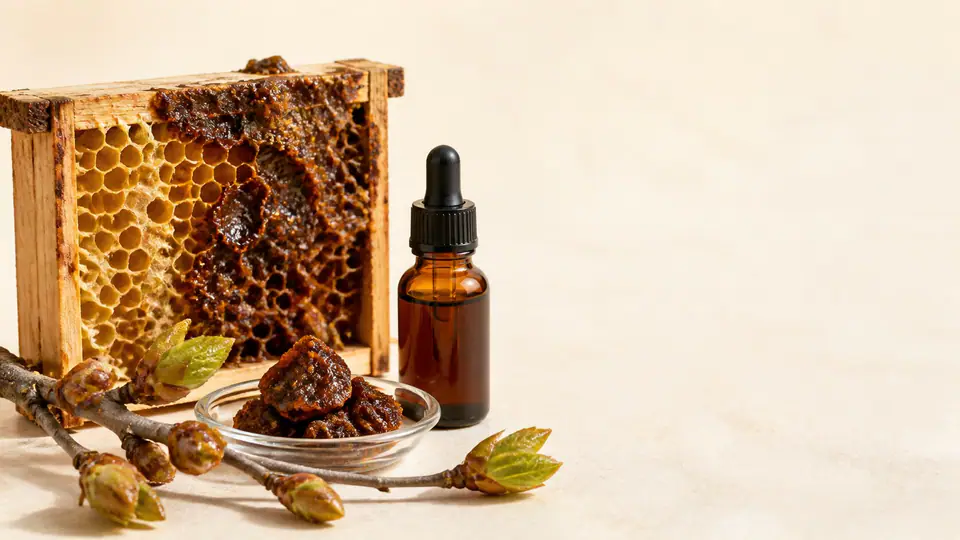
From Resin Filling Hive Gaps to Immune Raw Material
Will using a propolis spray when you have a scratchy throat help a cold recover faster? In short, it is difficult to conclude that it definitely will. While a short trial of one product in 2021 reported that mild upper respiratory symptoms disappeared faster than with a placebo, this result was obtained only under specific origins, formulations, and conditions.
Propolis is a variable hive substance created by honeybees mixing resin collected from surrounding plants with beeswax and other materials. Its chemical composition varies significantly depending on the origin and flora, and sprays, capsules, tinctures, mouthwashes, and ointments are not the same product. Therefore, the statement "propolis is good" only becomes meaningful when you first ask which propolis was used and in what form.
Where the Questions Begin
Many people approach propolis as a "natural antibacterial agent" or "immune booster." Throat sprays are among the most common forms. However, this question actually splits into several: Is it a cold or simple sore throat? Is the product used standardized? Is there a history of allergies? The reason one question splits this way is that propolis is not a single raw material.
Identity of the Raw Material: A Hive Substance and a Chemical Record of the Region
Propolis is a substance created by honeybees collecting plant resins. As explained by the US NCBI LiverTox, the composition varies greatly depending on the bee species, region, and surrounding plants. In reality, different compounds are mixed under the same name. This is key when comparing propolis from different origins, such as poplar-type and Brazilian-type. Although they share the same name, they are often difficult to consider the same raw material.
Reason for Expectations: A Short Trial of One Product
In a 2021 single-center trial involving 122 adults with mild upper respiratory symptoms, it was reported that using a standardized poplar-type propolis spray for 5 days led to faster symptom resolution than in the placebo group. This result is noteworthy. However, this is a result limited to one short trial and a specific standardized product. Therefore, it cannot be concluded that general propolis prevents or treats colds.
While the name "propolis" may feel as though it grants a common efficacy to all products, it is actually only a possibility observed in a specific product under specific conditions.
Differences in Formulation: Spray, Capsule, Tincture, Mouthwash, Ointment
Even with the same raw material, if the formulation is different, it is a different product. Sprays, capsules, tinctures, mouthwashes, and ointments differ in the area and method of use, concentration, and purpose.
| Category | Key Difference |
|---|---|
| Spray | Applicable to the upper respiratory symptom trial of a specific standardized product |
| Capsule | Spray trial results cannot be applied to oral intake products |
| Tincture | May contain alcohol solvents; check the label |
| Mouthwash | A separate formulation related to oral mucosal research |
| Ointment | For external skin use; distinct from oral or mucosal products |
The results of one standardized poplar-type spray product cannot be applied to Brazilian extracts, capsules, candies, or non-standardized sprays. This is why the formulation, origin, and standardization status must be considered together.
The Danger of Applying Results to Different Clinical Situations
There are signals of potential efficacy in research on propolis oral rinses for oral mucositis related to cancer treatment. However, because the patients, diseases, and formulations differ, these results cannot be applied to general sore throats or immune effects. A mild upper respiratory infection and cancer-treatment-related oral mucositis are entirely different clinical situations.
Antibacterial and antioxidant actions observed in cells or animals do not automatically prove treatment efficacy for infections in humans. There are boundaries of interpretation between in vitro and in vivo, animals and humans, and healthy individuals and patients with specific diseases.
Combined Intake and Individual Circumstances
What should be considered when using propolis with other supplements or medications? First is the formulation. Different approaches are needed depending on whether it is a spray, capsule, tincture, or mouthwash. Next, check the origin and whether the standardized components are labeled.
Additionally, you must distinguish between simple throat discomfort and medical warning signs such as high fever, difficulty breathing, or difficulty swallowing. You should not miss these signs by believing that propolis alone will cure a cold.
Allergies and Safety Signals
NCBI LiverTox explains that propolis may contain environmental allergens and contaminants, and that contact dermatitis, angioedema, and anaphylaxis have been reported. Out of 18 cases in Italian surveillance data, 16 were skin or respiratory allergies, some of which required emergency care or hospitalization.
People with allergies to bee products or pollen, a tendency toward asthma or atopy, or a history of contact dermatitis from lip or oral products should avoid trying it arbitrarily. Swelling of the lips, tongue, or throat, difficulty breathing, and systemic hives are signals that require immediate emergency evaluation.
Since raw materials vary by region, it is important not to generalize the fact that there were no adverse reactions to one product as evidence of the safety of all propolis products.
The Gap Between Human Evidence and Expectations
To date, human-based evidence for propolis is limited. The 2021 spray trial was a single short-term study, and the oral mucositis research showed potential in a different environment. Filling these gaps with general expectations such as "it boosts immunity" or "it makes a cold heal faster" is an exaggeration of the evidence.
In other words, this does not mean that propolis is a completely meaningless ingredient. It simply means that you should not judge various products as a single group based on one name.
Differences from similar raw materials
Caution is also needed when comparing propolis from different origins. Poplar-type and Brazilian-type propolis have different compositions despite sharing the same name. Throat sprays, capsules, mouthwashes, and topical products also have different uses. A mild upper respiratory infection and cancer-treatment-related oral mucositis are not comparable.
Such comparisons dismantle the question, "Isn't all propolis basically the same?" The name of the raw material alone is not sufficient.
Criteria to Check Today
Rather than first trusting the image of natural antibacterial and immune properties, first check the origin, formulation, standardization status, the very limited evidence for that specific product, warning signs of symptoms, and the risk of bee, pollen, or resin allergies. Before reaching for a spray when your throat is sore, the correct way to view this ingredient is to pause and consider the origin and formulation of the product, whether you have allergy signals, and whether it is simple throat discomfort or a symptom requiring more attention.
References
- NCBI LiverTox: Bee products—propolis.
- Standardized propolis spray for uncomplicated URTI: randomized trial.
- Propolis and chemotherapy-related oral mucositis: systematic review.
- Surveillance of adverse reactions to propolis.
- Contact allergy to propolis 2013-2025.
This text explains the origin of the raw materials, the scope of research, and precautions before consumption. As this cannot replace individual diagnosis or treatment, please consult a medical professional if you are taking medication or if symptoms persist. If sudden and severe symptoms such as difficulty breathing or decreased consciousness occur after consumption, seek help from 119 or the emergency room.

Medical Staff Review
Director Choi Yeon-seung
Chief Director of Baekrokdam Korean Medicine ClinicPropolis Dictionary Entry, reviewed the safety of expressions and the scope of verification before administration.
Review scope: Ingredient origin, human studies, concomitant medications, safety of intake · Last reviewed 2026-08-17
- Graduated from Kyung Hee University College of Korean Medicine
- Providing Korean medicine treatment since 2010
- Consultations for Gongjindan, Gyeongokgo, Nokyong (Deer Antler) restorative medicine, and customized restorative herbal medicine