What 'Good Bacteria' Actually Refers To
Since they are said to be good for the gut, can I take any probiotic every day? In short, no. Probiotics are living microorganisms that are intended to provide health benefits when ingested or applied to the body.
However, the broad term 'lactic acid bacteria' or the species of the bacteria alone is not enough. You must also consider which strain it is, what combination it contains, the product form, and which target condition it is intended for. You should start by checking the details that are often omitted after the name.
Why It Is Easy to Think 'Any Product Will Do'
Probiotics appear in fermented foods, supplements, and sometimes in medical contexts. Because these are grouped under one term, various situations are merged into a single friendly image of 'bacteria that are good for the gut.' However, different probiotics can have different effects. Results from one strain cannot be applied directly to another product within the same genus. Just because the names are similar does not mean they function the same way.
The Identity of the Ingredients: Living Microorganisms, but Strains Must Be Considered
The first point of distinction when understanding probiotics is classification. Lactobacillus or Bifidobacterium are merely genus names. Even within the same genus, effects can differ if the strains are different. This is why you should check if the full strain name is listed on the product label. Genus and species alone cannot specify the research results of a particular strain.
Reasons for High Expectations: Research Signals and Their Limitations
Expectations for probiotics are based on possibilities found in various clinical studies. In the prevention of antibiotic-associated diarrhea, benefit signals are seen in some strains and combinations. However, research results vary depending on the strain and the baseline risk of the subject. While the possibility of overall symptom improvement has been reported for Irritable Bowel Syndrome (IBS), it is difficult to determine exactly which species, strain, or combination is useful. For most uses, it is not yet fully known which probiotic is needed for whom and in what amount. Therefore, rather than concluding that they 'are effective,' it is necessary to examine which strain showed what results in which group of people.
Differences in Product Form: Fermented Foods vs. Strain-Labeled Supplements
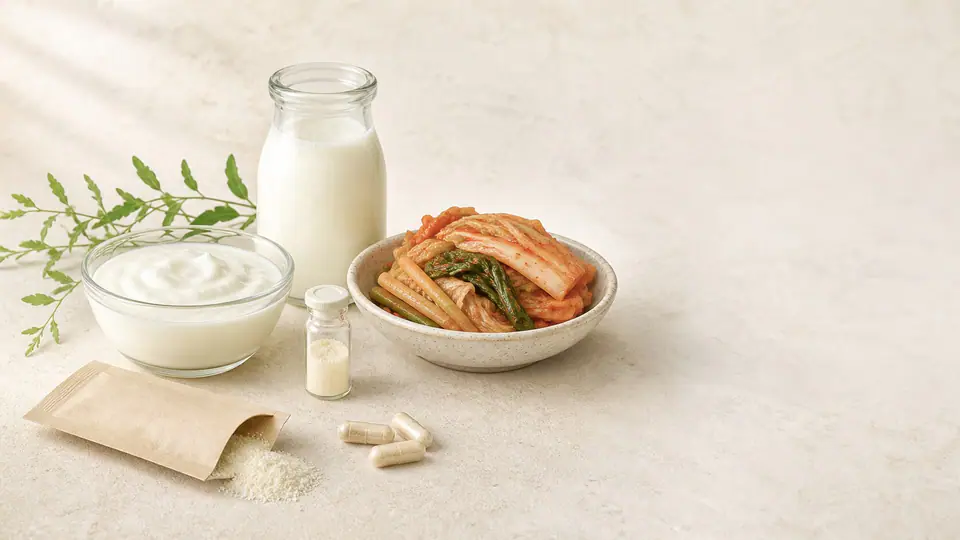
Fermented foods and supplements with clearly labeled strains both fall under the 'probiotics' category, but they have different characteristics.
| Category | Characteristics | Points to Check |
|---|---|---|
| Fermented Foods | Foods that may contain various microorganisms | May be difficult to verify if a specific researched strain is present |
| Strain-Labeled Supplements | Microorganisms can be verified via the label | Strain name, combination, storage/distribution conditions, researched purpose and target population |
However, clinical effects cannot be compared based solely on the number of living microorganisms in a product. The type of strain, combination, storage/distribution conditions, and the researched purpose and target population must be considered together.
Similar Names, Different Ingredients: Probiotics, Prebiotics, and Synbiotics
Probiotics are the living microorganisms themselves. Prebiotics are ingredients that serve as food for these microorganisms. Synbiotics are a combination of the two. These three terms are different. Because the suffix 'biotics' is similar, it is easy to think of them as the same, but their points of action are different. It is advisable to check this distinction first when choosing a product.
When taking with medications or supplements
When using probiotics in combination with other treatments, you must first consider the specific problem you are trying to address. The criteria for selecting strains vary depending on the purpose, such as antibiotic-associated diarrhea, constipation, or IBS. Probiotics should not be used as a replacement for prescribed medical treatments. Probiotics serve a supportive role, and there is insufficient evidence to justify replacing the primary treatment for specific diseases.
Individual circumstances and safety signals
In healthy individuals, mild digestive symptoms such as gas are primarily reported. However, data on long-term safety are limited. For those with severe underlying diseases or immunodeficiency, there may be a rare but increased risk of serious infection. In particular, the FDA has issued warnings to medical professionals following reports of severe or fatal infections after administering probiotics to premature infants. Patients with central venous catheters or those suffering from severe illnesses are also considered high-risk for infection. High-risk groups must consult with medical professionals before using these products.
The Gap Between Human Evidence and Expectations
Probiotic research is conducted on specific strains, specific combinations, and specific target groups. There is still a significant gap in applying those results indiscriminately to the general public. Rather than choosing a product based solely on the number of 'hundreds of millions of bacteria,' it is better to verify which strains the product consists of and for what purpose it was researched. It is also important to remember that safety standards differ between general use in healthy adults and use in premature infants, immunocompromised individuals, or severely ill patients.
Criteria to Check Today
So, what should you look for? First, check if the full strain name is listed on the product. Second, clarify the problem you are trying to solve, such as antibiotic-associated diarrhea, constipation, or IBS. Third, check if there are high-risk infection factors, such as being a premature infant, having immunodeficiency, a central venous catheter, or a severe illness. Fourth, check if the storage and distribution conditions can maintain live microorganisms. Rather than the 'hundreds of millions' count, the realistic starting point for choosing this ingredient is to first verify the full strain name, the researched purpose and target group, the storage and distribution conditions, and the risk of infection.
References
- NCCIH Probiotics: Usefulness and Safety.
- Strain-Specificity and Disease-Specificity of Probiotic Efficacy.
- Probiotics for prevention of antibiotic-associated diarrhoea in adults: meta-analysis.
This text explains the origin of the raw materials, the scope of research, and precautions before consumption. As this cannot replace individual diagnosis or treatment, please consult a medical professional if you are taking medication or if symptoms persist. If sudden and severe symptoms such as difficulty breathing or decreased consciousness occur after consumption, seek help from 119 or the emergency room.

Medical Staff Review
Director Choi Yeon-seung
Chief Director of Baekrokdam Korean Medicine ClinicProbiotics Glossary Entry, reviewed the safety of expressions and the scope of verification before administration.
Review scope: Ingredient origin, human subject research, concomitant medications, intake safety · Last reviewed 2026-08-16
- Graduated from Kyung Hee University College of Korean Medicine
- Providing Korean medicine treatment since 2010
- Consultations for Gongjindan, Gyeongokgo, Nokyong (Deer Antler) restorative medicine, and customized restorative herbal medicine