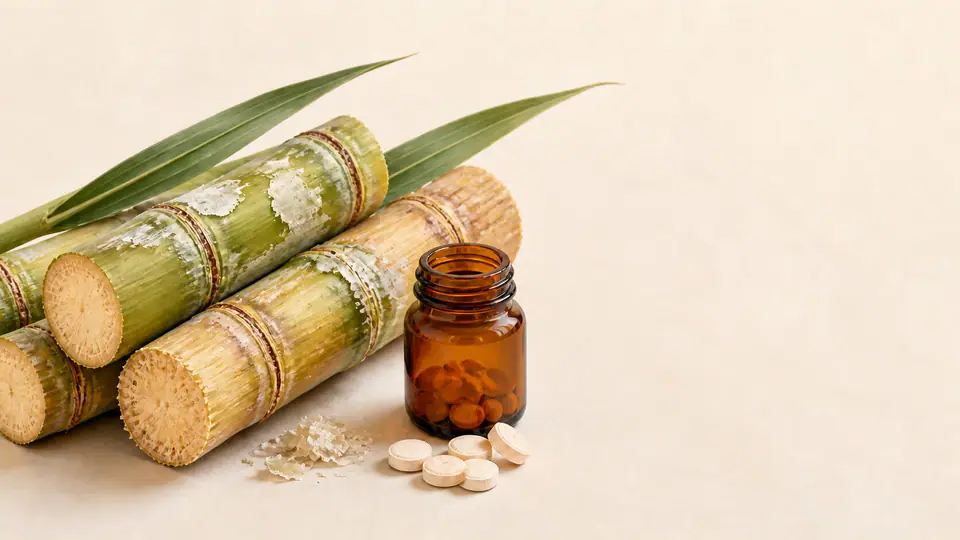
Can 'Cholesterol Ingredients' from Sugarcane Wax Replace Statins?
Will taking policosanol to lower cholesterol be helpful as a substitute for statins? In short, independent replication trials to date do not support that expectation.
Behind the name 'policosanol' are various products with different source plants, extraction methods, and composition ratios; strong effects found in one research region were not replicated elsewhere. What should you look for? When choosing this ingredient, you should first verify the actual mixture composition, whether it is a single or complex product, the context and reproducibility of the research, and your own current lipid treatment status, rather than relying on the image of it 'coming from sugarcane'.
Where the Question Began: Policosanol as a Cholesterol Supplement
Policosanol is known as a functional ingredient for improving lipid levels. It is a mixture of long-chain aliphatic alcohols obtained from sugarcane wax and may include components such as octacosanol. Many seek this ingredient as an alternative to manage cholesterol without prescription medication. However, while the word 'policosanol' sounds like a single component, it is actually a mixture of several long-chain alcohols. Even for products using the same name, if the composition differs, the intervention may not be the same.
Identity of the Ingredient: A Mixture, Not a Single Molecule
Policosanol is not synonymous with octacosanol alone. While octacosanol refers to one specific long-chain alcohol, policosanol is a substance consisting of a mixture of several long-chain aliphatic alcohols. Extraction from sugarcane wax is representative, but products obtained from wheat germ or rice bran also fall into the same category. If the source plant differs, the ratio of components changes, and the characteristics of the final product vary depending on the extraction and purification methods. Therefore, the name 'policosanol' alone cannot accurately identify the product. This is the first point of caution regarding this ingredient.
Reasons for High Expectations: Early Research and Its Background
The impression that policosanol is effective for cholesterol was formed in early research. A 2018 meta-analysis of 22 trials involving 1886 people reported lipid-improving effects. However, this meta-analysis showed high heterogeneity; the effects of Cuban research were greater than those of research outside Cuba, and the dose-response was inconsistent. In other words, even with the same ingredient, results varied depending on where, with which product, and with what design the test was conducted. A significant portion of the early strong effects came from one research region, and those effects were not replicated in external multi-center trials.
Replication of Research: Differing Results in Germany and North America
In a German multi-center randomized trial using Cuban sugarcane policosanol, doses up to 80 mg per day failed to lower lipids more than a placebo. In a North American randomized trial of 40 people, using 20 mg per day for 8 weeks failed to change LDL and other lipid markers. These two trials produced results opposite to the early research. This demonstrates that even for products claiming to be the same ingredient, results can differ based on the region where the research was conducted, its independence, and participant characteristics. Rather than concluding it is effective, one must consider the number of studies, consistency, and limitations together.
Differences in Product Form: Single Ingredient vs. Complex Product
Policosanol products may be a single ingredient or a complex product mixed with red yeast rice, berberine, etc. The results of a complex product cannot be interpreted as the effect of policosanol alone. For example, if a product containing red yeast rice and berberine showed changes in lipids, there is no basis to conclude that this was due to policosanol. It is also inappropriate as evidence for replacing statins. When choosing a product, check the label to see if policosanol is a single ingredient or if other components are included.
| Checkpoints | Reason |
|---|---|
| Source plant and composition/standardization labeling | Different compositions such as sugarcane, wheat germ, and rice bran |
| Whether it is a single policosanol or a complex product | Easy to mistake the effects of complex ingredients for a single raw material |
| Intent to replace statins and concurrent use of supplements or prescription drugs | Preventing the risk of arbitrarily changing lipid treatment |
Concurrent Use and Current Treatment: What Should You Know First?
If you use policosanol with other lipid supplements or prescription medications, you must share the full ingredients of both single and complex products with your medical provider or pharmacist. In particular, for complex products containing red yeast rice or berberine, the liver, muscle, and drug interactions of ingredients other than policosanol must be verified separately. If your lipid levels are high, it is important not to arbitrarily reduce or stop prescription medications in favor of policosanol. Supplements are not tools to replace prescription treatment.
Safety Signals: Symptoms You Should Not Endure
Even if no significant adverse reactions were evident in short-term trials, long-term safety cannot be generalized to all products due to uncertainty of efficacy and differences in product composition. If muscle pain, chest pain, or neurological symptoms occur, you should seek a medical evaluation rather than trying to endure them with supplements. This is a general principle that applies not only to policosanol but to all lipid management supplements.
The Gap Between Human Evidence and Expectations
Human-based evidence for policosanol is insufficient to be certain of its efficacy. While meta-analyses showed positive results, there was significant heterogeneity, and independent replication trials failed to confirm the effect. Dose-response was also inconsistent. This means that products with the same name may actually be different substances, and the conditions under which those substances were studied greatly influence the results. Acknowledging the gap between expectation and evidence is the starting point for evaluating this material.
Similar Names, Different Materials: Distinguishing from Octacosanol
Policosanol mixtures and octacosanol are often used interchangeably, but they are not the same. Octacosanol is a single long-chain alcohol, whereas policosanol is a mixture of several components. Furthermore, results differed between Cuban studies and independent replication trials outside of Cuba, even when dealing with the same material. Single policosanol products must also be distinguished from complex formulations containing red yeast rice or berberine. It is necessary to develop a habit of looking at the actual composition and research context rather than the similarity of the name.
Final Judgment Criteria: Substance Over Name
When choosing policosanol, you should first verify the actual mixture composition, whether it is a single or complex product, the region where research was conducted and its reproducibility, the absence of dose-response, and your current lipid treatment status, rather than just the name 'sugarcane-derived material.' Do not view it as a replacement for statins; if you are taking concurrent medications or supplements, it is safe to share the ingredients with your medical provider or pharmacist. The story of this material is a process of finding a balance between a hopeful image and limited reproducibility.
References
- PubChem: Octacosanol.
- Sugarcane policosanol and dyslipidemia: meta-analysis.
- Policosanol multicenter dose-ranging randomized trial.
- Policosanol ineffective in mild hypercholesterolemia: randomized trial.
- Berberine-policosanol-red yeast rice combination: meta-analysis.
This text explains the origin of the raw materials, the scope of research, and precautions before consumption. As this cannot replace individual diagnosis or treatment, please consult a medical professional if you are taking medication or if symptoms persist. If sudden and severe symptoms such as difficulty breathing or decreased consciousness occur after consumption, seek help from 119 or the emergency room.

Medical Staff Review
Director Choi Yeon-seung
Chief Director of Baekrokdam Korean Medicine ClinicPolicosanol Dictionary Entry, reviewed the safety of expressions and the scope of verification before administration.
Review scope: Ingredient origin, human studies, concomitant medications, safety of intake · Last reviewed 2026-08-17
- Graduated from Kyung Hee University College of Korean Medicine
- Providing Korean medicine treatment since 2010
- Consultations for Gongjindan, Gyeongokgo, Nokyong (Deer Antler) restorative medicine, and customized restorative herbal medicine