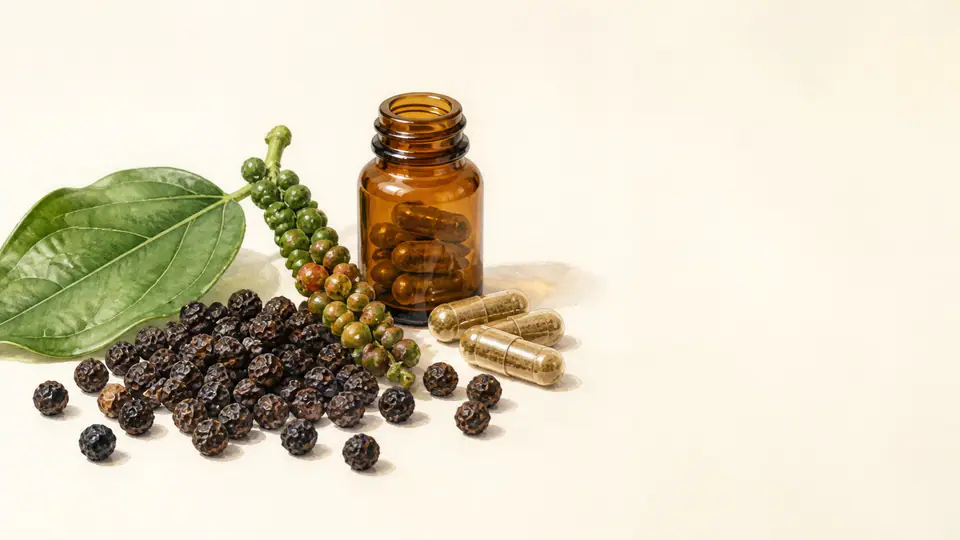
When a pinch of pepper's spiciness becomes a capsule
Can I take piperine, which is said to increase curcumin absorption, together with prescription medication?
Simply put, you must check first before taking them together. This is because products containing piperine have different exposure levels than the pepper on your dining table and may affect the body's processing pathways for certain medications.
Where the questions begin: The name 'absorption booster'
When you see phrases like 'enhanced absorption' or 'contains BioPerine' on health supplement labels, it is often understood to mean that ingredients like curcumin are better absorbed. However, 'more is absorbed' does not necessarily mean 'more effective' or 'safer.' The fact that piperine can involve certain drug-metabolizing enzymes or transporters in the intestines and liver opens the possibility that it may affect the processing of co-administered medications, not just the desired nutrients. Therefore, combining it with prescription drugs is a point that cannot be dismissed simply by saying 'it's a natural ingredient, so it's fine.'
What kind of molecule is piperine?
Piperine is an alkaloid component from the pepper tree Piper nigrum that contributes to the spiciness of the fruit. Kew explains that black pepper, white pepper, and green pepper all come from the fruit of the same tree, with the difference lying in the harvest timing and processing method. In other words, the pepper we sprinkle on food and the raw materials for supplements start from the same plant, but the exposure levels and forms differ. Pepper consumed in small amounts as food, pepper extracts, and piperine isolated and concentrated in mg units (or branded ingredients like BioPerine) each tell a different story.
How do raw materials with similar names differ?
This is where the name 'BioPerine' appears. This is a branded ingredient that concentrates piperine, and it is easy to understand it as being the same component as piperine. However, what is important is not the name, but actually how many mg of piperine it contains and whether it is a pepper extract or an isolated concentrate. Pepper eaten as a spice is only a tiny amount per meal, but a single capsule can contain a much more concentrated amount of piperine. When the exposure level changes, the possibility of interaction also changes.
Reasons for the expectation of 'better absorption' and its limitations
Increasing the bioavailability of ingredients like curcumin does not guarantee actual symptom improvement or disease prevention. Results in studies showing increased processing volume do not mean that health outcomes such as pain, inflammation, or weight have improved. Furthermore, the mechanism of increasing bioavailability may not act selectively only on curcumin. If piperine can affect certain enzymes and transporters in the intestines and liver, it may also slow down the processing speed of co-administered prescription drugs. While changes in the concentration of some drugs were observed in early human studies, this cannot be expanded to a confirmed interaction for all drugs. One must remember the distance between possibility and proof.
Differences in product forms: food, extracts, isolated concentrates
Black pepper, white pepper, and green pepper are all Piper nigrum fruits, but their harvest timing and processing differ, and piperine capsules concentrate this food experience. There are different exposure levels between black pepper in food, concentrated piperine, pepper extracts, and isolated piperine or BioPerine. Even with the same raw material, the amount the body encounters varies depending on the form. Therefore, the first step is to distinguish between 'pepper extract' and 'piperine' on the label and check the amount per dose and per day.
The first things to check when combining treatments
So, what should you look for? First, check whether the product contains pepper extract or isolated piperine, and how many mg the dose per time and per day is. Second, check the exact name of the prescription or over-the-counter drugs you are taking, the timing of administration, and whether the therapeutic concentration progress is being monitored. Third, consider pregnancy, breastfeeding, liver or kidney disease, experience of gastrointestinal irritation, and whether you are using other absorption-enhancing products concurrently. In particular, if you are taking medications where dose adjustment and the amount of drug in the body are critical, such as anticonvulsants, anticoagulants, or immunosuppressants, it is necessary to have a professional interaction review by a pharmacist or medical provider before starting concentrated piperine products.
Why safety is discussed separately from 'spices'
Safety reviews distinguish between consuming small amounts of pepper as a spice and swallowing concentrated piperine at once. Some point out that data on repeated and long-term safety in humans are limited. Because safety data are lacking for pregnant or breastfeeding women, children, and long-term high-dose use, consuming spices and taking supplements should be viewed as different categories. If gastrointestinal irritation causes heartburn, abdominal pain, or nausea, discontinue use; as a rule, avoid it if you have an allergy or hypersensitivity to pepper.
When are there warning signs?
If signs appear that the effect of your current medication is changing, you must stop the product and receive a prompt medical evaluation. For example, changes such as severe dizziness, tendency to bleed, changes in seizures, or abnormal sedation are signs that drug exposure may be higher than expected. In such cases, assuming that 'it will be fine because the ingredient is natural' can be dangerous.
The actual distance between things that look similar
Four distinctions are helpful when understanding this ingredient: black pepper in food vs. concentrated piperine, pepper extract vs. isolated piperine/BioPerine, increased systemic exposure vs. clinical efficacy, and enhanced curcumin absorption vs. prescription drug interactions. The first two are differences in exposure amount, and the latter two are differences in outcome. It is important not to automatically translate a pharmacokinetic result like 'better absorption' into a clinical result like 'improved symptoms' or a safety evaluation like 'this ingredient is safe.'
Criteria to Check Today
Do not look only at the advantage of being an absorption booster; check the actual piperine mg, all accompanying ingredients, and the medications you are taking. Do not automatically translate an increase in concentration into efficacy or safety. If you are taking prescription medication, receive an interaction review before use; a realistic standard is to stop and receive an evaluation if gastrointestinal irritation or changes in drug effect occur.
References
- Kew Plants of the World Online: Piper nigrum.
- PubChem: Piperine.
- Piperine and drug interactions: pharmacokinetic review.
- Piperine safety review from food and supplements.
- Piperine inhibits P-glycoprotein and CYP3A4.
This text explains the origin of the raw materials, the scope of research, and precautions before consumption. As this cannot replace individual diagnosis or treatment, please consult a medical professional if you are taking medication or if symptoms persist. If sudden and severe symptoms such as difficulty breathing or decreased consciousness occur after consumption, seek help from 119 or the emergency room.

Medical Staff Review
Director Choi Yeon-seung
Chief Director of Baekrokdam Korean Medicine ClinicPiperine Dictionary Entry, reviewed the safety of expressions and the scope of verification before administration.
Review scope: Ingredient origin, human studies, concomitant medications, safety of intake · Last reviewed 2026-08-17
- Graduated from Kyung Hee University College of Korean Medicine
- Providing Korean medicine treatment since 2010
- Consultations for Gongjindan, Gyeongokgo, Nokyong (Deer Antler) restorative medicine, and customized restorative herbal medicine