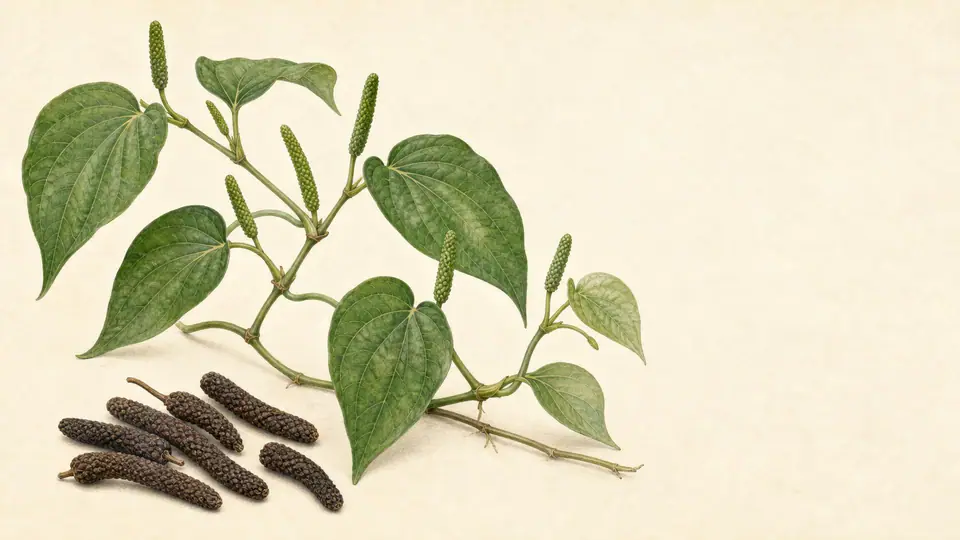
The two sides of unripe fruit spikes: When is Pippali an absorption enhancer and when is it an interaction
“Can I take Pippali or piperine together with medication to help the drug be absorbed better?”
To answer briefly, you should not simply take them together. Pippali is an ingredient used as a spice and as a digestive medicinal herb in some traditional medicines. However, it has been confirmed that the component piperine can change the systemic exposure of various drugs. The claim that it 'makes medicine work better' also implies that the risk of side effects may increase accordingly.
The important thing here is to first distinguish the name, the part of the plant used, the product form, and the types of medications currently being taken.
Where the question begins: The claim of aiding absorption
There are cases where people suggest using Pippali or the piperine within it with other supplements or medications for the purpose of 'absorption enhancement.' Some products promote the idea of increasing bioavailability. However, this is only one side of the story. Increased absorption of a drug or component means that not only the desired effect but also the possibility of overexposure, interactions, and adverse reactions may increase. This difference becomes critical especially when taking medications with a narrow therapeutic window.
How do ingredients with similar names differ?, Pippali is not black pepper
Pippali is Piper longumthe unripe fruit spike of the plant. The standards of the Ministry of Food and Drug Safety also follow this definition. It is commonly called pepper Piper nigrumThe root of Pippali differs from the fruit spike in terms of the medicinal part used. Furthermore, isolated components such as piperine or piperlongumine, or concentrated supplements for absorption enhancement, do not result in the same exposure as the raw material itself. You should not assume they are the same ingredient or expect the same effects just because the names are similar.
Why there are expectations: Many preclinical activities, but limited human evidence
Piper longumComprehensive reviews on the subject summarize various preclinical activities. It is true that various biological signals have been reported in cell or animal experiments. However, it is also noted that there are significant gaps in clinical validation, toxicology, and pharmacokinetic data. Most broad claims of efficacy are not yet based on established studies in humans. Preclinical results only show possibility; they do not prove how safe and effective the substance is for a specific disease.
Why product form matters: Spices, raw materials, and concentrates are different
When encountering Pippali, you must first distinguish what form it is in.
| Category | Characteristics |
|---|---|
| Raw material rarely used as a food spice | Low piperine concentration, and exposure is limited to small amounts used for seasoning |
| Pippali raw herbal medicine | Research on the fruit spike itself is limited |
| Piperine concentrated supplements/capsules | As a single-component concentrate, the potential for interactions differs significantly |
Capsule products containing high concentrations of piperine have a completely different exposure level than a pinch of spice. Even products sold under the name 'Pippali' may actually be piperine concentrates, so checking the label is the first step.
When combined with medications: Piperine may increase drug exposure
Reviews of human interactions have summarized studies showing that piperine increases exposure to phenytoin, propranolol, theophylline, and rifampin. A review by researchers from the German Federal Institute for Risk Assessment also concluded that isolated piperine interacts with drugs and that there are signals of reproductive and developmental toxicity in animals, though human safety data are limited. This means concentrated products cannot be viewed simply as spices.
If you are taking medications with a narrow therapeutic index or those requiring precise dosage management, such as anticonvulsants, cardiovascular drugs, bronchodilators, or antibiotics, you should particularly avoid Pippali or piperine products. Do not take piperine concentrates on your own to increase the absorption of prescription drugs, and it is necessary to inform your doctor or pharmacist of all medications and supplements you are taking.
Personal circumstances and warning signs: Who should be more cautious
It is recommended not to self-administer Pippali or piperine products that exceed the range of food spices during pregnancy, when preparing for pregnancy, or while breastfeeding. Caution is also required for those with liver disease or those taking multiple supplements where piperine overlaps.
If you experience symptoms suggestive of drug overdose, such as severe dizziness, throbbing, tremors, vomiting, or changes in consciousness, stop using the product and seek a prompt medical evaluation immediately. Rather than being common side effects of Pippali or piperine itself, these may be signals of overdose due to drug interactions.
Extent of human research: One small trial and its limitations
In a small open-label clinical trial using 4 g of Pippali twice daily for 3 weeks, no serious adverse events were reported. However, due to the limited scale, design, and subjects, the results cannot be generalized to long-term safety, other diseases, or other populations. It should be remembered that human therapeutic research on Pippali itself is small and limited.
Among similar names: What should be compared
When understanding Pippali, four layers of comparison operate together. Pippali Piper longumis pepper Piper nigrumand unripe fruit spikes are different parts from the roots. Spices used in food have different exposure levels than piperine concentrated supplements, and research on raw herbal medicine must be read separately from research on single components like piperine and piperlongumine.
These distinctions are not merely academic classifications. This is because the exposure level, potential for interaction, and strength of evidence all change depending on which one is selected.
Criteria for today: Look at exposure and medications first, not just the spicy taste
So, what should you look for? First, check whether the product is raw Pippali or a piperine concentrated capsule. Next, check if you are taking medications with known interactions with piperine, such as phenytoin, propranolol, theophylline, and rifampin, or drugs with a narrow therapeutic index. You must also check for possibility of pregnancy, breastfeeding status, liver disease, and whether piperine overlaps with other supplements.
Rather than seeing the spicy taste or 'enhanced bioavailability' only as advantages, the realistic criterion for choosing this ingredient is to first verify the species, part used, piperine concentration, and the therapeutic index of your current medications.
References
- Ministry of Food and Drug Safety Herbal Medicine Standards: Pippali.
- Piper longum systematic review.
- Piperine herb-drug interactions in humans.
- Isolated piperine safety assessment.
- Small clinical study of Pippali.
This text explains the origin of the raw materials, the scope of research, and precautions before consumption. As this cannot replace individual diagnosis or treatment, please consult a medical professional if you are taking medication or if symptoms persist. If sudden and severe symptoms such as difficulty breathing or decreased consciousness occur after consumption, seek help from 119 or the emergency room.

Medical Staff Review
Director Choi Yeon-seung
Chief Director of Baekrokdam Korean Medicine ClinicPippali Dictionary Entry, reviewed the safety of expressions and the scope of verification before administration.
Review scope: Ingredient origin, human studies, concomitant medications, safety of intake · Last reviewed 2026-08-17
- Graduated from Kyung Hee University College of Korean Medicine
- Providing Korean medicine treatment since 2010
- Consultations for Gongjindan, Gyeongokgo, Nokyong (Deer Antler) restorative medicine, and customized restorative herbal medicine