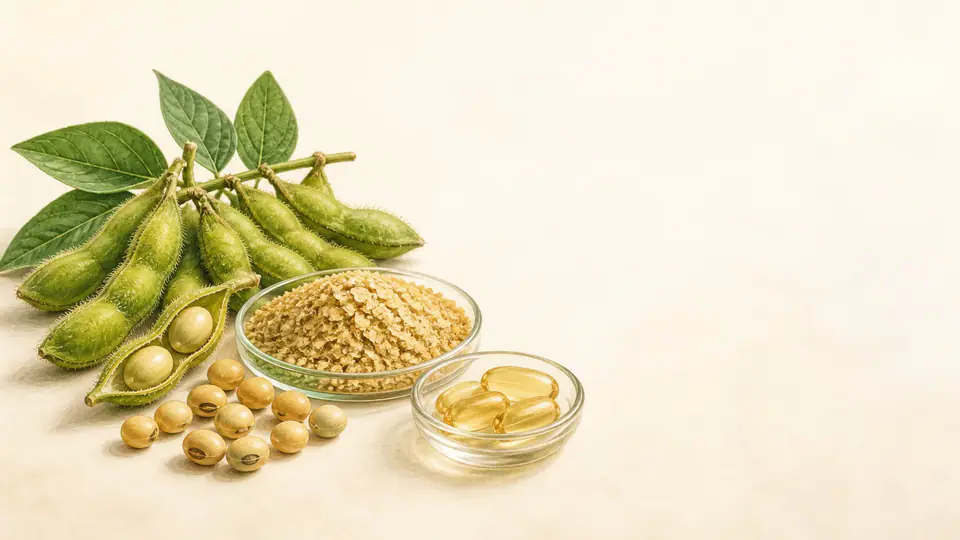
From phospholipids inside the cell membrane to memory capsules
Will taking phosphatidylserine help when you feel your memory is declining? In short, it is difficult to definitively say that it might help. While this ingredient is physiologically significant as a phospholipid that makes up the cell membrane, clinical evidence that taking it in capsule form improves memory is limited. The core of the question lies in distinguishing the identity of the raw ingredient from the effectiveness of the supplement.
It is precisely this gap that must be distinguished.
Where the questions begin: Forgetfulness, mild cognitive impairment, and dementia are different conditions
The feeling of declining memory may sound the same, but there are actually very different stages. Temporary forgetfulness is a subjective experience that can happen to anyone. Mild cognitive impairment is a state where there is objective cognitive decline, but basic independence is generally maintained. Dementia is a state where cognitive decline interferes with daily functioning. Assuming these three operate on the same principle can lead to wrong choices in supplements. In particular, if memory decline progresses rapidly or if there are changes in daily functioning, language, or navigation, a medical evaluation takes priority over supplements.
What is Phosphatidylserine: A phospholipid with a serine head
NCBI MeSH classifies phosphatidylserine as a phospholipid derivative bonded with serine. It is one of the phospholipid families present in the cell membrane, characterized by a structure with a serine head. This is physiologically important as it is a component of the cell membrane. However, the fact that it exists in the cell membrane does not automatically mean that additional intake results in the clinical effect of improving cognitive function. What is already in the body, what is taken orally, and whether it acts in the desired location in the desired manner are all different issues.
Why the expectation: From a cell membrane component to a memory-improvement ingredient
The explanation that it is a component of the cell membrane is intuitively appealing. It naturally leads to the speculation that supplementing the materials of the brain cell membrane might improve brain function. This physiological role is where marketing connects it to being an ingredient for memory improvement. However, while phosphatidylserine is a phospholipid present in cell membranes, this physiological function alone is not enough to conclude the memory-improvement effects of supplements. Multiple stages of verification are required between physiological presence and clinical effect.
Different sources of ingredients: Soy, sunflower, and marine sources
Phosphatidylserine products available on the market today have different sources. They can be obtained from soy, sunflower, or marine sources, and the composition varies depending on the raw material. In the past, materials derived from bovine brains were used, but these differ in composition from today's plant-based and marine-based materials. Therefore, when judging based on a study, one must look at which ingredient and which formulation were tested. When choosing soy-derived products, it is necessary to check for soy allergies and ingredient labels, and to distinguish them from sunflower or marine sources.
Product forms must also be distinguished: Single PS and complex products do not share the same evidence
Phosphatidylserine products are largely divided into two categories: single PS products and complex products mixed with DHA, ginkgo biloba, vitamins, etc. These two do not share the same evidence. In a 2024 trial of 190 people with mild cognitive impairment, there was an improvement in cognitive indicators, but that product was a complex product containing PS, ALA, ginkgo biloba, and vitamins. Therefore, the effect of PS alone cannot be isolated. When looking at complex products, the overlap and interactions of each ingredient must be checked together.
The Extent of Evidence in Human Subjects
In a 2026 network meta-analysis of supplements for Alzheimer's disease and mild cognitive impairment, there were some MMSE signals, but no supplement showed significant improvement in ADAS-Cog. The FDA requires that qualified health claims related to cognitive function be accompanied by a statement that the scientific evidence is very limited and preliminary, and that there is little scientific evidence to support it. In other words, while there are some signals regarding memory improvement, the evidence is not consistent or definitive.
Concurrent use and individual circumstances: Who needs to be cautious?
While no clear major safety signals were evident in short-term trials of single phosphatidylserine ingredients, data on long-term safety for specific products and concurrent use with various medications are limited. If you are taking multiple medications or have an upcoming surgery, it is necessary to share the full list of product ingredients with your medical staff or pharmacist. For products mixed with DHA, ginkgo biloba, and vitamins, the overlap and interactions of each ingredient must be checked. If you have a soy allergy, you should avoid soy-derived products or carefully check the ingredient labels.
Precautions when comparing similar names
Three comparisons are important when evaluating phosphatidylserine. First, the difference between phosphatidylserine within the cell membrane and oral supplements. Second, the difference between soy, sunflower, and marine-derived products. Third, the difference between single PS trials and complex trials involving DHA, ginkgo biloba, and vitamins. Missing these distinctions leads to applying the research results of one product directly to another.
Final Judgment Criteria: What to Verify Today
So, what should you look for? First, check the source of the ingredients and the complex components. See whether it is soy, sunflower, or marine-derived, and whether it is a single PS or a complex product. Next, look at who was involved in the test and what the results were. Distinguish whether it was temporary forgetfulness or suspected mild cognitive impairment or dementia accompanied by functional decline. Keep in mind the limited evidence mentioned by the FDA. Finally, check for medical warning signs of memory decline first. If memory problems progress rapidly or affect daily life, a medical evaluation takes priority over supplements.
References
- NCBI MeSH: Phosphatidylserines.
- FDA qualified health claims for phosphatidylserine.
- Supplements for Alzheimer disease or MCI: network meta-analysis.
- Phosphatidylserine-containing supplement in MCI: randomized trial.
This text explains the origin of the raw materials, the scope of research, and precautions before consumption. As this cannot replace individual diagnosis or treatment, please consult a medical professional if you are taking medication or if symptoms persist. If sudden and severe symptoms such as difficulty breathing or decreased consciousness occur after consumption, seek help from 119 or the emergency room.

Medical Staff Review
Director Choi Yeon-seung
Chief Director of Baekrokdam Korean Medicine ClinicPhosphatidylserine Preliminary Items, reviewed the safety of expressions and the scope of verification before administration.
Review scope: Ingredient origin, human studies, concomitant medications, safety of intake · Last reviewed 2026-08-17
- Graduated from Kyung Hee University College of Korean Medicine
- Providing Korean medicine treatment since 2010
- Consultations for Gongjindan, Gyeongokgo, Nokyong (Deer Antler) restorative medicine, and customized restorative herbal medicine