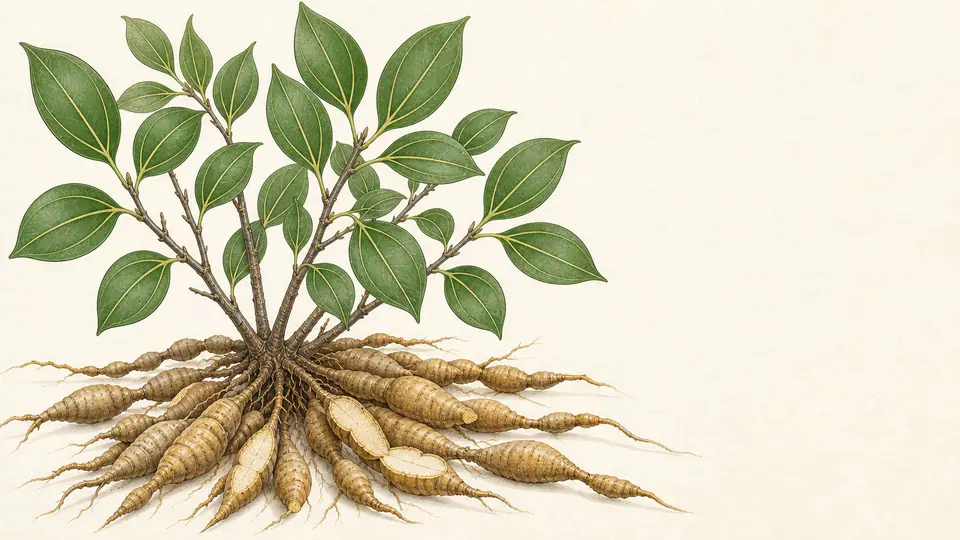
Bead-shaped roots with a camphor scent: Three boundaries behind the name Oyak
Can I take Oyak when I have indigestion or frequent urination? In short, while there is a traditional context for raw material teas or prescriptions from a Korean medicine clinic, concentrated products or complex capsules require prior verification because the efficacy of Oyak alone cannot be determined. This is because various different substances are easily mixed under a single name for this ingredient.
In the domestic pharmacopoeia, Oyak is defined as the root of Lindera strichnifolia. It meets the criteria for camphor scent, form, and identification tests. However, in modern research, the same plant is more frequently referred to as Lindera aggregata. While having two scientific names is a matter of taxonomic synonymy, both names should be kept in mind when selecting raw materials. This is because products containing different parts or different plants are sometimes called Oyak if the names differ.
This article follows three boundaries hidden behind the name Oyak: distinguishing whether it is the root or another part, whether it is a raw material or a concentrated complex product, and what the cause of the symptoms is.
Where the questions begin: Abdominal pain and frequent urination
Oyak is typically considered in two situations: one involving a feeling of slow digestion and abdominal discomfort, and the other involving frequent urination or nocturia (waking up at night to urinate). Traditional medicine has linked both pathways to Oyak. However, modern human-subject research has not verified these two symptoms with Oyak alone. A 2024 critical review summarized approximately 260 components and broad preclinical activities, but concluded that most were simple cell or animal studies and that more clinical, pharmacokinetic, and long-term toxicity studies are needed. In other words, there is still a gap between long-term usage experience and modern evidence.
The identity of this ingredient: Pharmacopoeia roots and modern scientific names
Domestic standards define Oyak as the root of L. strichnifolia. Modern literature primarily uses L. aggregata. These two are understood as synonyms referring to the same plant. However, in the market or on product labels, these scientific names may be used interchangeably, or 'Oyak' may be used to describe leaves, stems, substitute raw materials for straight roots, vinegar-processed products, essential oil or linderaene components, and even bladder complex products mixed with other plants. This is the core issue surrounding the identity of this ingredient. Leaves, stems, essential oil components, and complex products do not share the same evidence as the Oyak root defined by the pharmacopoeia.
What should you look for then? The first step is to check if the product uses the root part corresponding to the pharmacopoeia and if the scientific name is specified as L. strichnifolia or L. aggregata.
Why expectations exist: A study on a complex product
Expectations for Oyak are mostly focused on overactive bladder or frequent urination. There is an 8-week randomized trial involving 150 people. This study used a complex product that concentrated Oyak root, Crataeva stem bark, and Equisetum stem, and reported changes in overactive bladder symptoms. However, the important point here is that these results cannot be isolated as the effect of Oyak alone, as it was a concentrated extract containing three plants together.
Research on alkaloids isolated from the root only dealt with inflammatory and cytotoxic activity at the cellular level, not the therapeutic effect on abdominal pain or frequent urination in humans. Therefore, the claim that 'Oyak is good for the bladder' can be seen as an exaggeration that applies results from a complex product study to a single ingredient.
Differences in product forms: Raw material, vinegar-processed, and concentrated complex
When encountering Oyak, you must distinguish between three forms: first, the raw root based on pharmacopoeia standards; second, vinegar-processed products; and third, bladder complex products that concentrate Oyak with two other plants. Although they use the same name, their evidence bases differ.
| Form | Characteristics | Limitations of evidence |
|---|---|---|
| Raw root | L. strichnifolia root based on pharmacopoeia standards | Lack of modern clinical evidence |
| Vinegar-processed product | Components may change depending on the processing method | Evaluation criteria different from Pharmacopoeia standards |
| Three-plant concentrated complex product | Used in combination with Crataeva and Horsetail | Cannot be isolated as the effect of Oyak alone |
This table is simply for distinguishing forms. It cannot be concluded that one form is superior to another. However, it is clear that research results for concentrated complex products should not be applied directly to raw materials or other formulated products.
When taking with other medications or supplements
Two things should be kept in mind when using Oyak with other medications or supplements. If you are taking medications for overactive bladder, diuretics, or diabetes medications, it may affect your symptoms and fluid balance. It is necessary to inform your medical staff of all ingredients in the product. In particular, if a person using diuretics or diabetes medications adds an Oyak complex product to mask frequent urination, it may obscure the condition without diagnosing the cause.
Additionally, the principle that research results for three-plant complex products are not applied as the efficacy or safety of raw Oyak or other formulated products also applies to combination evaluations. You must look at both what is in the product and what you are currently taking.
Individual circumstances and safety signals
Some people require a medical evaluation before using Oyak. If you have symptoms such as painful urination, hematuria (blood in urine), fever, flank pain, or urinary obstruction, a urinary tract evaluation is the immediate priority. These may suggest infection, stones, or urinary disorders rather than simple frequent urination.
There is insufficient safety data for humans regarding long-term high-dose use in cases of pregnancy, lactation, children, or those with liver and kidney disease. Therefore, the general rule is not to take concentrated products arbitrarily. Frequent urination and nocturia have various causes, including infection, diabetes, prostate issues, heart failure, and diuretics. A cause evaluation must come before masking symptoms with medicinal herbs.
The Gap Between Human Evidence and Expectations
Expectations for Oyak generally fall into two categories: abdominal pain and frequent urination/overactive bladder. However, most of the activities summarized in the 2024 review are at the cellular or animal level, and randomized trials for humans exist only for the three-plant complex product. Clinical trials showing that Oyak alone improved abdominal pain or frequent urination are not within the reviewed evidence.
In other words, the scientific evidence for Oyak remains at the level of having 'many components and diverse preclinical activity,' and it is correct to view that definitive human efficacy for specific symptoms has not yet been proven.
Similar names, different ingredients
The most common confusion when choosing Oyak comes from the similarity of names. L. strichnifolia and L. aggregata often refer to the same plant, but on product labels, leaves, stems, substitute roots, vinegar-processed products, essential oil components, and complex products mixed with other plants can all appear under the name 'Oyak'. Furthermore, traditional uses for frequent urination must be distinguished from modern diagnostic causes. While frequent urination can occur simply because the bladder is sensitive, it can also be caused by infection, diabetes, prostate problems, heart failure, or side effects of diuretics.
You must first verify whether the name 'Oyak' refers to the Pharmacopoeia root or another product borrowing that name.
Criteria to Check Today
If you are considering Oyak, check these three things first. First, check if the product is the root of L. strichnifolia or L. aggregata as defined by the Pharmacopoeia, or if it is the leaf, stem, substitute part, essential oil, or a complex product. Second, distinguish whether it is a raw material, a vinegar-processed product, or a three-plant concentrated complex product. Third, evaluate the cause of the frequent urination or abdominal pain, and whether there is pregnancy, lactation, childhood, liver/kidney disease, or medications currently being taken.
The final criterion for selecting this ingredient is to verify the exact species, root, processing, and complex components, as well as the cause of the symptoms, rather than just the symptom names like abdominal pain or frequent urination.
References
- Ministry of Food and Drug Safety Korean Pharmacopoeia: Oyak.
- Lindera aggregata critical review.
- Three-herb combination trial for overactive bladder.
- Lindera aggregata root constituents and cell activities.
This text explains the origin of the raw materials, the scope of research, and precautions before consumption. As this cannot replace individual diagnosis or treatment, please consult a medical professional if you are taking medication or if symptoms persist. If sudden and severe symptoms such as difficulty breathing or decreased consciousness occur after consumption, seek help from 119 or the emergency room.

Medical Staff Review
Director Choi Yeon-seung
Chief Director of Baekrokdam Korean Medicine ClinicOyak Dictionary Entry, reviewed the safety of expressions and the scope of verification before administration.
Review scope: Ingredient origin, human studies, concomitant medications, safety of intake · Last reviewed 2026-08-17
- Graduated from Kyung Hee University College of Korean Medicine
- Providing Korean medicine treatment since 2010
- Consultations for Gongjindan, Gyeongokgo, Nokyong (Deer Antler) restorative medicine, and customized restorative herbal medicine