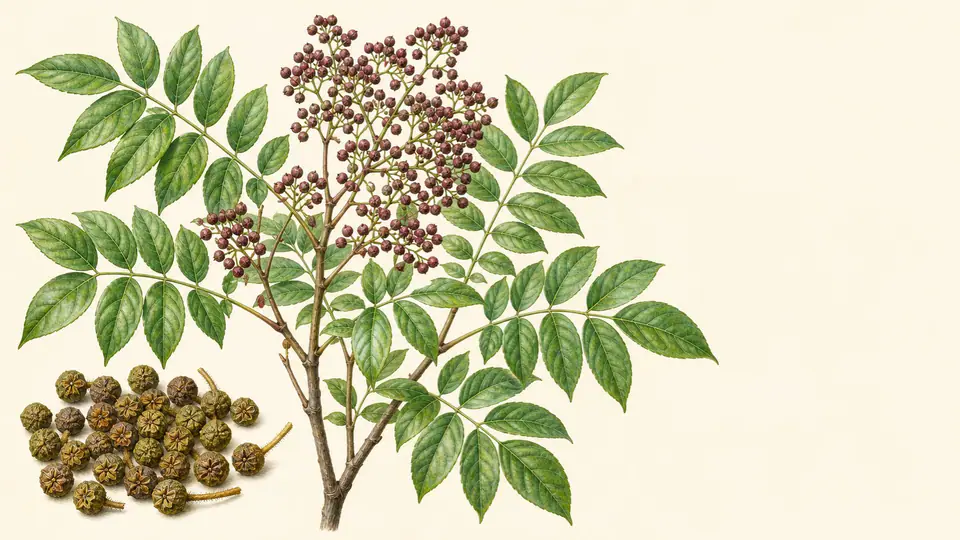
Big Questions Raised by Small Berries
Can I brew Evodia fruit myself when I have a cold stomach, abdominal pain, or a headache? In short, it is not yet recommended because safe self-administration dosages and long-term risks for humans have not been sufficiently established. Evodia fruit consists of small, strongly scented berries similar to peppercorns. While they have long been associated with treating abdominal pain, vomiting, and headaches, modern research is raising questions about the drug metabolism of evodiamine and rutaecarpine, as well as signals of liver, heart, and kidney toxicity, rather than focusing solely on therapeutic effects.
It is critical to distinguish this gap. To conclude first: do not treat these small berries and their traditional uses for abdominal and headache pain as a safe herbal tea. Instead, you must first verify the botanical origin, harvest timing, processing, dosage, and your own liver, heart, and kidney health, as well as any medications you are taking.
Korean Pharmacopoeia Evodia Fruit: Identity Defined by Harvest Timing
The Korean Pharmacopoeia defines Evodia fruit as the fruits of Evodia rutaecarpa and two varieties, E. rutaecarpa Bentham var. officinalis Huang and E. rutaecarpa Bentham var. bodinieri Huang, harvested before they are fully ripe and split open. Here, 'before they are fully ripe and split open' is not merely a harvesting method, but a part of the identity recognized by the Pharmacopoeia. Domestic Evodia fruit encompasses the nearly ripe fruits of these three botanical taxa, and the harvest timing is included in the identity of the raw material.
The Pharmacopoeia also sets combined standards for evodiamine and rutaecarpine. These two alkaloids are indicator components used to evaluate the quality of Evodia fruit, but they are also the subjects of caution in modern research.
How do raw materials with similar names differ?
You may encounter the name Tetradium ruticarpum in modern literature. This is simply a case of the same plant group being referred to by a different taxonomic name; it is not necessarily identical to the raw medicinal material defined by the Pharmacopoeia. A more important distinction lies in the form and part used. Fully ripe fruits, leaves, stems, isolated evodiamine or rutaecarpine components, and concentrated extracts do not present the same exposure as the raw medicinal material.
So, what should you look for? When choosing a product, you must first distinguish whether it consists of fruits harvested before they are fully ripe and split open, fully ripe fruits, or other parts or concentrated components. Even if the names are similar, if the form of exposure differs, the basis for comparison changes.
Reasons for Expectations and the Reality of Research
Evodia fruit is linked to traditional uses or complex prescriptions related to headaches, abdominal pain, and menstrual pain. However, this data cannot be translated into definitive human efficacy for self-brewed Evodia decoctions. A 2020 comprehensive review summarizing 165 components and various preclinical activities pointed out the potential for major alkaloids to cause drug interactions and liver damage. This review concluded that more research on combination use, processing, and toxicity is required.
A 2025 review categorized the risks of liver, heart, and kidney toxicity of Evodia fruit separately, but explained that data on heart and kidney toxicity are particularly lacking. A multi-center histotoxicity study from the same year presented preclinical data investigating various organ indicators and the effects of hot water washing in animal and analytical models. However, this study does not conclude a safe human dose or that washing alone makes it safe.
A significant portion of pharmacological research has been conducted on concentrated extracts or isolated evodiamine and rutaecarpine components in cells and animals. Therefore, those results cannot be directly linked to the effects of raw medicinal decoctions in humans.
The Gap Between Raw Decoctions and Concentrated Products
The most common forms of Evodia fruit are raw decoctions and concentrated extracts or capsule products. Even with the same raw material, these two differ in exposure amount and component spectrum. A raw medicinal decoction is a form where nearly ripe fruits, according to Pharmacopoeia standards, are brewed with water. In contrast, isolated evodiamine and rutaecarpine components or highly concentrated extracts intentionally increase specific components.
The potential for drug interactions and liver damage pointed out in the 2020 review primarily emerged from signals in research on these concentrates or isolated components. Therefore, one cannot simply assume that 'it will be safe because it is raw,' nor can one conclude that 'only concentrates are dangerous.' Both share limitations in evidence.
What to Check First Regarding Current Medications
Evodia fruit is classified as an elevated-risk material. As a rule, avoid long-term use of self-brewed decoctions, powders, or highly concentrated extracts, and follow the species, processing, and dosage of a professional prescription. In particular, if you have liver disease, kidney disease, arrhythmia, or cardiovascular disease, or if you are taking anticoagulants, heart medication, or drugs metabolized in the liver, you should not add these products arbitrarily.
In other words, you must check your current medications and organ health before adding Evodia fruit. Since the possibility has been raised that major alkaloids such as evodiamine and rutaecarpine may interfere with drug metabolism, those taking other medications must be especially cautious.
Personal Circumstances and Warning Signs to Stop
There is insufficient safety data for pregnant or breastfeeding women, children, and those taking the medicine long-term. Additionally, if you experience sudden severe headaches, neurological symptoms, or persistent abdominal pain, seeking a medical evaluation for the cause should take priority over attempting to use herbal medicine.
If any of the following symptoms appear during use, stop immediately and seek a medical evaluation: jaundice, dark urine, or severe vomiting may be signs of liver damage; pulsating sensations, feeling of fainting, or chest pain may be heart-related signs; and a decrease in urine output may indicate changes in kidney function. While a causal relationship between these signs and Evodia rutaecarpa has not been confirmed, they should be used as criteria to stop and be evaluated when taking elevated-risk ingredients.
The Gap Between Human Evidence and Expectations
Expectations for Evodia rutaecarpa are primarily derived from traditional use and preclinical studies. However, definitive efficacy studies in humans are limited. Reviews from 2020 and 2025, as well as a 2025 multicenter histotoxicity study, all focus on preclinical data. This means that rather than concluding it is 'effective,' one must consider the number of studies, consistency, and limitations together.
In particular, the potential for liver, heart, and kidney toxicity remains at the level of possibility, and safe self-administration doses and long-term risks in humans have not been sufficiently established. Therefore, it is more evidence-based to view Evodia rutaecarpa as a medicinal herb to be used only under professional prescription rather than as a treatment alternative.
Differences from Similar-Looking Substances
Four distinctions are useful when evaluating Evodia rutaecarpa. First, the difference between fruits harvested nearly ripe before opening and fully ripe fruits. Second, the difference in classification names between Evodia rutaecarpa and the modern name Tetradium ruticarpum. Third, the difference between a decoction of the raw herb and isolated components such as evodiamine and rutecarpine. Fourth, the difference between a professional complex prescription and high-concentration self-administration.
These distinctions are not merely academic classifications. This is because the spectrum of components released and the risk profile can vary depending on which form is taken, in what dose, and for how long.
Realistic criteria to check today
If you are considering Evodia rutaecarpa, first check these three things. First, check if the product consists of nearly ripe fruits of the three origin species listed in the pharmacopoeia, or if it is fully ripe fruit, other parts, or an evodiamine concentrate. Second, check whether it is a self-made decoction or a complex prescription formulated by a Korean medicine doctor, and verify the single dose, duration of use, and processing method. Third, check for liver, kidney, or heart disease, possibility of pregnancy, and whether you are using anticoagulants, antiarrhythmic drugs, medications metabolized in the liver, or other concentrated herbal medicines.
It is not recommended to decoct and drink Evodia rutaecarpa at home before verifying these three points. The old stories held by these small fruits are interesting, but when applying those stories to the body, the origin, harvest time, processing, dosage, concomitant medications, and the individual's organ health must come first.
References
- Ministry of Food and Drug Safety Korean Pharmacopoeia: Evodia rutaecarpa.
- Tetradium ruticarpum fruit pharmacology, interactions and toxicology review.
- Euodiae Fructus botany, processing and toxicology review.
- Euodiae Fructus multi-tissue toxicity and processing study.
This text explains the origin of the raw materials, the scope of research, and precautions before consumption. As this cannot replace individual diagnosis or treatment, please consult a medical professional if you are taking medication or if symptoms persist. If sudden and severe symptoms such as difficulty breathing or decreased consciousness occur after consumption, seek help from 119 or the emergency room.

Medical Staff Review
Director Choi Yeon-seung
Chief Director of Baekrokdam Korean Medicine ClinicEvodia rutaecarpa Dictionary Entry, reviewed the safety of expressions and the scope of verification before administration.
Review scope: Ingredient origin, human studies, concomitant medications, safety of intake · Last reviewed 2026-08-17
- Graduated from Kyung Hee University College of Korean Medicine
- Providing Korean medicine treatment since 2010
- Consultations for Gongjindan, Gyeongokgo, Nokyong (Deer Antler) restorative medicine, and customized restorative herbal medicine