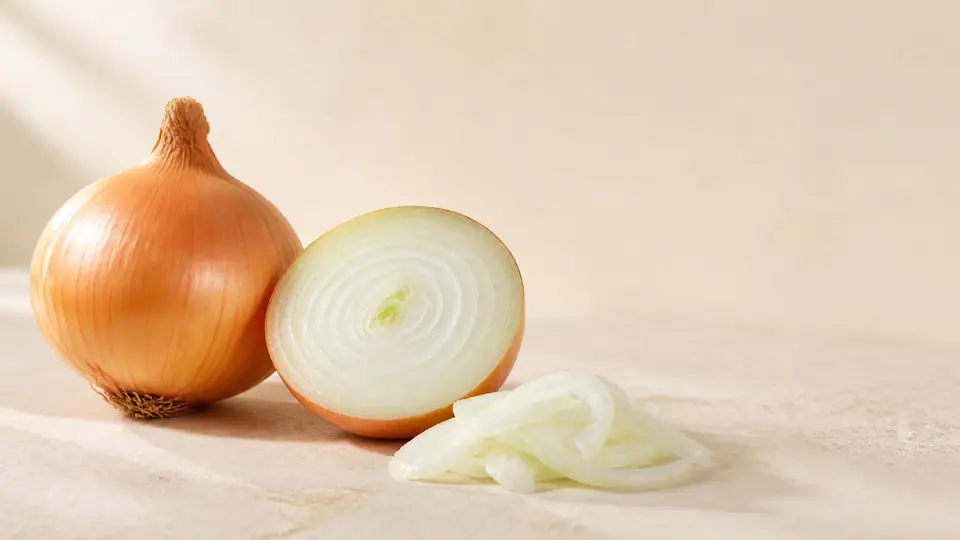
Onions: What Changes When a Side Dish Becomes a Supplement?
Would drinking onion juice every day help with blood pressure or cholesterol? In short, a plate of onions eaten daily is not the same as the onion supplements used in research, and there is a significant gap between the average numerical changes seen in supplement trials and the prevention of cardiovascular disease or the replacement of medication.
So, what should we look at? It starts by first distinguishing whether it is a meal-time food or a concentrated product, and whether it is a small numerical change or a disease treatment outcome, rather than focusing on the name 'onion'.
Why Do Questions Start with Onion Juice?
Onions are vegetables Allium cepawhere the bulb of the Allium genus is consumed. Kew classifies this plant as a recognized species of the Allium genus and a widely consumed crop. Thus, onions are a common food ingredient, but they are also raw materials separated into onion juice, powder, peel extracts, and quercetin supplements. The reason questions often center on onion juice is likely because the boundary between 'something eaten daily' and 'a product aimed at health' seems particularly blurred with onions.
The Identity of Onions: One Species, Multiple Forms of Exposure
As per Kew's classification, Allium cepait is a recognized bulb plant used as food. However, raw onions, cooked food, onion juice, powder, peel extracts, and quercetin supplements are not the same form or exposure. If the single name 'onion' covers all of these, it is easy to confuse a side dish for a meal with a concentrated product, or the whole raw material with isolated components. In other words, what is actually consumed and how is more important than the name 'onion'.
Why the Expectations: What the Research Shows
A 2023 meta-analysis of 14 randomized trials reported improvements in some body fat, lipid, and systolic blood pressure markers from onion supplementation. However, the product forms, dosages, and durations varied. In a 2021 lipid meta-analysis of 446 people across 10 trials, LDL decreased by an average of 6.64 mg/dL and HDL increased by 2.29 mg/dL, but triglycerides did not change significantly, and some results were not robust, requiring caution. These figures are merely average changes in supplement trials and cannot be equated to the effect of a plate of onions eaten normally or the prevention of cardiovascular disease. Rather than concluding that it 'is effective,' one must also consider that the number of studies is limited and there are constraints regarding the consistency and robustness of the results.
The Difference Between a Plate and a Pouch
Eating onions as a side dish is not the same exposure as trials where extracts, powders, or peel-derived products are taken in fixed doses. Whether one is changing their diet or adding a concentrated product to an existing diet also differs. The whole onion and quercetin, a single component within it, cannot be viewed as having the same evidence. Even if the name is the same, if the amount, form, and context the body encounters change, the same conclusion cannot be reached. Therefore, it is appropriate to first ask what form it is in.
Boundaries When Used Alongside Medication
There is no evidence to arbitrarily reduce or stop blood pressure medication or lipid-lowering agents using onions or onion juice. It is important not to adjust prescription medications on your own, even if blood pressure or lipid levels change. Onions do not have the same safety profile when they are food versus when they are concentrated juice, peel extracts, or isolated component products. Therefore, if you are currently taking blood pressure or lipid medication, you should first check the relationship with your current treatment before adding onion products.
Individual circumstances and safety signals
Onions may cause gas, bloating, and pain in some people sensitive to fructans, which are fermentable carbohydrates. Onion allergies are rare, but anaphylaxis has been reported not only with raw onions but also after cooked onions. If an allergy is suspected, such as itching of the mouth or throat, hives, or difficulty breathing, stop consumption, and severe reactions must receive prompt medical evaluation. Whether you experience bloating or allergic reactions, and what medications you are currently taking, are personal signals to check before choosing an onion product.
Between Small Numerical Changes and Disease Treatment
The changes in LDL, HDL, and systolic blood pressure shown in research are merely numerical changes and do not directly translate to the treatment of cardiovascular disease. The nuance that onion supplements can replace medication goes beyond the scope of the evidence. It is difficult to say that the course of a disease has changed just because a number moved slightly. If this distinction is not made, a small average change can easily sound like a major therapeutic effect.
Similar names, different ingredients
What must be distinguished are onion-based foods versus onion supplements and peel extracts; the whole onion versus isolated quercetin; and changes in blood pressure or lipid levels versus the treatment of cardiovascular disease. If the distinctions between these three pairs become blurred, onions are easily reduced to 'something good for blood pressure' or 'something that lowers cholesterol.' Just because the name is the same does not mean they share the same evidence.
Criteria to Check Today
Rather than just the name 'onion', first check the actual product form and dosage, whether it is replacing or adding to something, the small and inconsistent numerical evidence, intestinal symptoms, allergies, and current treatments. A realistic starting point for choosing this ingredient is to consider whether it is raw or cooked onion, juice, powder, or skin extract; whether you are changing your diet or adding a concentrated product; and whether you are taking blood pressure or lipid medication or experience abdominal bloating or allergic reactions after consuming onions.
References
- Kew Plants of the World Online: Allium cepa.
- Onion supplementation and metabolic parameters: systematic review.
- Onion and blood lipid profile: meta-analysis.
- Immunological characterization of onion allergy.
- FODMAP food challenges and symptom response.
This text explains the origin of the raw materials, the scope of research, and precautions before consumption. As this cannot replace individual diagnosis or treatment, please consult a medical professional if you are taking medication or if symptoms persist. If sudden and severe symptoms such as difficulty breathing or decreased consciousness occur after consumption, seek help from 119 or the emergency room.

Medical Staff Review
Director Choi Yeon-seung
Chief Director of Baekrokdam Korean Medicine ClinicOnion Dictionary Entry, reviewed the safety of expressions and the scope of verification before administration.
Review scope: Ingredient origin, human studies, concomitant medications, safety of intake · Last reviewed 2026-08-17
- Graduated from Kyung Hee University College of Korean Medicine
- Providing Korean medicine treatment since 2010
- Consultations for Gongjindan, Gyeongokgo, Nokyong (Deer Antler) restorative medicine, and customized restorative herbal medicine