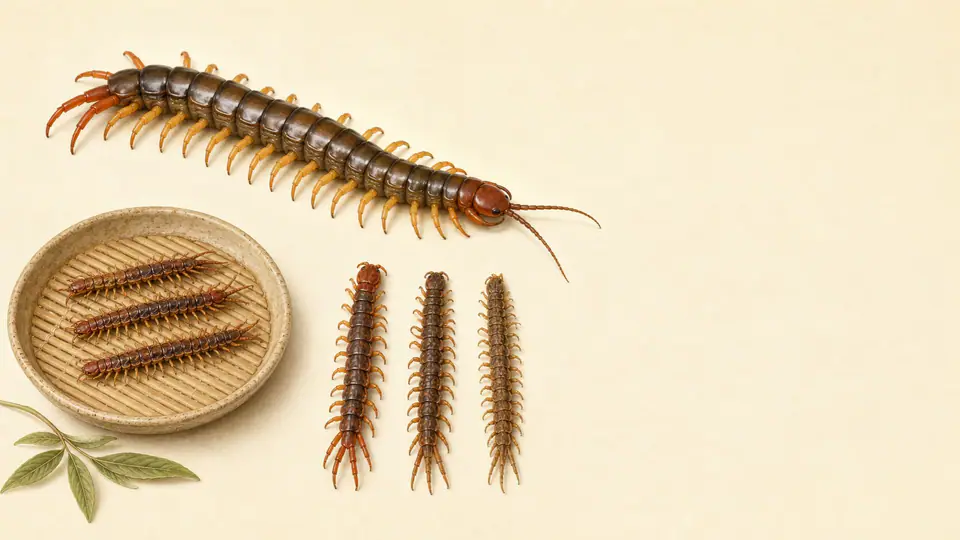
Misconceptions About Twenty-One Pairs of Legs: The Boundaries of Ogong as an Ingredient
Can I directly consume Ogong, a centipede medicinal herb, for pain or spasms? In short, it is currently difficult to find established human-based evidence to support this. More importantly, various forms and risks are mixed under the name 'Ogong'.
Ogong refers to the dried body of the giant centipede Scolopendra subspinipes mutilans. Centipede bites, venom from live centipedes, other centipede species, edible insect proteins, Ogong pharmacopuncture, and isolated peptides are neither the same ingredient nor the same pathway. This article follows these distinctions to discuss what kind of ingredient Ogong is, what the verified facts are, and what to look for when choosing a product.
Why Centipedes: Images and Expectations of Animal-Derived Ingredients
When a predator with twenty-one pairs of legs becomes a dried whole-body medicinal herb, the image of toxicity creates expectations of strong efficacy. Therefore, Ogong is often discussed alongside expectations for anti-inflammatory, analgesic, and anti-cancer effects. However, many of these expectations stem from cell and animal experiments or research on isolated components. This is not established clinical evidence that orally administering dried Ogong treats spasms or pain in humans.
'Ogong' means the body of a specific giant centipede, but in reality, it is difficult to distinguish from other species with similar appearances. The standards of the National Institute of Food and Drug Safety Evaluation define Ogong as the body of the giant centipede S. subspinipes mutilans, and the national genetic identification casebook lists species prone to counterfeiting or adulteration, such as multi-polar Ogong, combined Ogong, Japanese Ogong, and red Ogong. In other words, it cannot be concluded that what is visually called 'Ogong' matches its actual origin.
The Identity of Ogong: Which Species, Which Part
Ogong is the dried body of the giant centipede Scolopendra subspinipes mutilans. This is an animal-derived ingredient belonging to the arthropod crustacean group. The ingredient recognized as a standard in Korea is limited to the body of this specific species.
However, the problem is the appearance. Other Scolopendra Species also have similar bodies, making them difficult to distinguish in a dried state. This means it is an ingredient that requires genetic identification. Therefore, even for a product labeled 'Ogong', whether it is, per the specification S. subspinipes mutilans, another species, or a complex mixture.
Reasons for Expectations: The Gap Between Research and Products
Many of the anti-inflammatory, analgesic, and anti-cancer expectations for Ogong come from cell and animal experiments. There is also research on specific isolated components or peptides. However, applying these research results to products where the dried body is boiled and consumed or taken in capsules is a significant leap.
In particular, data on Ogong pharmacopuncture cannot be used as evidence for oral medicinal herbs. Substances administered via injection and those entering the digestive tract differ completely in terms of absorption, metabolism, and concentration. It must also be kept in mind that it is difficult to find high-quality, single-ingredient randomized trials that support therapeutic effects in humans.
In other words, scientific interest in Ogong (centipede) is not the same as the actual efficacy of Ogong products.
Differences in Form: Whole Body, Powder, Pharmacopuncture, Peptides
When discussing Ogong, it is first necessary to distinguish between the route of administration and the state of processing.
| Category | Characteristics | Points to Check |
|---|---|---|
| Dried whole body of giant centipede | Corresponds to Ogong by standard | Species identification, origin testing |
| Powder · capsule | Processing form | The species of the raw material and the processing method |
| Ogong pharmacopuncture | Injection route | Safety profile differs from oral intake; self-injection is prohibited |
| Isolated toxic peptides | Components for research purposes | Risks and efficacy differ from the whole body |
The dried whole body of a giant centipede and the venom of a living centipede are not the same raw material. Literature on centipede bites mentions cases of severe pain, swelling, blisters, and rare systemic anaphylaxis, but this data pertains to exposure to the venom of living centipedes. This cannot be directly compared to the oral risks of dried medicinal herbs. However, it serves as a signal that animal-derived materials should not be handled lightly.
Allergies and Concurrent Use: Who Should Be More Cautious?
Studies on edible insect allergies suggest that tropomyosin and arginine kinase in arthropods may cross-react with crustaceans and mites. However, the risk rate for each specific Ogong product is not known. Therefore, individuals with allergies to crustaceans, insects, or house dust mites, or those with asthma, must inform their medical staff before use.
If hives, throat swelling, or difficulty breathing occur, you must seek an immediate 119 evaluation. Safety data is also insufficient for pregnant or breastfeeding women, children, those with liver or kidney disease, or those taking anticoagulants or sedatives. If you experience new onset of seizures, changes in consciousness, one-sided paralysis, or extreme pain, an emergency evaluation of the cause takes priority, regardless of whether Ogong was taken.
The Gap Between Human Evidence and Expectations
While expectations for Ogong are high, there is a lack of established evidence in human subjects. The fact that high-quality, single-ingredient randomized trials have not been confirmed makes it difficult to select this material as a primary treatment.
Cell and animal experiments and research on isolated components only demonstrate scientific interest in the material; they are not evidence that the same effects occur in humans. Pharmacopuncture research is also limited to data on the injection route and cannot serve as evidence for oral intake.
What should be looked at then? You must verify which species and which part of the animal were used, how they were processed, and which research provided the basis for those methods.
Differences from Similar Materials: Not All Centipedes are Ogong
Different from Ogong Scolopendra Species are easily confused due to similar appearances. Species such as Daguk-ogong, Hapsik-ogong, Japanese Ogong, and Red Ogong are classified as species prone to counterfeiting or adulteration. Therefore, one should not expect the same efficacy and safety under the general term 'centipede'.
Additionally, oral herbal decoctions, pharmacopuncture, the whole body, and isolated toxic peptides are all different raw materials. Just because they share the same name does not mean they produce the same effect. This distinction is the first criterion you should check when selecting Ogong.
Realistic criteria to check today
The impression of a strong animal-derived ingredient should not be mistaken for a strong therapeutic effect. If you are considering Ogong, please check the following first.
You must first verify whether the product is the official whole body of the Chinese red-headed centipede, or if it is a different centipede species, powder, complex prescription, pharmacopuncture, or isolated peptide; whether the route of administration is oral, topical, or injection; whether the origin test, processing, and single dose have been verified; and whether you have allergies to crustaceans, house dust mites, or insects, or if you have asthma, are pregnant, breastfeeding, or taking other medications.
Do not ingest or apply centipede powder of unknown origin to the skin, and do not self-inject Ogong pharmacopuncture. Discussions regarding Ogong ultimately begin with identifying the raw material and maintaining these boundaries.
References
- National Institute of Food and Drug Safety Evaluation Crude Drug Standard: Ogong.
- Casebook of Genetic Origin Identification for Herbal Medicine Crude Drugs: Ogong.
- Scolopendra bites case report and review.
- Systemic anaphylaxis after centipede envenomation.
- Allergic risks of consuming insects: systematic review.
This text explains the origin of the raw materials, the scope of research, and precautions before consumption. As this cannot replace individual diagnosis or treatment, please consult a medical professional if you are taking medication or if symptoms persist. If sudden and severe symptoms such as difficulty breathing or decreased consciousness occur after consumption, seek help from 119 or the emergency room.

Medical Staff Review
Director Choi Yeon-seung
Chief Director of Baekrokdam Korean Medicine ClinicOgong Dictionary Entry, reviewed the safety of expressions and the scope of verification before administration.
Review scope: Ingredient origin, human studies, concomitant medications, safety of intake · Last reviewed 2026-08-17
- Graduated from Kyung Hee University College of Korean Medicine
- Providing Korean medicine treatment since 2010
- Consultations for Gongjindan, Gyeongokgo, Nokyong (Deer Antler) restorative medicine, and customized restorative herbal medicine