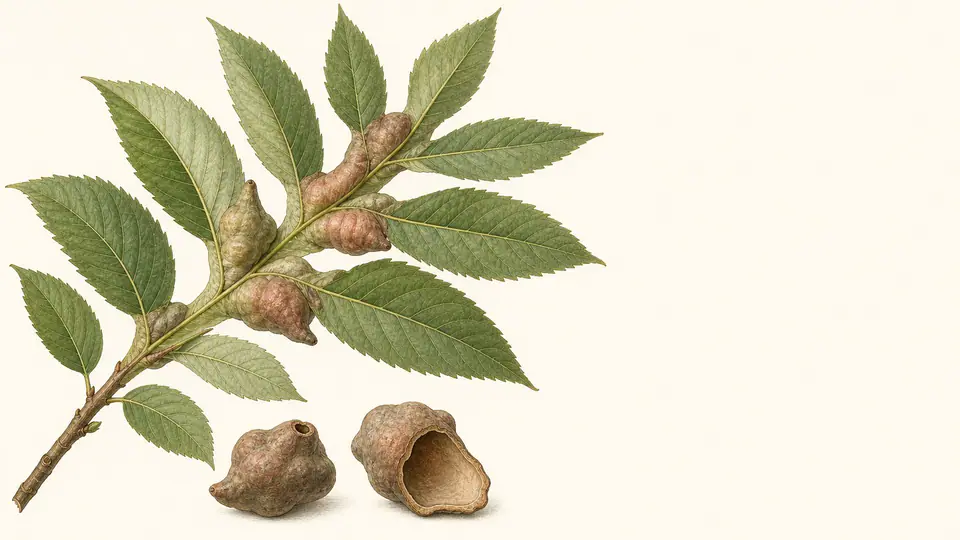
Not a fruit borne by a tree, but a home created by insects and leaves together on the leaf
Can I consume Galla Chinensis or use it in oral products for diarrhea or gum and tooth problems? In short, there is insufficient human evidence to support the oral ingestion of the raw material or to expect treatment from Galla Chinensis alone. Toothpaste research is merely the result of comparing formulations that also contain fluoride, which is a different type of exposure than consuming the raw Galla Chinensis material.
Galla Chinensis is often mistaken for a fruit, but it is actually an insect gall. Rhus Rhus javanica, Cheongbuyang Rhus potaninii, Hongbuyang Rhus punjabensis var. sinica javanica are involved. It is a gall formed when Galla Chinensis aphids parasitize the leaf wings of these three plants, causing the leaf tissue to swell. The astringent tannins contained within have long been used as materials for dyes and ink, and today they appear in oral products and concentrated extracts. However, even if the identity of the raw material is the same, the evidence for expected results changes if the formulation and method of exposure change.
Then, where does the evidence diverge between the raw insect gall, tannins, and oral products?
Galla Chinensis is not a fruit, but a gall
At first glance, Galla Chinensis looks like a small red fruit. However, according to the definition based on the Standard Korean Medicine Terminology, Galla Chinensis is a gall formed on three types of Rhus It is a gall formed when Chinese sumac gall aphids parasitize the wings of tree leaves. In other words, it is not the fruit or the leaf of the tree itself, but a structure created together by insects and plant tissue.
Galla Chinensis, Rhus, Myrica, tannin, gallic acid, these all sound like the same raw material, but they are not the same exposure. The fruit or leaf of the tree itself, general Myrica, purified tannin/gallic acid, and the mixed ingredients in toothpaste or oral products are each different forms and have different evidence. If these are judged as one under the name Galla Chinensis, expectations for the raw material may be incorrectly transferred to research on purified ingredients or oral products.
Why astringent tannins create expectations
Tannins in Galla Chinensis are the core of its astringent taste. A 2010 literature review summarized the traditional uses, components, and various biological activities of Galla Chinensis and Rhus. While signals such as antibacterial, antidiarrheal, and anti-inflammatory effects are visible, this study emphasizes that the primary efficacy signals are preclinical and that anecdotes must be separated from evidence.
In other words, activity observed in test tubes or animals does not directly translate to the treatment of diarrhea or gum disease in humans. Because tannins have an astringent taste and a binding effect, they may have been used for various purposes traditionally, but that experience is not automatically approved as modern medical efficacy.
When the formulation changes, the evidence changes
There are four main ways to encounter Galla Chinensis: the insect gall formed on the fruit and leaves of Rhus, the raw Galla Chinensis versus purified tannin/gallic acid, oral powder versus toothpaste containing fluoride, and test-tube antibacterial signals versus the treatment of human diarrhea and periodontal disease. This distinction is not a simple classification, but a boundary of evidence.
Toothpaste research is a representative example. An 8-week study of 98 patients with tooth sensitivity compared toothpaste containing fluoride and active ingredients derived from Galla Chinensis with fluoride-only toothpaste. Regardless of the result, this is not evidence for the raw material of Galla Chinensis or for oral ingestion. There was another active ingredient called fluoride, the formulation was for local oral use, and it was not meant to be swallowed. Using this study as a basis to ingest Galla Chinensis powder or to expect results from Galla Chinensis-only toothpaste is an interpretation that goes beyond the conditions of the research.
A 2025 review on the scope of hard dental tissues concluded that while remineralization is possible, further confirmation of long-term efficacy and safety is required because human studies are limited in scale and duration. There is possibility, but it is not yet proven.
Oral ingestion and oral care products are different types of exposure
Ingesting Galla Chinensis (Chinese gall) and applying Galla Chinensis-derived ingredients in toothpaste to the mouth act on the body in different ways. In principle, oral care products should not be swallowed, and their effects are evaluated locally on the tooth surface or gums. Conversely, oral ingestion of powders or concentrated extracts enters the entire gastrointestinal tract, and tannin concentrations vary by product.
There is a lack of human data regarding the long-term oral safety of tannin concentrates. The same applies to data for pregnancy, lactation, and children. Therefore, it is necessary to inform a medical professional or pharmacist before ingesting raw Galla Chinensis or tannin-concentrated products. This is especially important if you are taking prescription medications.
Caution is required when taking with prescription medications
There are studies regarding the absorption of Galla Chinensis tannins and rifampicin. As these are in vitro and animal data, they do not confirm clinical interactions in humans. These results cannot be generalized to other drugs or iron supplements. However, if you intend to take high-tannin concentrated products with prescription medications, you should verify the product and your medications first rather than ignoring the uncertainties.
What should you check? First, check if you are taking any medications, especially prescription drugs including rifampicin. Also, inform the consultant during product counseling if you are taking iron supplements or other high-tannin products. Based on current data, specific intervals or the magnitude of clinical risk cannot be determined.
Whatever the symptom, medical evaluation comes first
There are safety signals to check before taking Galla Chinensis for diarrhea. Diarrhea accompanied by bloody stools, black stools, high fever, severe abdominal pain, repeated vomiting, decreased urination, or decreased consciousness requires immediate medical evaluation over the use of Galla Chinensis. In such cases, the cause and dehydration status must be evaluated rather than testing the product.
The same applies to oral health. For toothaches, facial swelling, pus, or persistent gum bleeding, you should receive a dental evaluation rather than delaying it by self-testing with oral care products. When using oral care products, do not swallow them; if oral irritation, rash, swelling of the lips or throat, or difficulty breathing occurs, stop use and seek immediate evaluation.
The gap between human studies and expectations
Expectations for Galla Chinensis generally fall into three categories: stopping diarrhea, reducing tooth sensitivity, and soothing gum inflammation. However, human studies corresponding to these expectations are limited.
A study of 98 people on tooth sensitivity compared toothpaste containing both Galla Chinensis-derived active ingredients and fluoride; therefore, the results cannot be applied to the oral ingestion of raw materials or the effect of Galla Chinensis alone. Human clinical trials for diarrhea or periodontal disease are also still insufficient in scale and duration. There is a significant gap between in vitro antibacterial signals and the treatment of diseases in humans.
Similar names, different ingredients
Galla Chinensis and the sumac tree are discussed in the same context but represent different exposures. Galla Chinensis is the insect gall formed on the fruit and leaves of the sumac tree; the fruit or leaves of the tree themselves are not Galla Chinensis. Raw Galla Chinensis also differs from purified tannins and gallic acid. Purified components are concentrations of specific substances, whereas raw materials have a much more complex composition.
Oral powders and toothpaste containing fluoride cannot be viewed as the same raw material. One is a form that enters the gastrointestinal tract, and the other is a formulation that acts locally on the teeth along with fluoride. In vitro antibacterial signals and the treatment of human diarrhea or periodontal disease are not at the same stage.
Criteria to Check Today
If you are considering Galla Chinensis, first distinguish these three things: whether it is the raw insect gall, a powder, a tannin concentrate, or an oral care product; whether it is for ingestion or topical application; and whether you have prolonged diarrhea, bloody stools, fever, or dehydration, or need evaluation of the cause of gum bleeding or toothache. Finally, check if you are taking prescription medications including rifampicin, iron supplements, or other high-tannin products.
Rather than the impression of a strong astringent taste, it is important to first verify the exact identity as an insect gall, the oral or local formulation, and the cause of the symptoms. The correct way to view this material is to avoid equating toothpaste mixed-ingredient studies or preclinical results with the effects of ingesting Galla Chinensis.
References
- Galla Chinensis entry based on the Standard Korean Medicine Terminology of the Society of Korean Medicine.
- Rhus chinensis and Galla Chinensis: folklore to modern evidence review.
- Galla chinensis and fluoride toothpaste for dentin hypersensitivity: clinical study.
- Galla chinensis for dental hard-tissue remineralization: scoping review.
- Galla chinensis tannins and rifampicin pharmacokinetics: preclinical study.
This text explains the origin of the raw materials, the scope of research, and precautions before consumption. As this cannot replace individual diagnosis or treatment, please consult a medical professional if you are taking medication or if symptoms persist. If sudden and severe symptoms such as difficulty breathing or decreased consciousness occur after consumption, seek help from 119 or the emergency room.

Medical Staff Review
Director Choi Yeon-seung
Chief Director of Baekrokdam Korean Medicine ClinicGalla Chinensis Dictionary Entry, reviewed the safety of expressions and the scope of verification before administration.
Review scope: Ingredient origin, human studies, concomitant medications, safety of intake · Last reviewed 2026-08-17
- Graduated from Kyung Hee University College of Korean Medicine
- Providing Korean medicine treatment since 2010
- Consultations for Gongjindan, Gyeongokgo, Nokyong (Deer Antler) restorative medicine, and customized restorative herbal medicine