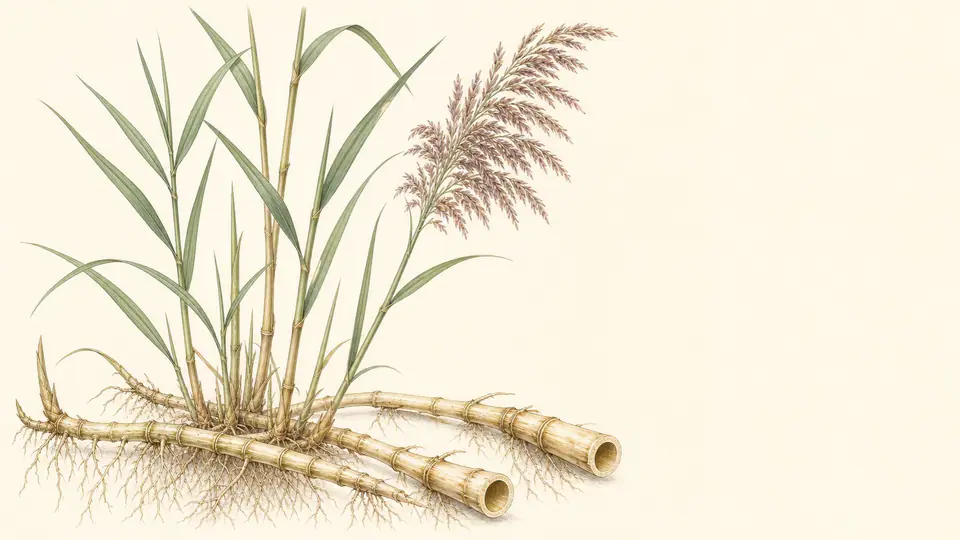
Between the refreshing image of the waterside and the underground rhizome
Can I drink Nogeun tea when I have a fever and thirst? Thinking of reeds by the water, it seems as though tea brewed from their roots would cool the body. However, it is difficult to reach a conclusion based on intuition alone. First, we must verify what is defined as 'Nogeun' and whether the form used in research is the same as the tea consumed in daily life.
The stage for Nogeun is not above the water, but beneath the mud. The horizontally extending rhizome of the reed is the medicinal part, and distinctions must be made between fresh and dried versions, as well as rhizomes of similar Poaceae plants.
Nogeun is the underground rhizome of the reed
The standards of the National Institute of Food and Drug Safety Evaluation define Nogeun as the Phragmites communis rhizome of Phragmites australis. The important point is that the medicinal part is not the above-ground stem or leaves. While the image of reeds swaying by the water forms the perception of Nogeun, the actual raw material is the underground part that is not easily visible.
Based on this part alone, Nogeun is not simply 'reed'. Even for the same reed, the above-ground part and the rhizome must be viewed as different materials; this is the first distinction in understanding Nogeun.
Why a refreshing image leads to expectations of efficacy
Reeds grow by the water and their stems are hollow, causing them to sway in the wind. This image is linked to 'refreshment,' creating a feeling that Nogeun tea might be effective in improving feverish colds, thirst, and vomiting. However, image and pharmacology are different domains.
There is a lack of clinical research on humans showing that Nogeun alone improves fever, thirst, or vomiting. When Nogeun appears in literature regarding influenza or respiratory diseases, it is merely one component of a complex prescription containing various medicinal herbs. Therefore, the results of an entire prescription should not be interpreted as the effect of Nogeun tea alone. Animal experiments, in vitro studies, and complex prescription research may show possibilities, but they are not evidence that daily Nogeun tea produces the same effects.
Fresh Nogeun, dried Nogeun, and extracts are not the same material
Nogeun is divided into fresh Nogeun and dried Nogeun. Furthermore, the amount and concentration consumed vary depending on the formulation, such as tea-style slices, concentrated extracts, or capsules. Quality research dealt with the chromatographic fingerprint of a 70% methanol extract, which is merely data to verify the consistency of the product's components, not a human efficacy test.
In other words, the fact that the component pattern of an extract is consistent is a separate issue from whether it has a specific effect on humans. Chewing fresh Nogeun, brewing dried slices, and consuming concentrated extracts should each be viewed as different scenarios.
Rhizomes of similar Poaceae plants are counterfeit
Giant reed Arundo donax, silvergrass Triarrhena lutarioriparia, pampas grass Miscanthus sinensisThe rhizomes of some plants are so similar in appearance to Nogeun (reed rhizome) that they are categorized as substitutes. Morphological and microscopic identification studies view these as substitutes for Nogeun.
Therefore, when selecting Nogeun, simply relying on the name 'reed root' is not sufficient. The species name Phragmites communisand whether the part used is the rhizome must be verified together. If you collect wild reed rhizomes yourself, it is difficult to verify not only possible species misidentification but also whether the water and soil are contaminated; therefore, it is safer not to collect them yourself for food or medicinal use.
When using with other medications, first consider the possibility of concurrent use
There have been pharmacokinetic studies in mice regarding the concurrent use of Nogeun water extract and docetaxel. However, this is not evidence to confirm safety during human chemotherapy, nor is it a basis to arbitrarily recommend concurrent use.
If you are undergoing chemotherapy, have kidney disease or diabetes, and are taking multiple medications, you should notify your medical team rather than arbitrarily adding concentrated Nogeun products. While Nogeun may be perceived as a light tea, the possibility of interactions with other drugs cannot be ruled out in its concentrated form.
For certain symptoms, medical evaluation comes before Nogeun tea
If you have a high fever, difficulty breathing, changes in consciousness, repeated vomiting to the point where drinking water is difficult, or dehydration, it is not a situation to wait for Nogeun tea. In such cases, immediate medical evaluation is the priority. Nogeun tea can be thought of as a beverage to soothe mild thirst or discomfort, but it cannot replace the treatment of severe symptoms.
Human safety data regarding pregnancy, lactation, children, and long-term high-concentration intake are also insufficient. This means that when choosing Nogeun, age, duration of intake, and the concentration of the formulation must be considered together.
Three questions when choosing Nogeun
Then, what should you look for? First, verify if it is indeed the rhizome of a reed and that it is not mixed with above-ground stems, leaves, or similar Poaceae (grass family) plants. Next, check the form, whether it is raw Nogeun, dried slices, tea, or concentrated extract, and the daily intake amount. Finally, consider how long the fever, vomiting, or thirst has lasted, and whether you have diabetes, kidney disease, are undergoing chemotherapy, or are taking other medications. These are three criteria that simultaneously question the identity of the raw material, the concentration of the product, and your own physical condition.
Final Decision Criteria
Nogeun is a material where the reed species, rhizome, raw/dried status, and formulation must be verified, rather than relying on the image of a waterside plant. It is important not to extrapolate prescriptions or preclinical research to the therapeutic effects of everyday Nogeun tea. While the expectations brought by its 'cooling' image are understandable, Nogeun should be selected while recognizing the gap between those expectations and the actual evidence.
References
- National Institute of Food and Drug Safety Evaluation Herbal Medicine Standards: Nogeun.
- Phragmitis Rhizoma and counterfeit identification study.
- Phragmitis Rhizoma UPLC quality-control fingerprint.
- Phragmitis Rhizoma and docetaxel pharmacokinetics in rats.
This text explains the origin of the raw materials, the scope of research, and precautions before consumption. As this cannot replace individual diagnosis or treatment, please consult a medical professional if you are taking medication or if symptoms persist. If sudden and severe symptoms such as difficulty breathing or decreased consciousness occur after consumption, seek help from 119 or the emergency room.

Medical Staff Review
Director Choi Yeon-seung
Chief Director of Baekrokdam Korean Medicine ClinicNogeun Dictionary Entry, reviewed the safety of expressions and the scope of verification before administration.
Review scope: Ingredient origin, human studies, concomitant medications, safety of intake · Last reviewed 2026-08-17
- Graduated from Kyung Hee University College of Korean Medicine
- Providing Korean medicine treatment since 2010
- Consultations for Gongjindan, Gyeongokgo, Nokyong (Deer Antler) restorative medicine, and customized restorative herbal medicine