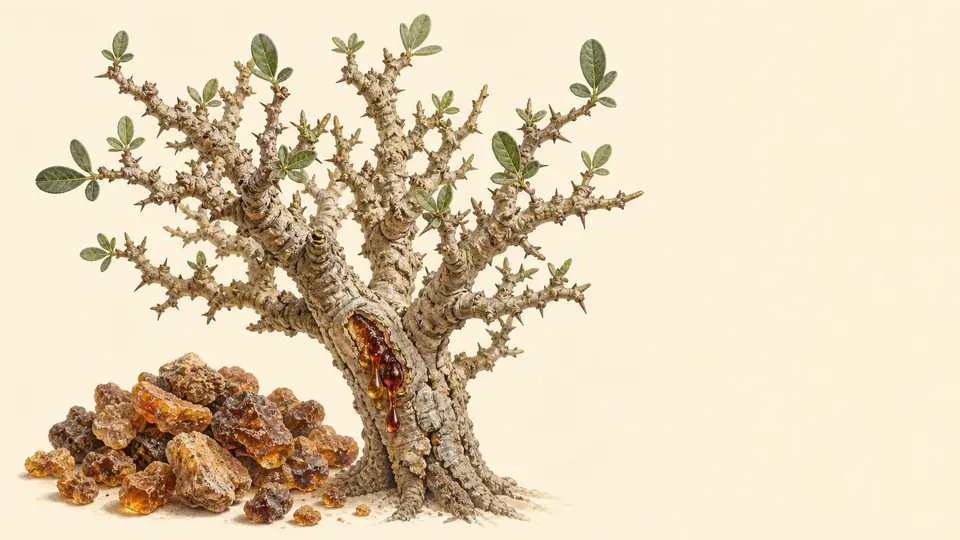
Resin Hardened from Wounds: Between the Mouth and the Body
Can I take myrrh orally or use it as a gargle for gums, wounds, or inflammation? In short, while there are small trials for oral rinses used briefly in the mouth, it is premature to extend those results to oral products that are swallowed or to essential oils. A particularly conservative approach should be taken during pregnancy.
Myrrh is a fragrant gum resin that a tree produces by hardening its own wounds. However, many substances are commonly referred to as 'myrrh.' There is natural myrrh obtained from Commiphora myrrha and colloidal myrrh obtained from Commiphora molmol. Raw resin, oral powder, alcohol tinctures, oral rinses, essential oils, fragrances, and resins from other Commiphora species may have similar names, but their components and exposure methods differ. Therefore, the species of the raw material, the site of use, and the form of processing must be verified.
Where the Questions Begin
This question asks three things at once: whether it can treat gums, wounds, or inflammation; whether it can be ingested; and whether it can be used as a gargle. The answers differ for these three, even with the same raw material. The exposure routes are completely different between something that touches the mouth as an oral rinse, something swallowed as a powder or capsule, and something inhaled or applied to the skin as an essential oil. Can the results of small trials on gargles be applied to oral myrrh? The answer depends on separating the routes of administration.
What Myrrh Is: A Gum Resin from the Stem
Myrrh is a gum resin obtained from the stems of Commiphora myrrha Engl. or Commiphora molmol Engl. It is important that it comes from the stem, not the bark or roots. Items based on the Standard Korean Medicine Terminology also define myrrh as a gum resin obtained from the stems of these two species. While myrrh has been used for a long time in the history of fragrance and preservation, historical use must be distinguished from today's clinical evidence. The fact that it has been used for a long time does not automatically guarantee its efficacy today.
Reasons for Expectation: Tradition and Preclinical Data
A 2023 comprehensive review summarized the various traditional uses and preclinical activities of myrrh, showing that further research on drug interactions and clinical validation is needed. This means that tradition and laboratory research are interesting, not that a definite effect in humans has been proven. While there is expectation, evidence in humans is still small and limited.
Formulation Changes the Answer
Myrrh products are largely divided into four categories: raw resin/oral powder, alcohol tinctures/oral rinses, essential oils/fragrances, and resins from other Commiphora species. These differ in components and exposure. Research on oral rinses cannot be generalized to the oral intake of raw resin, the inhalation or application of essential oils, or the treatment of systemic inflammation or infection. In other words, results from use as a gargle cannot be applied to oral medications or topical oils.
| Formulation | Method of Use | Caution |
|---|---|---|
| Raw resin / Oral powder | Ingested by swallowing | Lack of human interaction data, conservative use during pregnancy |
| Alcohol tincture / Oral rinse | Local application in the mouth, spat out | Follow product instructions, do not swallow |
| Essential oils and fragrances | Inhalation, topical application, etc. | Differs from oral rinse research |
| Resins from other Commiphora species | Similar names only | Different ingredients and exposure |
What is the extent of human research?
Human research is focused on the use of oral rinses after tooth extraction and implants. In a 7-day randomized trial of 40 patients who underwent tooth extraction, C. molmol oral rinse reported initial wound indicator signals compared to saline. However, the scale and duration were small. In a trial of 35 implant patients, there was no significant difference in edema, pain, bleeding, or redness between myrrh and chlorhexidine oral rinses. Both of these trials were short-term, small-scale, and involved local intraoral use. Human research is centered on small trials using oral rinses and is not the same as the systemic effects of oral myrrh.
Oral myrrh is a different story
For oral products, such as swallowing powders or capsules, the evidence is separate from that of oral rinses. There is insufficient data on human interactions with prescription medications, such as anticoagulants and diabetes medications. Therefore, it is necessary to inform a medical professional or pharmacist before using concentrated oral products. Those who are pregnant or may be pregnant should not use oral myrrh products or high-concentration formulations arbitrarily. This is because cases of consuming large amounts during pregnancy showed improvement in abdominal pain after stopping use, raising the possibility of uterine stimulation. A particularly conservative approach is taken regarding pregnancy.
Combined Intake and Individual Circumstances
There are three questions to check before using myrrh. First, is it raw resin, powder, tincture, oral rinse, or essential oil, and is it swallowed or used locally? Second, has the cause of gum bleeding, toothache, or wounds been evaluated at a dental clinic, and are there prescription guidelines after surgery? Third, is there a possibility of pregnancy, or are you currently pregnant or breastfeeding, and are you taking other medications such as anticoagulants or diabetes drugs? These questions are not simple checklists, but criteria for distinguishing the name and formulation of the raw material, the purpose of use, and the individual's condition.
Adverse reaction signals
Use oral rinses according to the product instructions and do not swallow them; prioritize the instructions of the attending dentist after tooth extraction or implants. If there is persistent bleeding, facial swelling, pus, high fever, swelling of the lips or throat, or difficulty breathing, stop use and seek prompt medical evaluation. These are not signals limited to myrrh, but common warnings that can appear after intraoral use.
Similar names, different ingredients
Four comparisons are necessary when choosing myrrh: the oleogum-resins of C. myrrha and C. molmol; raw resin/oral powder versus oral rinses; myrrh resin versus essential oils/fragrances; and local wound recovery after tooth extraction versus systemic inflammation treatment. This distinction is the threshold for maintaining the identity of the raw material. It is easy to expect the same efficacy if the names are the same or similar, but in reality, the ingredients and exposure differ.
Today's criteria for judgment
Verify the exact species, resin, formulation, and route of administration before relying on old images of fragrance and preservatives. Do not extrapolate small, short-term oral trials to the effects of oral ingestion, and do not use oral or high-concentration formulations arbitrarily during pregnancy. Myrrh is a resin that a tree hardens from a wound. The story changes depending on how a person encounters that resin.
References
- Myrrh entry based on the Standard Korean Medicine Terminology of the Society of Korean Medicine.
- Commiphora myrrh phytochemical and pharmacological update.
- Myrrh mouthwash after tooth extraction: randomized trial.
- Myrrh versus chlorhexidine after implant placement: randomized trial.
- Risks of myrrh use in pregnancy: case report.
This text explains the origin of the raw materials, the scope of research, and precautions before consumption. As this cannot replace individual diagnosis or treatment, please consult a medical professional if you are taking medication or if symptoms persist. If sudden and severe symptoms such as difficulty breathing or decreased consciousness occur after consumption, seek help from 119 or the emergency room.

Medical Staff Review
Director Choi Yeon-seung
Chief Director of Baekrokdam Korean Medicine ClinicMyrrh Dictionary Entry, reviewed the safety of expressions and the scope of verification before administration.
Review scope: Ingredient origin, human studies, concomitant medications, safety of intake · Last reviewed 2026-08-17
- Graduated from Kyung Hee University College of Korean Medicine
- Providing Korean medicine treatment since 2010
- Consultations for Gongjindan, Gyeongokgo, Nokyong (Deer Antler) restorative medicine, and customized restorative herbal medicine