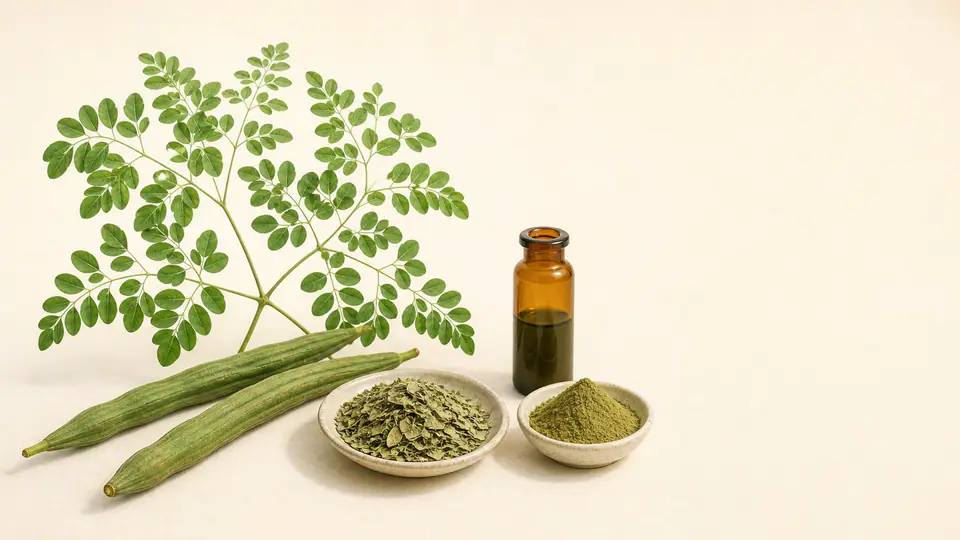
When the leaves and seeds of one tree take different paths
Can I take Moringa leaf powder, which is said to be good for blood sugar and cholesterol, along with diabetes medication? Are seeds or extracts the same?
In short, leaf powder and seed, root, or extracts are not the same. When used with diabetes or blood pressure medications, blood sugar or blood pressure may drop further, so it is better not to add them indiscriminately. Since this question covers almost all the confusion surrounding Moringa, let's break down the parts, formulations, food vs. supplements, and nutrition vs. treatment one by one.
What kind of tree is Moringa?
Moringa is Moringa oleiferaa tree. Kew classifies this tree as an edible and medicinal tree native to the region spanning from northeastern Pakistan to northwestern India. The leaves and young pods are eaten as food, while leaf powder, seeds, oil, and various extracts are distributed as supplements. Even from the same tree, the leaves, pods, seeds, roots, and bark are different parts, and their components and safety should not be treated as the same. If one says Moringa is good or bad without specifying the part, it becomes impossible to know what is actually being discussed.
Are the leaves just nutrient-rich vegetables, and nothing more?
Moringa leaves contain vitamins, minerals, and polyphenols. This means the leaves are worth eating as a nutrient-rich food. However, the fact that the leaves are nutrient-dense does not mean that the powder treats diabetes or hypertension. The value of eating nutrient-rich leaves as food and the claims of treating diseases with concentrated products must be judged separately. The distinction begins here: a spoonful of leaf powder may replace a plate of vegetables, but it cannot replace medication.
What are the product forms of leaf powder and seed/root extracts?
The experience of using leaves as food should not be extended to the safety of seeds, roots, bark, or highly concentrated alcohol extracts. Leaf and young pod foods are different parts from seeds, roots, and bark; and whole-leaf powder is a different formulation from water or alcohol concentrated extracts. The components extracted by water and alcohol are also not the same. Therefore, because the single name "Moringa" refers to all these differences, choosing the right product becomes more important.
What do the research results show?
There is a 2025 meta-analysis that evaluated 9 randomized trials using GRADE. This analysis found no consistent benefit in most blood sugar, lipid, weight, or blood pressure results, and the certainty of evidence was very low. Even a small signal seen in diastolic blood pressure was not maintained in sensitivity analysis, so it is not evidence to replace blood pressure medication. Human trials are mixed with leaf powder, food blends, and water extracts, making it difficult to translate these to the effects of specific commercial capsules. Just because large blood sugar changes appeared in animal studies, the small and heterogeneous results of human trials should not be merged into a single line of efficacy.
What changes when used with diabetes or blood pressure medications?
Using Moringa with diabetes or blood pressure medications may increase the possibility of blood sugar or blood pressure dropping further. Therefore, the rule is not to add it without measuring blood sugar/blood pressure and consulting a medical professional. If you are taking medication, you must first check whether the product is leaf powder, a water extract, or an alcohol extract, as well as the daily recommended dose and complex ingredients. You should also check if you have ever experienced hypoglycemia or hypotension.
Who should be more cautious?
There is a lack of reliable safety data for use during pregnancy, lactation, in children, or for long-term high-dose use. Caution is also needed for those with liver or kidney disease. If you expect it to replace meals or therapeutic agents, that expectation itself can be dangerous. If you experience persistent vomiting, diarrhea, severe abdominal pain, jaundice, or dark urine, you must stop the product and seek evaluation. For severe hypoglycemia, fainting, difficulty breathing, facial swelling, or decreased consciousness, you must seek help from 119 or the emergency room.
Nutrient density and therapeutic effect are different metrics
There are commonly confused criteria when choosing Moringa. One is looking at nutrient components and antioxidant indicators, and the other is lowering blood sugar, lipids, or cardiovascular events. The fact that leaves are rich in vitamins and minerals falls into the former. Evidence for the latter in humans is still lacking. It is important not to place animal diabetes models and human randomized trials on the same level.
What are the criteria to check today?
Rather than relying on the nickname 'miracle tree,' first verify the exact species, part of the plant, and formulation. Moringa oleiferaCheck whether it is the leaf, seed, or root, and whether it is a food powder, water extract, or alcohol extract. Verify if you are taking diabetes or blood pressure medication, as well as the combined ingredients and daily dosage. Distinguish between nutrient density and animal mechanisms versus long-term treatment results in humans. Furthermore, a more cautious approach is required for those who are pregnant, breastfeeding, children, or those with liver or kidney disease. While Moringa is called by one name, what you actually select are the specific part, formulation, and your own medication status.
References
- Kew Plants of the World Online: Moringa oleifera.
- Moringa and cardiometabolic outcomes: RCT meta-analysis with GRADE.
- Moringa and glucose control: systematic review of animal and human studies.
This text explains the origin of the raw materials, the scope of research, and precautions before consumption. As this cannot replace individual diagnosis or treatment, please consult a medical professional if you are taking medication or if symptoms persist. If sudden and severe symptoms such as difficulty breathing or decreased consciousness occur after consumption, seek help from 119 or the emergency room.

Medical Staff Review
Director Choi Yeon-seung
Chief Director of Baekrokdam Korean Medicine ClinicMoringa Dictionary Entries, reviewed the safety of expressions and the scope of verification before administration.
Review scope: Ingredient origin, human studies, concomitant medications, safety of intake · Last reviewed 2026-08-17
- Graduated from Kyung Hee University College of Korean Medicine
- Providing Korean medicine treatment since 2010
- Consultations for Gongjindan, Gyeongokgo, Nokyong (Deer Antler) restorative medicine, and customized restorative herbal medicine