Manganese is found in grains and tea; do I need to take it separately?
Should I take manganese separately for bone health and antioxidants? If it is already in a multivitamin, do I not need to worry about overdose?
In short, there is almost no need to take it separately, and you must sum the overlapping manganese amounts in multivitamins and joint/bone complexes. While manganese is an essential trace mineral, it is widely present in grains, nuts, beans, tea, and vegetables, making deficiency very rare in healthy adults. Rather, long-term intake without knowing the total supplement amount and your liver or iron status can lead to cumulative neurotoxicity.
Why is manganese an element that is 'essential' yet 'rarely deficient'?
Manganese is a trace mineral required as a cofactor for the operation of various enzymes. While its role in aiding specific reactions in the body is clear, this does not mean you should take large amounts. The NIH ODS Adequate Intake (AI) for adults is 2.3 mg for men and 1.8 mg for women. This figure is an AI, an estimated value based on the actual intake of the average healthy population. It is important to remember that this standard has lower certainty than a Recommended Dietary Allowance (RDA).
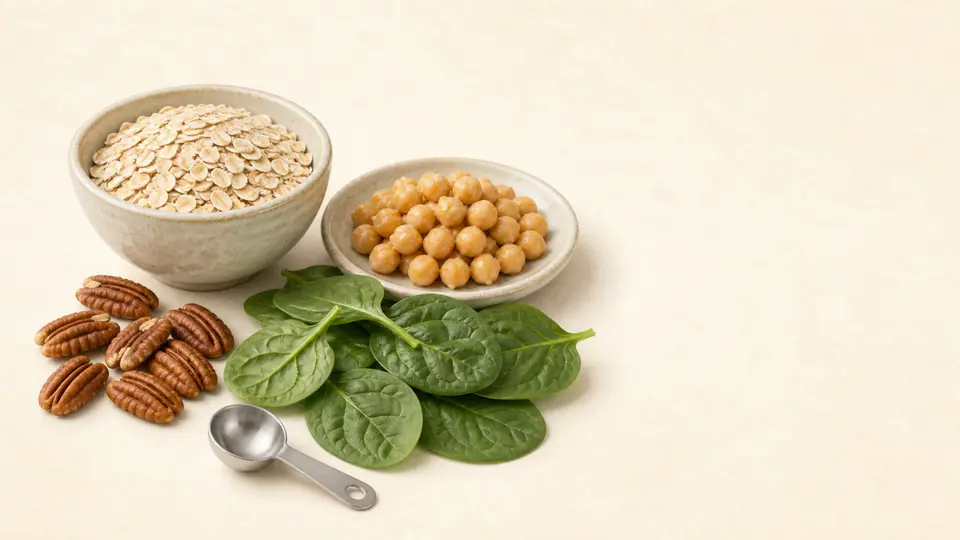
Manganese in food is widely distributed in grains, nuts, beans, tea, and vegetables. Therefore, it is very rare for a healthy person with a typical diet to experience manganese deficiency. There is a gap between the tension created by the term 'essential' and the actual risk of deficiency. This gap creates the most common misconception when choosing supplements.
How much evidence supports the expectations for bone, joint, and blood sugar supplements?
It is known that manganese is a component of antioxidant enzymes. Based on this mechanism, products claim to help with bone health, joint function, and blood sugar control. However, the fact that it is a component of an enzyme is a different matter from clinical results showing that additional supplements actually improve joint, bone, or blood sugar outcomes.
To date, evidence that manganese supplementation improves bone, joint, or blood sugar in healthy individuals is limited. The existence of a mechanism does not automatically guarantee efficacy. This is why one must consider the number of studies, consistency, and the characteristics of the study subjects.
Manganese from food vs. supplements: Same element, different exposure routes
Manganese from food, supplemental manganese from multivitamins or joint complexes, and manganese from drinking water or occupational inhalation cannot be viewed as having the same exposure patterns and toxicity risks. Overdose through a typical diet is rare, but since the contents of various supplements can overlap, you must separately calculate the total amount on the labels.
Inhalation exposure, such as welding fumes or mine dust, falls into a different risk category. This requires a different evaluation system than nutritional supplements or food intake. Workplace environment assessments and protective equipment are the priority.
Why looking at only one multivitamin can lead to missing an overdose
The upper limit for manganese in adults, combining food and supplements, is 11 mg per day. This limit is set based on healthy adults. However, many people take multivitamins, bone complexes, and joint complexes simultaneously while only looking at the manganese content of each product individually.
What should you look at then? You must sum the total amount of supplements. If one tablet of a multivitamin, one tablet of a joint product, and one tablet of a bone product each contain manganese, you must check if the combined total exceeds the upper limit. While it is difficult to calculate food intake exactly, checking the total amount of supplements first is a realistic starting point.
Why liver disease and iron deficiency change vulnerability
If you have chronic liver disease or iron deficiency, you should not assume it is safe based solely on the upper limit for general adults. Iron deficiency increases manganese absorption. Chronic liver disease reduces bile excretion, which slows down the rate at which manganese leaves the body. When absorption increases and excretion decreases, the risk of accumulation in the body increases even with the same intake amount.
In such conditions, you may be more sensitive to neurotoxicity even below the upper limit of 11 mg. Therefore, if you have liver disease or iron deficiency, it is necessary to check the total amount of manganese more strictly when choosing supplements and consult with a professional.
Precautions when using with other supplements or medications
The total amount of manganese changes not only when looking at a single product, but also when taken with multivitamins or bone and joint complexes. This is because the same element may be duplicated across multiple products. Long-term intake of high-dose single supplements without confirming a deficiency should be avoided.
Particularly if you have chronic liver disease or iron deficiency, you must not judge safety based on the general adult upper limit alone. Additionally, if there is occupational inhalation exposure such as welding, mining, or dust, risks different from food intake are added, so workplace environment evaluation and protection must come first.
What are the signals of excess?
Manganese excess can cause central nervous system symptoms. Tremors, changes in gait and balance, rigidity, and changes in mood and memory may appear. These symptoms can resemble Parkinson's disease, making them easy to dismiss as simple aging or fatigue.
If new tremors, gait instability, rigidity, confusion, or behavioral changes progress, you should stop taking supplements and receive a neurological evaluation. It is especially important not to overlook this connection if you are taking multiple products containing manganese.
How to judge between rare deficiency and cumulative toxicity
The core of the manganese discussion lies at two extremes: very rare deficiency on one side, and slowly accumulating cumulative neurotoxicity on the other. Healthy adults rarely need to worry about deficiency; rather, they should be cautious of excess due to overlapping supplements.
The term 'essential trace mineral' may make it feel dangerous to be deficient, but manganese is widely present in food, so a general diet is often sufficient. The word 'trace' also means that only a small amount is required. The fact that a small amount is needed should not be mistaken as a reason to take large amounts.
Avoiding confusion with magnesium and gadolinium
Manganese is easily confused with other elements in name or use. Magnesium is a different element from manganese and is a macromineral involved in bone, muscle, and nerve function. Gadolinium, used in MRI contrast agents, is also a completely different metal from manganese. Each has different metabolic pathways and toxicity profiles.
When reading product labels, you should avoid the mistake of swapping 'manganese' and 'magnesium,' or thinking of 'gadolinium exposure' and 'manganese exposure' as the same category. Being careful that the similarity of element names does not cloud judgment is part of understanding the ingredients.
Criteria to Check Today
In other words, manganese is an element where excess should be checked before deficiency. Just because it is in a multivitamin does not mean there is no concern about excess. What matters is not a single product, but the total amount of manganese in all supplements being taken.
The criteria to check today are as follows. First, distinguish whether it is a single manganese product or a multivitamin or joint/bone complex. Next, add the total amount of supplements excluding food and drinking water and compare it with the daily upper limit of 11 mg. Keep in mind that those with chronic liver disease, iron deficiency, or exposure to welding, mining, or dust may be sensitive to lower levels of exposure. Finally, ask yourself what your goal is among bone, joint, or blood sugar, and whether there is evidence confirming a deficiency.
Manganese is an element required as a cofactor for enzymes. However, saying it is required does not mean you should take a lot of it. Checking its wide presence in food, total supplement amount, liver and iron status, and exposure routes, and separating the enzyme mechanism from clinical benefit, is the calm standard for handling this ingredient.
References
- NIH ODS: Manganese fact sheet for health professionals.
- NIH ODS: Manganese fact sheet for consumers.
- CDC NIOSH: Welding and manganese.
This text explains the origin of the raw materials, the scope of research, and precautions before consumption. As this cannot replace individual diagnosis or treatment, please consult a medical professional if you are taking medication or if symptoms persist. If sudden and severe symptoms such as difficulty breathing or decreased consciousness occur after consumption, seek help from 119 or the emergency room.

Medical Staff Review
Director Choi Yeon-seung
Chief Director of Baekrokdam Korean Medicine ClinicManganese Dictionary Entry, reviewed the safety of expressions and the scope of verification before administration.
Review scope: Ingredient origin, human studies, concomitant medications, safety of intake · Last reviewed 2026-08-17
- Graduated from Kyung Hee University College of Korean Medicine
- Providing Korean medicine treatment since 2010
- Consultations for Gongjindan, Gyeongokgo, Nokyong (Deer Antler) restorative medicine, and customized restorative herbal medicine