The Holes Revealed When Cutting Stems in Mud: The Story Behind the Name
Would eating lotus root frequently or taking lotus root powder help with blood sugar or cholesterol?
To put it briefly, enjoying lotus root as a vegetable on the dining table is different from concluding that it treats blood sugar or lipid disorders. While lotus root is a rhizome vegetable that has been consumed for a long time, clinical evidence directly based on human subjects has not been established. This does not mean it is ineffective, nor does it mean that traditional experience immediately equates to a therapeutic effect. It is simply a signal that food and concentrated products must be judged separately.
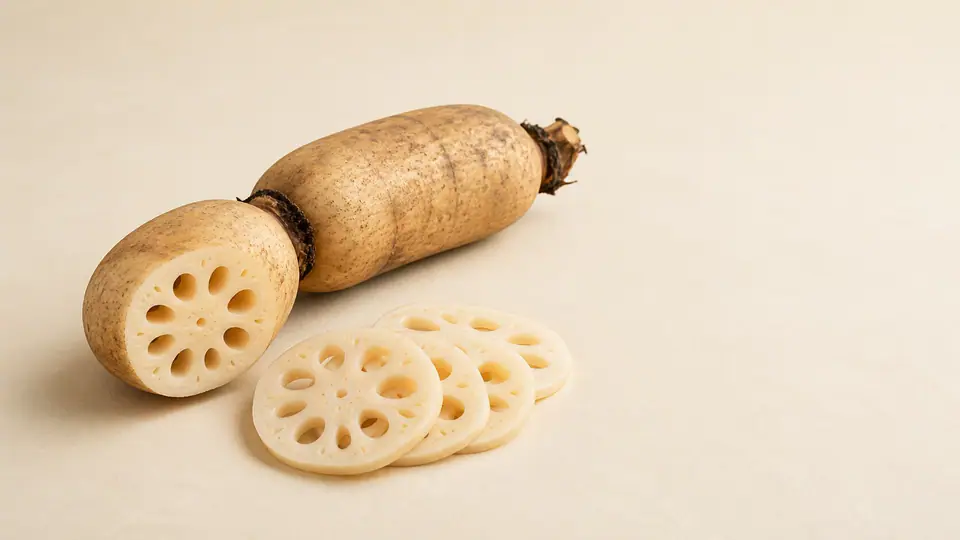
Lotus root is commonly referred to as a root. However, according to Kew's classification, the part we eat is not the root of the lotus aquatic plant, Nelumbo nuciferabut the rhizome, an underground stem that spreads horizontally in the mud. The holes in its cross-section made lotus root symbolic, and that image led to expectations that it is a food beneficial for blood vessels and blood sugar. However, botanical identity and health effects are separate issues.
Called a Root, but Actually a Rhizome
The name 'lotus root' brings roots to mind, but it is actually a vegetable where the rhizome is consumed. A rhizome is an underground stem, and its function and form differ from those of a root. This distinction is not merely a botanical fact. This is because lotus root side dishes, fresh juice, powder, and concentrated extracts differ in part, composition, and research evidence from lotus leaves, lotus seeds, and lotus plumules. If one part is interpreted as another, or one form as another, the identity of the raw material becomes blurred.
One Lotus Plant, Multiple Parts
In the lotus plant, not only the rhizome but also the seeds, leaves, petioles, and flowers are edible or used traditionally. Therefore, expectations for lotus root are often supported by research on nuphiferine in lotus leaves or alkaloids in lotus plumules. However, research on polyphenols, starch, and fiber in lotus root is not the same evidence as research on the components of lotus leaves or plumules. Nelumbo nucifera Many of the health effects introduced in comprehensive reviews are based on component analysis and cell or animal studies of lotus leaves, seeds, embryos, stamens, and extracts. These are not the same as the effects of lotus root on the dining table. In other words, a single paper covering the entire lotus plant does not necessarily demonstrate the efficacy of lotus root side dishes.
The Metaphor of the Perforated Cross-Section
The visual metaphor that the holes in the cross-section of lotus root resemble blood vessels or bronchi is strong. This metaphor sometimes settles into a belief that it helps manage blood sugar and cholesterol. However, the mere fact that lotus root contains components such as starch, fiber, and polyphenols does not allow one to claim specific disease prevention or drug replacement effects. There is a different level of proof between the existence of a component and that component preventing or treating a specific disease in humans. What then should we look for? We should look for the direct results of human-based research.
The Sweetness of Braised Lotus Root Is Not Just About the Root
When eating braised lotus root, the burden on blood sugar and calories does not come from the lotus root alone. It varies depending on the amount of sugar and corn syrup, the serving size per portion, and other carbohydrates consumed in the meal. Since braised dishes with high amounts of soy sauce and sugar increase sodium and sugar intake, it is difficult to determine if it is a healthy meal based solely on the nutritional facts of the raw ingredient. If you have diabetes, rather than viewing lotus root as a non-starchy vegetable, it is more realistic to treat it as a starchy food and calculate both the added sugars in the braising liquid and the portion size per meal.
Fresh Juice, Powder, and Extracts Are Not the Same as Lotus Root
Boiled or stir-fried lotus root, sweetly braised side dishes, fresh juice, powder, and extracts are all different forms. Eating lotus root thoroughly washed and properly cooked in normal food quantities is different from viewing fresh juice or concentrated powder as the same amount. Extracts from lotus plant parts or products mixed with various components cannot be evaluated based on the safety history of lotus root as food. During pregnancy, breastfeeding, or while taking medication, the entire product must be verified.
First, Distinguish What Is Being Consumed Together
When choosing lotus root, ask three things first: whether it is boiled or stir-fried, whether it is a side dish braised in sugar, or whether it is a raw juice, powder, or extract. Ask if it is pure lotus root or a complex product containing lotus leaf, lotus seed, or lotus plumule. Ask if it is intended to replace blood sugar or lipid treatment, and if you have diabetes, how to manage the sugar in braised dishes and the amount of carbohydrates per meal. Without these distinctions, different things are mixed together under the name of lotus root.
How to View the Gap in Human-Based Research
The fact that direct clinical trials on lotus root are rare is not proof that it is ineffective, nor is it proof that traditional experience equals therapeutic effect. Rather, it means that food and concentrated products must be judged separately. Cell and animal studies and component analysis can show possibilities, but they do not lead directly to human blood sugar, lipid, or disease outcomes. Acknowledging the distance between observation, possibility, and proof is the starting point for viewing this ingredient correctly.
Safety Varies by Form and Situation
The standard is to eat lotus root in the amount of general food, thoroughly washed and properly cooked. If repeated oral itching, hives, vomiting, or difficulty breathing occurs after consumption, you must stop. In particular, difficulty breathing or systemic reactions require immediate emergency help. If you are pregnant, breastfeeding, or taking medication, it is necessary to check the full ingredients of lotus plant extracts or complex products and consult a professional.
Final Decision Criteria
Rather than the image of a 'healthy root with holes,' what should be checked first are the actual plant part, the cooking method, and the amount consumed at once. You can check sequentially whether research from other parts of the lotus plant was borrowed, the extent of direct human trials, and the amount of sugar and sodium in braised dishes. Lotus root has a long history as a vegetable, but the moment it is converted into the efficacy of a drug or concentrated product, different standards are required. The key is not to miss the boundary between lotus root eaten as food and concentrated products for which efficacy is expected.
References
- Kew Plants of the World Online: Nelumbo nucifera.
- Traditional and modern uses of Nelumbo nucifera: comprehensive review.
- Lotus: cultural, ecological and nutraceutical review.
This text explains the origin of the raw materials, the scope of research, and precautions before consumption. As this cannot replace individual diagnosis or treatment, please consult a medical professional if you are taking medication or if symptoms persist. If sudden and severe symptoms such as difficulty breathing or decreased consciousness occur after consumption, seek help from 119 or the emergency room.

Medical Staff Review
Director Choi Yeon-seung
Chief Director of Baekrokdam Korean Medicine ClinicLotus Root Dictionary Entry, reviewed the safety of expressions and the scope of verification before administration.
Review scope: Ingredient origin, human studies, concomitant medications, safety of intake · Last reviewed 2026-08-17
- Graduated from Kyung Hee University College of Korean Medicine
- Providing Korean medicine treatment since 2010
- Consultations for Gongjindan, Gyeongokgo, Nokyong (Deer Antler) restorative medicine, and customized restorative herbal medicine