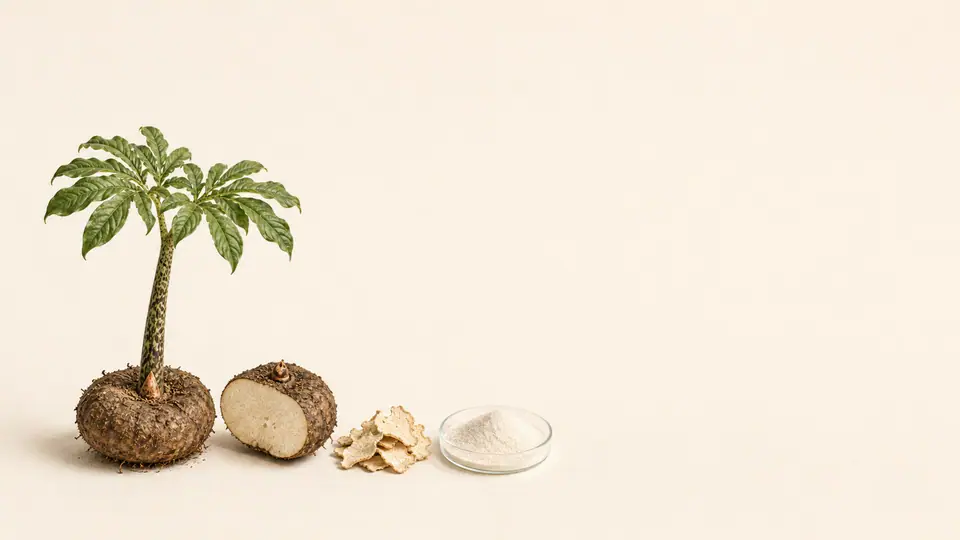
Konjac before and after meeting water
Will eating konjac jelly or glucomannan supplements before meals lead to weight loss by creating a feeling of fullness?
In short, while some may experience satiety, the claim that it 'leads to weight loss' depends first on the product form and what meal it replaced. Even with the same ingredient, hydrated konjac noodles, jelly, and blocks differ in volume, calories, and risk compared to dry glucomannan powder or capsules.
The first name: Glucomannan
The konjac plant is a member of the Araceae family Amorphophallus konjacIt refers to the underground corm of the plant. Glucomannan is the viscous, water-soluble dietary fiber obtained from this corm. Since there are two names, it is easy to think of them as the same, but konjac is the raw material and glucomannan is the polysaccharide component within it. A more important distinction is 'whether it has met water.' Hydrated konjac noodles, blocks, and jellies are already expanded, whereas dry glucomannan powder or capsules are small clumps just before meeting water. This difference separates not only the effect but also the safety.
The secret to low calories lies in the state, not the ingredients
Why are konjac foods low in calories? It is because they absorb a lot of water, increasing in volume while containing few actual energy-providing components. On the other hand, the claim that dry glucomannan capsules directly burn body fat is a different story. Capsules do not replace food; they are a form of adding a small amount of fiber. Therefore, 'what you ate instead' has a greater impact on weight. Replacing rice or noodles with konjac noodles reduces calories. If you add capsules while maintaining your usual diet, the reduction in calories will be different.
Hydrated foods and dry supplements are not used in the same way
When people hear 'konjac,' some think of konjac noodles, blocks, or jellies, while others think of glucomannan capsules. Both contain the same glucomannan, but the hydrated state and dry state are different. Konjac glucomannan is a water-soluble dietary fiber that increases in viscosity as it absorbs water, and hydrated foods and dry supplements are not used in the same way. Since blocks have already absorbed water, additional water intake is not the key. Because capsules are in a state before meeting water, the water instructions on the label are both a condition for operation and a condition for safety.
EU-approved claims apply only under narrow conditions
EU-approved weight-related claims apply only when overweight adults take 3 g per day (1 g three times) before meals with sufficient water, alongside a calorie-restricted diet. Looking at these conditions, 'before meals' and '1 to 2 glasses of water' are key. Since glucomannan is a fiber that increases in viscosity by absorbing water, swelling does not occur without water. Therefore, the water intake instructions on supplement labels are not mere recommendations but part of the mechanism. Regarding cholesterol maintenance, there is another condition of 4 g per day. Even for the same ingredient, the dosage and conditions vary depending on the purpose.
What did the research show?
In a 2014 meta-analysis of 8 trials involving overweight and obese subjects, the average weight difference compared to placebo was not significant, and abdominal discomfort, diarrhea, and constipation were reported. Other meta-analyses showed signals of LDL reduction, but there was significant heterogeneity between trials. This does not mean it can replace lipid-lowering medications, nor does it mean all products produce the same effect. When looking at research results, rather than concluding that it 'is effective,' one should remember that the weight effect is limited and the cholesterol effect is at a level of possibility.
The two sides of dry powder: satiety and the risk of obstruction
Dry glucomannan expands significantly upon meeting water. While this physical property can create satiety, it is contraindicated for people with dysphagia. Swallowing dry glucomannan without sufficient water poses a risk of obstruction in the throat, esophagus, or intestines. If chest pain, vomiting, or difficulty swallowing or breathing occurs, prompt medical evaluation is required. Thus, the benefits and risks of supplements stem from the same principle. The swelling that provides satiety can lead to choking or obstruction if it settles incorrectly inside the body.
Medications and conditions to be cautious of when taking together
Viscous fibers can alter the timing of medication absorption and may lower postprandial blood glucose. Therefore, the interval between diabetes medications and all oral medications must be coordinated with a pharmacist. Gas, bloating, abdominal pain, diarrhea, or constipation may occur; if you have a history of intestinal stricture, obstruction, or abdominal surgery, you must consult medical staff first. Dry powders or capsules should be taken with sufficient water as directed on the label, and should not be swallowed while lying down or immediately before sleep. Do not use if you have dysphagia or esophageal stricture.
Three Questions to Determine if This is Right for You
When choosing this ingredient, first consider these three points. First, check whether it is a moisture-containing konjac noodle, jelly, or block, or a dry powder or capsule, and verify the actual glucomannan grams and the water intake instructions per dose. Second, clarify what you are replacing to reduce total calories for your weight goal, and determine which result you desire among constipation relief, cholesterol management, or blood glucose control. Third, check for dysphagia, esophageal disease, intestinal stricture, history of surgery, or whether you are taking diabetes medications or other oral medications.
Final Decision Criteria
Rather than focusing on the 'diet' label on the front, first examine the product's moisture state, glucomannan grams, sufficient water intake, and your swallowing condition; judge the weight-loss effect by considering what was replaced within a calorie-restricted diet. This is because konjac is an ingredient that is completely different before and after it meets water.
References
- EFSA: Re-evaluation of konjac gum and konjac glucomannan.
- FDA: Glucomannan accepted as dietary fiber based on cholesterol evidence.
- Health Canada licensed glucomannan product risk information.
- Glucomannan for overweight and obesity: systematic review and meta-analysis.
- Konjac glucomannan and LDL cholesterol: systematic review.
This text explains the origin of the raw materials, the scope of research, and precautions before consumption. As this cannot replace individual diagnosis or treatment, please consult a medical professional if you are taking medication or if symptoms persist. If sudden and severe symptoms such as difficulty breathing or decreased consciousness occur after consumption, seek help from 119 or the emergency room.

Medical Staff Review
Director Choi Yeon-seung
Chief Director of Baekrokdam Korean Medicine ClinicKonjac Dictionary Entry, reviewed the safety of expressions and the scope of verification before administration.
Review scope: Ingredient origin, human studies, concomitant medications, safety of intake · Last reviewed 2026-08-17
- Graduated from Kyung Hee University College of Korean Medicine
- Providing Korean medicine treatment since 2010
- Consultations for Gongjindan, Gyeongokgo, Nokyong (Deer Antler) restorative medicine, and customized restorative herbal medicine