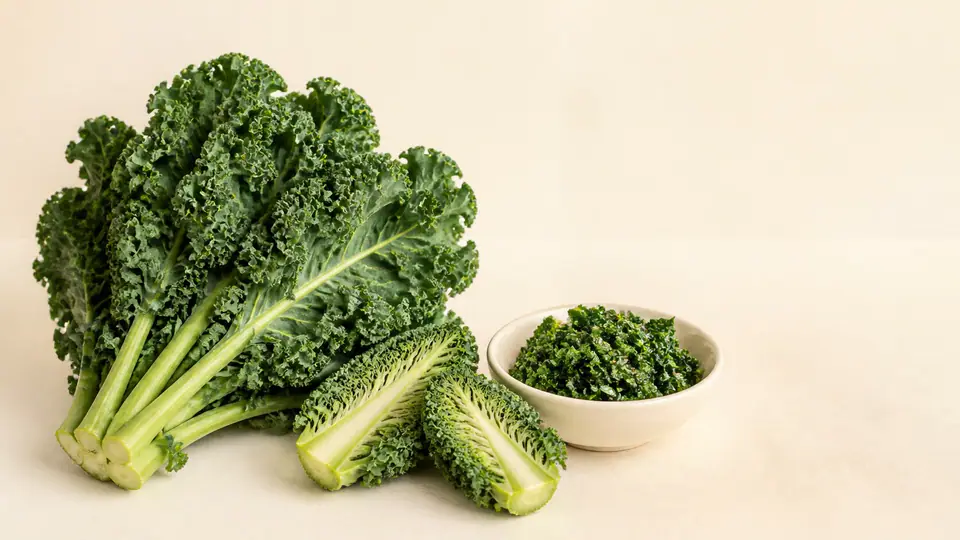
Kale: Evidence-based story of a leafy vegetable branched from the same species as cabbage
Does drinking kale juice every day help with vascular health or detoxification? In short, while kale is a green vegetable that provides vitamin K, there is no direct evidence proving that a single juice product has detoxification or vascular treatment effects. Rather, many expectations surrounding kale stem from applying dietary pattern research on Brassica vegetables as a whole to standalone kale products. It is necessary to distinguish between the identity of kale, the scope of actual evidence, and the precautions that vary depending on the medications taken together.
Kale belongs to the Brassica oleracea species, the same as cabbage or broccoli. However, it is simply a cultivation group called the Acephala Group that does not form a head; it is not a separate species. Descriptions from Kew emphasize this point. In other words, kale was selected from the same species as cabbage, but the edible parts and cultivation groups differ. Therefore, one cannot say that kale is a completely different raw material from cabbage or broccoli, nor can one conclude that the effects are identical because they are the same species. This is where a single name can obscure the facts.
Kale is not a separate vegetable species
Kew describes kale as the Acephala Group of Brassica oleracea. Cabbage and broccoli are also different cultivation groups of the same species. Kale is not a separate species, but a cultivation group selected within the same species to primarily consume the leaves. This distinction is important. Being the same species does not mean the same parts are eaten, nor does it mean they possess the same nutritional components identically. When simply comparing kale to cabbage or broccoli, this difference in cultivation groups must be remembered first.
Applying Brassica vegetable research to kale juice
A 2022 meta-analysis of randomized trials on Brassica vegetables reported a small average decrease in total cholesterol. However, this was not a result of testing kale alone. It was an analysis that grouped several Brassica vegetables, including cabbage, broccoli, and cauliflower. Therefore, these results cannot be read as the vascular treatment effect of a single kale juice product. The results of a dietary pattern involving Brassica vegetables and the effects of kale juice are not the same exposure. The research subjects are different, and the product forms are different. What then should be looked at? First, distinguish whether it is a direct clinical trial of kale alone or a study grouping all Brassica vegetables.
Raw leaves, cooked food, juice, and powder are not the same kale
Kale is sometimes added to salads as raw leaves or eaten as a side dish after being cooked. These days, it is also frequently available in the form of juices or powders. However, these do not represent the same level of exposure. The amount consumed per 1 serving is different, the fiber content is different, and the way it is mixed with other ingredients is also different. For concentrated green juices, one must consider how much they are mixed with other vegetables, fruits, and sugars, as well as how much is drunk per 1 serving. Therefore, it is difficult to apply the evidence for one plate of raw kale to one spoon of kale powder, or vice versa. When the form changes, the evidence also changes.
When taken with warfarin: Consistency of vitamin K intake
In USDA data, kale is classified as a green vegetable that provides vitamin K. However, the actual amount of vitamin K may vary depending on the variety, cooking method, and amount consumed per 1 serving. For those taking warfarin, rather than avoiding kale unconditionally, it is important not to suddenly and significantly change the usual intake of green vegetables. The key is to coordinate the consistency of intake with medical staff. Rather than kale being a specifically contraindicated food, the problem arises when the intake pattern of the vegetable group high in vitamin K changes. In other words, the more important question is not whether to eat kale or not, but how consistently it is eaten.
Thyroid and iodine: Distinguishing between general diet and extreme intake
A 2024 systematic review generally did not support the concern that general Brassica vegetable intake is harmful to thyroid function when iodine intake is sufficient. However, cases where individuals with thyroid disease or a risk of iodine deficiency repeatedly consume extreme amounts of raw kale juice or powder must be distinguished from a general diet. The form, amount, and individual health status change the conditions. Here too, the key is not kale itself, but who eats it, in what form, and how often.
Detoxification and medication replacement: No direct human evidence
There is no direct human evidence that kale replaces medication or removes toxins from the body. Such expectations mostly stem from the image of it being a superfood. Kale can provide nutrients as a green vegetable, but this should not be expanded as evidence for detoxification or disease treatment. Observed possibilities and proven effects are different. While it is easy to feel that kale juice cleanses the body, accepting that feeling as evidence equivalent to a therapeutic effect is a different matter.
How to view the differences between similar ingredients
Kale is the same species as cabbage and broccoli, but the cultivation group is different. Kale food and kale juice/powder have different exposure methods even if they are the same raw material. Additionally, studies on kale alone and studies on the Brassica vegetable group are not the same evidence. These three comparisons are the criteria to keep in mind when choosing kale. Remembering that names and forms that look similar actually point to different evidence allows one to look at the conditions of the raw material before the advertising copy.
Criteria to Check Today
When choosing kale, first check three things. First, whether it is raw leaves, cooked food, juice, or powder, and how much is consumed at once. Second, if taking warfarin, whether the usual intake of green vegetables is being changed suddenly. Third, whether concentrated raw kale is being consumed in excessive, repeated amounts despite having thyroid disease or a risk of iodine deficiency. If allergic reactions such as itching of the mouth or throat, hives, or difficulty breathing appear after consumption, stop use; for severe symptoms, seek prompt medical evaluation.
Rather than superfood or detox images, the start of using this raw material wisely is to first consider which cultivation group within the same species as cabbage kale belongs to, the difference between whole food and concentrated products, the scope of direct evidence, and how to maintain consistency in vegetable intake while taking warfarin.
References
- Kew Plants of the World Online: Brassica oleracea.
- Brassica vegetables and glucose and lipid profiles: systematic review.
- USDA vitamin K food list.
- Food and oral anticoagulant interactions: evidence review.
- Brassica vegetables and thyroid function: systematic review.
This text explains the origin of the raw materials, the scope of research, and precautions before consumption. As this cannot replace individual diagnosis or treatment, please consult a medical professional if you are taking medication or if symptoms persist. If sudden and severe symptoms such as difficulty breathing or decreased consciousness occur after consumption, seek help from 119 or the emergency room.

Medical Staff Review
Director Choi Yeon-seung
Chief Director of Baekrokdam Korean Medicine ClinicKale Dictionary Entry, reviewed the safety of expressions and the scope of verification before administration.
Review scope: Ingredient origin, human studies, concomitant medications, safety of intake · Last reviewed 2026-08-17
- Graduated from Kyung Hee University College of Korean Medicine
- Providing Korean medicine treatment since 2010
- Consultations for Gongjindan, Gyeongokgo, Nokyong (Deer Antler) restorative medicine, and customized restorative herbal medicine