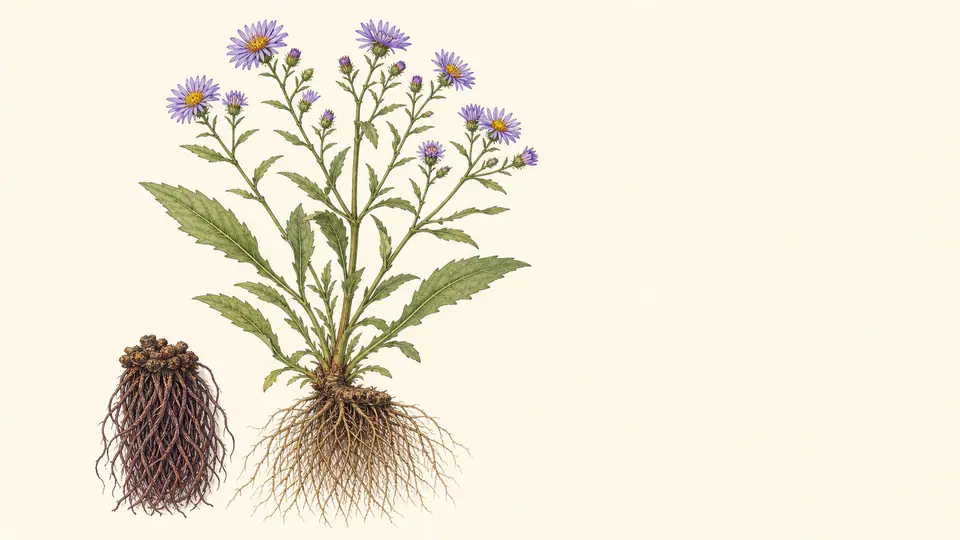
Under the purple flowers of autumn, bundles of thin roots underground
If I have a persistent cough, can I drink Jawan as a tea? To answer briefly, if the cough is long-lasting, it is more appropriate to seek a medical evaluation for the cause first rather than choosing Jawan tea. While it is true that Jawan is known as a herbal medicine for coughs, the data accumulated to date primarily shows changes in liver function in animal models and different extraction fractions rather than the treatment of chronic cough in humans.
This article explores where the name Jawan comes from, what it means, and the differences between its various forms hidden behind that name. I would like to address a common misunderstanding that often occurs when a plant with beautiful flowers becomes a medicinal herb.
When a cough persists: The order of priority for choosing herbal medicine
If a cough lasts for more than 3 weeks, or is accompanied by sudden shortness of breath, blood-tinged sputum, or high fever, a medical evaluation for the cause takes priority over considering the efficacy of Jawan. This is not limited to Jawan, but is a general approach to persistent coughs. A cough may be a sequela of a cold, or it could be asthma, post-nasal drip, or even other lung issues. Relying on herbal medicines to suppress a cough without knowing the cause may delay necessary treatments such as prescription inhalers or antibiotics.
Then, where does Jawan stand? While it is recorded as a herbal medicine traditionally used for coughs and sputum, comprehensive reviews published in 2024 and 2025 point out one clear fact: although traditional use and preclinical results related to coughs and asthma have been organized, most of the research is based on animal models, toxicity studies are lacking, and concerns have been raised regarding signals of liver damage, mechanisms, and uncertainties in safety.
Jawan consists of the roots and rhizomes, not the flowers
Jawan is Aster tataricus the root and rhizome of the plant Linne fil., commonly known as Aster tataricus. The National Institute of Food and Drug Safety Evaluation defines Jawan as A. tataricusthe root and rhizome, separating it from the flowers and leaves. This means that although it is called by one name, the actual parts exposed to the body are different.
Even within the same Aster tataricus, young leaf vegetables, flowers, aerial parts, honey processed products, concentrated extracts by polarity, and isolated components such as sionone, astin, and saponin are not the same form of exposure. In other words, the name Jawan refers to the narrow range of roots and rhizomes; any other form is a different matter.
Although the aerial parts of the plant that bloom purple flowers in autumn are prominent, the part used as a medicinal herb is the bundle of thin roots underground. This simple difference in the part used is the first point that must be verified in discussions of efficacy and safety.
Reasons for expectation: Preclinical activity and its limitations
A 2025 comprehensive review organized over 200 metabolites and various preclinical activities of Jawan. This is the context in which activities related to coughs and sputum were reported. However, the majority of the research is at the cellular or animal level, and clinical evidence for standalone use in humans is limited.
In other words, it has not been proven that the possibilities observed in laboratories and animals work the same way in humans. There are limitations, such as the number of studies, consistency, and a lack of human data, which make it premature to conclude that it is 'effective.' This gap is the most critical point to be cautious about when easily accepting Jawan as a cough remedy.
Decoctions of raw materials, concentrated extracts, and isolated components are different forms of exposure
The forms of Jawan one encounters are largely divided into three: decoctions of raw materials, concentrated extracts by polarity, and isolated components such as sionone, astin, and saponin. These are not the same just because they come from the same raw material.
A decoction of raw material is a form where the roots and rhizomes are boiled in water. A concentrated extract is a form where specific component groups are selectively gathered based on solvent and polarity. An isolated component is a state refined close to a single substance. Since the amount and combination that reach the body differ for each form, results from one form cannot be applied directly to another.
In particular, acute and sub-acute toxicity studies in animals have reported toxic changes centered in the liver in some fat-soluble fractions. While these studies were not designed to determine safe dosages for humans, they suggest that concentrated extracts or specific fractions may act differently than traditional decoctions of the raw material. Therefore, we emphasize that there is no evidence to support long-term consumption, such as using it as a daily tea.
What about your current medications and personal health situation?
When considering the use of Jawan (Platycodon grandiflorum root), you must first check your current medications and health status. As a rule, concentrated extracts of Jawan should not be self-administered if you have liver disease, abnormal liver function levels, or are taking medications that may affect the liver.
Because human safety data is insufficient, it should not be used repeatedly like a daily tea for children or during pregnancy and breastfeeding. There is also a lack of human data regarding long-term use. Caution is required when using it alongside cough medicines, sedatives, or other medicinal herbs.
If jaundice, dark urine, severe fatigue, or persistent vomiting occur while using Jawan, stop use immediately and undergo a liver function evaluation. If shortness of breath, chest pain, cyanosis, coughing up blood, high fever, or a prolonged cough appear, seek medical evaluation immediately; do not replace prescribed inhalers or antibiotics with Jawan.
The Gap Between Human Evidence and Expectations
The primary expectation for Jawan is the relief of cough and phlegm. However, current evidence remains at the pre-clinical signal stage, and clinical evidence directly supporting the treatment of chronic cough in humans is limited. Failing to acknowledge this gap leads to over-reliance on the label of a 'traditional medicinal herb'.
Traditional use does not automatically guarantee modern safety. In particular, as the concentration of extracts increases and they are consumed as concentrated products, exposure patterns differ from those of traditional raw material decoctions. This change must not be overlooked in safety discussions.
Similar names, different ingredients
The following are common comparisons often confused when understanding Jawan:
| Comparison Target | Key Difference |
|---|---|
| Jawan root/rhizome vs. Aster tataricus leaves/flowers | Different parts defined as medicinal material |
| Raw material decoction vs. polarity-based concentrated extract | Different component combinations and concentrations |
| Pre-clinical antitussive signals vs. treatment of chronic cough in humans | Different levels of evidence |
| Temporary cough vs. chronic cough requiring cause evaluation | Different priorities for response |
This table means more than simply distinguishing forms. It means that when a consumer chooses a product under the name 'Jawan', they must first ask which of these four categories the product actually falls into.
Final Decision Criteria: What to check first
If you are considering Jawan, check these three things first. First, whether it is the root/rhizome of Aster tataricus, the leaves/flowers, or another Aster species. Second, whether it is a raw material decoction, a honey-processed product, or an ethanol extract, and how long you plan to take it. Third, whether you have liver disease, abnormal liver levels, are pregnant/breastfeeding, or are using it concurrently with cough medicines or sedatives.
The standard for using Jawan wisely is to first verify the exact plant part, extraction method, duration of use, liver status, and the cause of a prolonged cough, rather than relying on its traditional use as a cough remedy. While the purple flowers of autumn may catch the eye, the decision must be based on the identity of the root bundles underground and the evidence supporting them.
References
- National Institute of Food and Drug Safety Evaluation Herbal Medicine Standards: Jawan.
- Aster tataricus pharmacology and toxicology review.
- Aster tataricus acute and subchronic toxicity in animals.
- Updated Aster tataricus review.
This text explains the origin of the raw materials, the scope of research, and precautions before consumption. As this cannot replace individual diagnosis or treatment, please consult a medical professional if you are taking medication or if symptoms persist. If sudden and severe symptoms such as difficulty breathing or decreased consciousness occur after consumption, seek help from 119 or the emergency room.

Medical Staff Review
Director Choi Yeon-seung
Chief Director of Baekrokdam Korean Medicine ClinicJawan Dictionary Entry, reviewed the safety of expressions and the scope of verification before administration.
Review scope: Ingredient origin, human studies, concomitant medications, safety of intake · Last reviewed 2026-08-17
- Graduated from Kyung Hee University College of Korean Medicine
- Providing Korean medicine treatment since 2010
- Consultations for Gongjindan, Gyeongokgo, Nokyong (Deer Antler) restorative medicine, and customized restorative herbal medicine