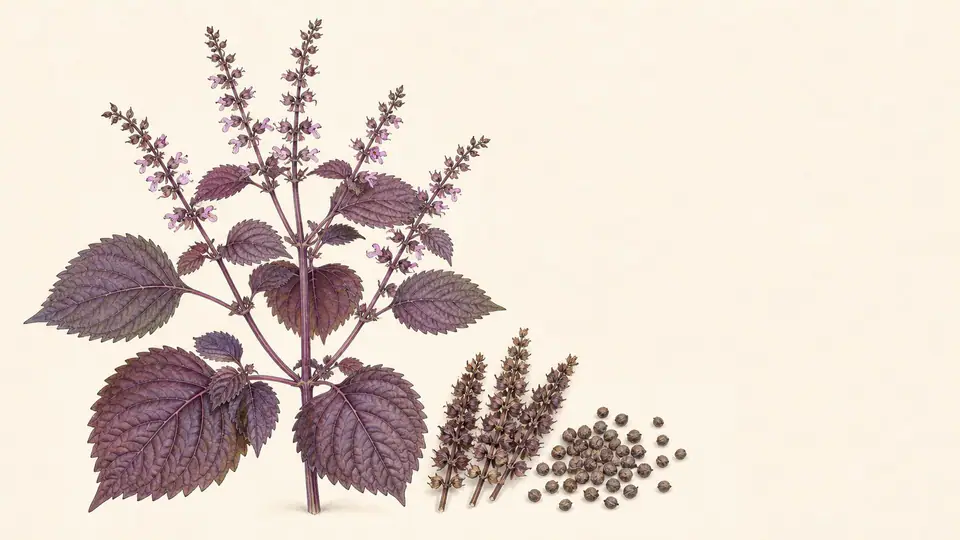
A maze of names surrounding a small fruit
Can I take Jasoja or perilla oil for a cough or constipation? In short, before taking them, you must first identify exactly what you are consuming, your own medical history, and what signals are mixed within your symptoms. While Jasoja may seem like a familiar edible seed, the leaves, fruits, whole fruits, oils, raw materials, and extracts do not share the same evidence base.
This name moves freely between the market and medicinal herbs. Some think of perilla leaves, while others think of perilla oil. Some see 'Jasoja extract' listed on the ingredients of a health functional food. Just because these come from the same plant does not mean they involve the same part, the same processing, or the same exposure. If these differences are overlooked, the gap between expectation and evidence becomes blurred.
One question, but multiple ingredients
Questions about Jasoja usually begin with coughs and constipation. However, the 'Jasoja' referred to in these questions could be the fruit, the leaf, pressed oil, or a concentrated extract. The National Institute of Food and Drug Safety Evaluation defines Jasoja as the fruit of Perilla frutescens. In other words, officially, Jasoja is the fruit. However, in daily life, the name 'Jaso' is applied to leaves, oils, and edible perilla seeds.
Even within the same plant, different parts expose different groups of components. Leaves are primarily composed of leaf flavonoids, while fruits are rich in fatty acids. Oil is a concentrated form of fatty acids, and extracts are formulations that have undergone solvent and concentration processes. These do not guarantee each other's effects.
The identity of Jasoja: The fruit is the protagonist
Jasoja is the ripe fruit of Perilla frutescens. Perilla frutescens var. acutaand Perilla frutescens var. crispais mentioned. These two are varieties of the Perilla origin plant, and their fruits are the targets used as medicinal herbs.
The important point here is that Jasoja is not the leaf. Jasoyeop (perilla leaf) is a separate part. Furthermore, edible perilla seeds, perilla oil, and Jasoja raw materials, pressed oils, and extracts are not the same in terms of raw material and exposure. Perilla seeds are seeds eaten as food, and perilla oil is oil pressed from those seeds. These do not necessarily share the same evidence as Jasoja medicinal decoctions or concentrated extracts.
Reasons for expectation: Fatty acids and flavonoids
A 2023 comprehensive review of Jasoja summarized various preclinical activities, such as fatty acids and flavonoids. Preclinical refers to test-tube or animal studies. While these studies show potential related to coughs or intestinal motility, it has not yet been proven that the same action occurs with the same intensity in the human body.
The conclusion is that more research on mechanisms of action and human studies are needed. In other words, the expectation that the oil within the small fruit soothes coughs and softens the intestines is close to the starting point of research. Between expectation and evidence, several stages remain, moving from animals to humans and from molecules to clinical application.
Pitfalls of Perilla clinical reviews
Clinical reviews on Perilla do exist. However, they mix various formulations such as leaves, seed oil, and extracts. Some studies may have used leaf extracts, some seed oil, and others mixtures. These results cannot be equated with the effects of raw Jasoja on coughs or constipation.
In other words, the sentence 'Perilla was helpful' may not mean that Jasoja fruit powder was helpful. If the research subject and product form are not accurately distinguished, errors occur, such as overestimating the effect of the raw material or incorrectly applying the safety of the oil to the raw material.
Differences in formulation: Whole fruit, powder, oil, and extract
When looking for Perilla seed (Jasosa), there are four main forms you will encounter. Whole seeds are raw materials with minimal processing. Powder is made by grinding the whole seeds. Pressed oil is extracted from the seeds. Extracts are produced by pulling out specific components using a solvent, then concentrating or drying them.
| Form | Characteristics | Possibility of Evidence Transfer |
|---|---|---|
| Whole seeds · Powder | Close to raw material | Difficult to link directly to oil research |
| Pressed oil | Concentrated fatty acids | Different exposure compared to decocting raw materials |
| Extract | Emphasis on specific components | Components vary depending on the manufacturing method |
Nutritional research on perilla oil and the decoction of Perilla seed as a medicinal herb must be distinguished, as the raw material varieties, processing, and exposure differ. Applying results from perilla oil research to Perilla seed extracts, or vice versa, exceeds the boundaries of the evidence.
Allergies: Previous consumption does not guarantee safety
Perilla seeds are a familiar food. However, having eaten them before does not eliminate the risk of an allergic reaction. Two cases of anaphylaxis have been reported after consuming perilla seeds. Hypersensitivity to seeds is rare, but it does exist.
If you have seed or nut allergies, or if you have experienced hives or lip swelling after eating perilla seeds in the past, it is advisable not to try them on your own. If you experience systemic hives, throat tightening, wheezing, or dizziness after consumption, you should call 119 immediately. This caution applies not only to Perilla seed but to all types of seeds.
When taking together: Medications and Supplements
There are no specifically identified interactions in the confirmed evidence when using Perilla seed with other supplements or medications. However, since safety data for pregnant women, breastfeeding women, children, and those taking concentrated extracts long-term are limited, the general rule is to consult a medical professional first.
If you have a specific medical condition or are taking other medications, consuming these materials without knowing the formulation and concentration can be risky. Rather than relying on the intuition that 'it should be fine since it is edible,' prioritizing a check with a medical professional regarding the relationship with your current medications is essential.
Individual circumstances and safety signals
There are personal warning signs to check before considering Perilla seed. If you have a cough, difficulty breathing, or bloody sputum for more than 3 weeks, or persistent constipation, bloody stools, weight loss, or severe abdominal pain, medical evaluation takes priority over using Perilla seed. These symptoms often exceed the scope of what Perilla seed can address.
So, what should you look for? First, check whether it is the Perilla seed, Perilla leaf, edible perilla, or pressed oil. Second, check for seed or nut allergies or a history of hives after consuming perilla seeds. Third, check for signs that require medical evaluation, such as a persistent cough, difficulty breathing, bloody stools, or severe abdominal pain. These three points are the practical starting points for choosing Perilla seed.
Differences from similar raw materials
Confusion surrounding Perilla seed stems from similar names. Perilla seed and Perilla leaf come from the same plant but are different parts. Perilla seed and edible perilla differ in variety and use. Whole seeds/powder and pressed oil/extracts differ in processing and exposure. There is a difference in the level of evidence between the antitussive and laxative signals seen in preclinical studies and human clinical trials.
These four comparisons prompt a re-evaluation every time you choose Perilla seed: Which category does the product I am looking at fall into? Where did the evidence for that product come from? Just because the name is the same does not mean the answer is the same.
Final Decision Criteria
Rather than the familiarity of it being an edible seed, first verify the exact part, formulation, allergy history, and the cause of any cough or constipation. Perilla seed is a small, familiar fruit, but it requires its own evidence distinct from leaves, oils, or extracts. Expectations begin with possibility, but choices must be made based on verified facts.
References
- National Institute of Food and Drug Safety Evaluation Herbal Medicine Standards: Perilla seed.
- Perillae Fructus comprehensive review.
- Perilla extracts in human clinical studies.
- Two cases of anaphylaxis caused by perilla seed.
- Perilla seed oil health effects review.
This text explains the origin of the raw materials, the scope of research, and precautions before consumption. As this cannot replace individual diagnosis or treatment, please consult a medical professional if you are taking medication or if symptoms persist. If sudden and severe symptoms such as difficulty breathing or decreased consciousness occur after consumption, seek help from 119 or the emergency room.

Medical Staff Review
Director Choi Yeon-seung
Chief Director of Baekrokdam Korean Medicine ClinicPerilla seed (Jasosa) dictionary entry, reviewed the safety of expressions and the scope of verification before administration.
Review scope: Ingredient origin, human studies, concomitant medications, safety of intake · Last reviewed 2026-08-17
- Graduated from Kyung Hee University College of Korean Medicine
- Providing Korean medicine treatment since 2010
- Consultations for Gongjindan, Gyeongokgo, Nokyong (Deer Antler) restorative medicine, and customized restorative herbal medicine