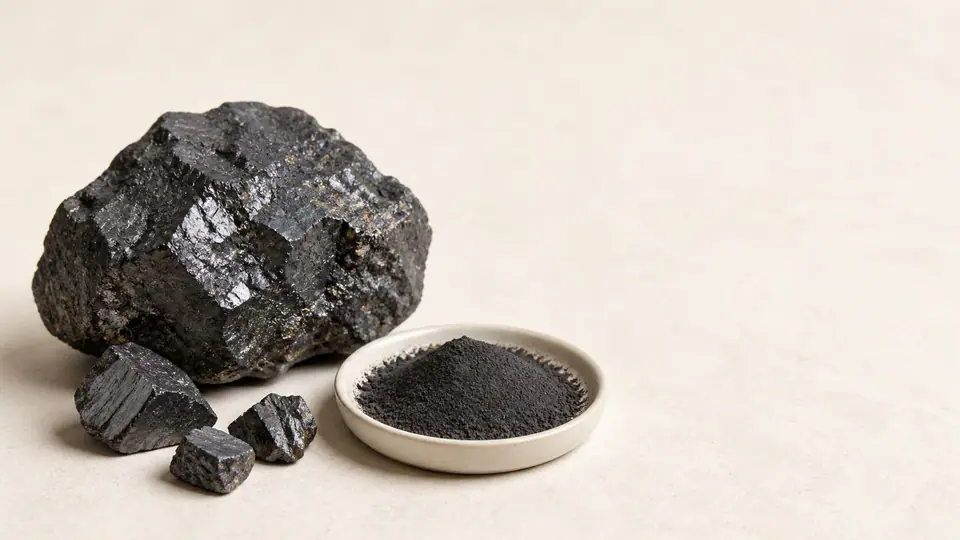
Until the black stone became a medicinal ingredient
Can I directly consume medicinal magnet powder if it is said to be good for tinnitus or insomnia? In short, you must not directly consume powder from an unknown source. A medicinal magnet is not an object found on a desk, but an oxide mineral defined as Magnetite (Fe3O4) in the pharmacopoeia.
The problem is that the name is too familiar. Because black minerals are often linked to discussions about insomnia or tinnitus, it is easy to think that magnets at home or mineral powders bought online are similar. However, there are boundaries that cannot be skipped between pharmacopoeia magnetite and desk magnets, between raw materials and processed products heated by fire and soaked in vinegar, and between traditional prescriptions and powders consumed directly.
Why this question begins with magnets
The word 'magnet' is used very frequently in daily life. We use the same term for refrigerator magnets, tool magnets, and neodymium magnets. However, magnets used as medicinal ingredients have a different identity. The standards of the National Institute of Food and Drug Safety Evaluation define the medicinal magnet as the oxide mineral magnetite, primarily composed of Fe₃O₄, and provide standards for magnetism, appearance, and heavy metal testing. In other words, a medicinal magnet is not simply a black, magnetic stone, but a mineral with defined specifications. The starting point of this discussion is that having the same name does not mean they are the same raw material.
The identity of the mineral Magnetite
Magnets according to official domestic standards are magnetite, with Fe₃O₄ as the main component, and their magnetism is verified. Magnetite is a mineral where iron has oxidized, and it likely drew attention since ancient times due to its magnetic properties. However, the presence of magnetism does not mean it can be concluded that it performs a specific action within the body. The pharmacopoeia only provides the appearance, composition, and heavy metal standards for this mineral; it does not support the claim that it directly acts on insomnia or tinnitus. This is exactly why identity and impurity testing are the starting points for interpreting evidence regarding mineral raw materials.
Jaseok-danshui is another form of the same mineral
Even the same mineral becomes a different medicinal ingredient depending on the processing method. Jaseok-danshui is defined as a processed product where magnetite is heated above 700 ℃ and then cooled by soaking it in vinegar. Therefore, its manufacturing process differs from raw magnets. The process of heating by fire and soaking in vinegar is not simple processing, but a separate specification corresponding to traditional processing methods (poje). When looking at raw materials, readers should first ask whether it is a raw magnet or Jaseok-danshui, and whether its processing history is verified. This distinction is not visible by name alone.
| Category | Definition | Points to Check |
|---|---|---|
| Raw Magnet | Raw magnetite according to pharmacopoeia standards | Specifications, magnetism, heavy metal testing |
| Jaseok-danshui | Processed product heated above 700 ℃ and then soaked in vinegar | Processing history, compliance with standards |
Where do the expectations for insomnia and tinnitus come from?
The reason magnets are linked to tinnitus or insomnia can be found in the context of traditional prescriptions. However, it is difficult to find reliable human clinical trials confirming that magnets alone treat tinnitus or insomnia. The key here is to distinguish between traditional use and confirmed clinical efficacy. Being used traditionally only means that the raw material appears in literature and was handled within a certain prescription system; it does not mean that its efficacy has been proven by modern medicine. So, what should we look at? We must simultaneously examine the identity of the raw material, quality tests, and the level of clinical evidence.
Magnets on a desk and magnets used as medicinal herbs are different substances
Household or industrial magnets, such as neodymium or ferrite products, are different substances from the magnetite that meets pharmacopeia standards. Large magnets of the hematite series may have similar names, but they are not the same raw material. Therefore, you must not grind and consume household, industrial, or collectible magnets, nor should you replace medicinal herbs with mineral powders of unknown origin. This is a matter of identity, regardless of efficacy. To be a medicinal herb, a material must have established standards, testing criteria, and a prescription context.
How is the quality of mineral raw materials verified?
Studies on the elemental analysis of traditional mineral medicines explain that it is important to perform analyses that distinguish not only Fe but also Pb, As, Cd, and Hg in mineral raw materials to verify quality. However, this is not data that proves the contamination of standard magnets themselves. In other words, while there is a principle that heavy metal testing is necessary, it does not mean that all magnets are contaminated. Readers should develop the habit of checking the testing history of raw materials and their compliance with official standards. In particular, mineral raw materials require a different quality evaluation method than plant-based materials.
The gap between prescription context and self-administered powder
Medicinal magnets are handled within a professional prescription context using raw materials with verified official standards and testing histories; long-term or high-dose self-administration should be avoided. Whether a material is part of a prescription formulated by a Korean medicine doctor or is consumed directly as a standalone powder is a completely different situation. A prescription is a system where the combination and dosage of various materials, the determination of indications, and the duration of intake are all considered together. Conversely, taking powder alone is an act devoid of this context.
Relationship with medications, supplements, and other mineral raw materials
When considering magnets, you must also look at what else you are taking. You should check for iron supplements, other mineral raw materials, and any medications currently being taken. In particular, the onset of tinnitus, hearing loss, or insomnia, as well as hearing test history, must be examined. Sudden hearing loss in one ear, severe dizziness, neurological symptoms, persistent tinnitus, or severe insomnia require a cause evaluation before considering magnets. If you have these symptoms, you must receive a medical evaluation before selecting any raw materials.
Swallowing a magnet is a different emergency
If consumer product magnets are swallowed, especially multiple magnets or a magnet and metal together, they can attract each other across the intestinal walls and cause serious damage. This is a completely different emergency from the ingestion of medicinal herbs. If you have swallowed or suspect you have swallowed a magnet product, you must receive an emergency evaluation immediately without waiting for symptoms. It should be noted that multiple magnets may appear as one on imaging. This part must be understood separately from discussions on the efficacy of raw materials.
Criteria to Check Today
Rather than the familiar name 'magnet,' first verify the mineral identity as magnetite, the processing method, official quality tests, and the prescription context. The first step is to distinguish whether it is pharmacopeia-standard magnetite or a household/industrial magnet or mineral powder of unknown origin. You must also distinguish whether it is raw magnetite or processed magnetite (Jaseok-danswi), and whether it is a standalone powder or a material within a prescription formulated by a Korean medicine doctor. Traditional use for insomnia and tinnitus does not mean clinical efficacy has been confirmed. Ultimately, the standard is simple: do not consume general magnets or powders of unknown origin.
References
- National Institute of Food and Drug Safety Evaluation Herbal Standard: Magnetite.
- National Institute of Food and Drug Safety Evaluation Herbal Standard: Jaseok-danswi.
- Minerals and heavy metals in traditional medicine: ICP-MS review.
- US CPSC magnet ingestion safety guidance.
This text explains the origin of the raw materials, the scope of research, and precautions before consumption. As this cannot replace individual diagnosis or treatment, please consult a medical professional if you are taking medication or if symptoms persist. If sudden and severe symptoms such as difficulty breathing or decreased consciousness occur after consumption, seek help from 119 or the emergency room.

Medical Staff Review
Director Choi Yeon-seung
Chief Director of Baekrokdam Korean Medicine ClinicMagnetite Dictionary Entry, reviewed the safety of expressions and the scope of verification before administration.
Review scope: Ingredient origin, human studies, concomitant medications, safety of intake · Last reviewed 2026-08-17
- Graduated from Kyung Hee University College of Korean Medicine
- Providing Korean medicine treatment since 2010
- Consultations for Gongjindan, Gyeongokgo, Nokyong (Deer Antler) restorative medicine, and customized restorative herbal medicine