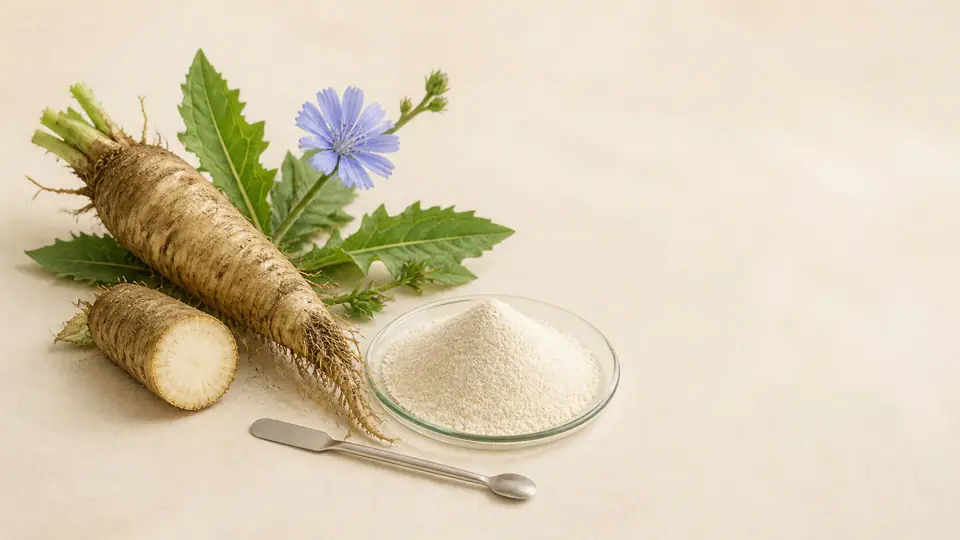
Inulin: Plant Carbohydrates That Feed Good Bacteria, But Not All Guts React the Same Way
“I am taking probiotics; would it be good to take inulin as well?” In short, the total amount of fermentable carbohydrates and your gut's reaction are more important than the mere fact of taking them together. Probiotics and inulin are not the same thing. Inulin is not a live bacterium, but a non-digestible carbohydrate of the fructan family that is not broken down by human digestive enzymes and is instead fermented by microorganisms in the large intestine.
First, it is important to distinguish between the 'bacteria' and the 'food for the bacteria.' In other words, rather than simply adding more based on the label 'gut health,' you must consider overlapping products and your body's reaction.
Why the Question Arises: Prebiotics Placed Next to Probiotics
Probiotics refer to the live microorganisms themselves. Inulin is classified as a component that can serve as food for those microorganisms. Because of this distinction, an increasing number of people take both products. However, since the 'bacteria' and the 'food for the bacteria' have different primary roles, they cannot be evaluated interchangeably under the same umbrella of 'gut health.' Inulin is a prebiotic dietary fiber component, distinct from live probiotic bacteria.
What Inulin Is: Fructans in Plants
Inulin is a non-digestible carbohydrate of the fructan family that occurs naturally in various plants. It is not broken down by human digestive enzymes and is fermented by microorganisms after reaching the large intestine. US FDA review materials describe inulin as a mixture of fructans with varying degrees of polymerization, raw materials, and manufacturing methods. It is noted that inulin can be obtained from chicory, agave, and Jerusalem artichokes. It should be noted that the composition may vary depending on the source plant and extraction method, even under the same name.
Why It Is Expected to Help: The Connection with Bifidobacteria
Interest in inulin stems from research on gut microbiota. In systematic reviews of human studies, an increase in gut bifidobacteria was the most consistent change. However, an increase in short-chain fatty acids was not confirmed. In other words, while the increase of specific bacteria was observed in several studies, the subsequent metabolic changes have not been proven. A meta-analysis of chicory-derived inulin-type fructans also observed changes in bifidobacteria and some bowel movement indicators in healthy individuals. However, responses varied among individuals and those with gastrointestinal diseases. Therefore, it cannot be concluded that inulin provides the same results for everyone.
Difference Between Whole Foods and Products: A Jerusalem Artichoke Field vs. a Spoonful of Powder
Just because raw foods such as Jerusalem artichoke, chicory, or agave contain inulin does not mean they are the same as quantified inulin products. Inulin itself, short-chain fructooligosaccharides, and raw foods differ in structure and intake amount, so research results cannot be applied interchangeably. For example, consuming the same amount of raw Jerusalem artichoke and concentrated inulin powder does not mean you are consuming the same amount of fructans. When choosing a product, it is necessary to check the ingredients list and the serving size per 1 dose.
| Category | Characteristics | Points to Note |
|---|---|---|
| Raw Food | Naturally present in Jerusalem artichokes, chicory, agave, etc. | Inulin content within the whole food varies by product |
| Inulin Extract | Purified and concentrated fructan mixture | Varies in degree of polymerization and manufacturing method |
| Fructooligosaccharides | Short-chain fructans | Different structure and intake amount than inulin |
When taking together: First, check if the total amount overlaps
If used with probiotics, fructooligosaccharides, or dietary fiber products, the total amount may overlap. Since it is easy to overlook the total amount when taking powders, processed foods, and supplements together, you must check the ingredients list and the serving size per 1 dose. Taking probiotics and inulin together does not guarantee specific results; what matters is how the total amount of fermentable carbohydrates reacts in your gut.
In sensitive guts, 'food' for bacteria can cause discomfort
Inulin is a fermentable carbohydrate. As microorganisms break it down in the large intestine, symptoms such as gas, bloating, abdominal pain, bowel sounds, and loose stools may occur. If you have irritable bowel syndrome (IBS) or sensitivity to fructans or FODMAPs, even small amounts may cause discomfort. In such cases, it is necessary not to increase the intake amount arbitrarily. You should also observe whether your symptoms change during IBS management or a low-FODMAP diet.
Safety Signals: When to stop
If you experience severe abdominal pain, persistent diarrhea, dehydration, or suspected allergic symptoms, stop use and seek medical evaluation. While inulin is generally introduced as food for gut microorganisms, not everyone's gut accepts it comfortably. If discomfort persists, it means it does not suit your body, regardless of how 'natural' the ingredient is.
The Gap Between Research Evidence and Expectations
Research on inulin shows a consistent trend of increasing Bifidobacteria. However, this cannot be concluded to lead directly to specific health effects. An increase in short-chain fatty acids has not been confirmed, and responses varied in groups with gastrointestinal diseases. Expecting that changes observed in healthy individuals will appear identically in those with sensitive guts is beyond the scope of the evidence.
Differences from similar raw materials
Inulin and probiotics are different. One is a live bacterium, and the other is a component that can serve as food for live bacteria. Even within the same fructan family, inulin and fructooligosaccharides differ in chain length and structure. Raw Jerusalem artichoke and purified inulin differ in intake amount and form, even if they share the same source. Ignoring these differences leads to the misapplication of research results.
Criteria to Check Today
So, what should be checked first today?
Rather than the label of 'gut health,' prioritize the total amount of fermentable carbohydrates and your gut's reaction. There is no rule that you must add inulin if you are taking probiotics. If you do add it, check the ingredients list and the serving size per 1 dose, and reduce the amount or stop use if symptoms such as abdominal bloating or diarrhea occur. While the description of it being 'food for good bacteria' is true for some people, not all guts react in the same way.
References
- FDA review of physiological effects of inulin-type fructans.
- NIH ODS probiotics fact sheet: distinction from prebiotics.
- Inulin and human gut microbial composition: systematic review.
- Chicory-derived inulin-type fructans and bowel function: meta-analysis.
- Gastrointestinal tolerance of nondigestible carbohydrates.
This text explains the origin of the raw materials, the scope of research, and precautions before consumption. As this cannot replace individual diagnosis or treatment, please consult a medical professional if you are taking medication or if symptoms persist. If sudden and severe symptoms such as difficulty breathing or decreased consciousness occur after consumption, seek help from 119 or the emergency room.

Medical Staff Review
Director Choi Yeon-seung
Chief Director of Baekrokdam Korean Medicine ClinicInulin Dictionary Entry, reviewed the safety of expressions and the scope of verification before administration.
Review scope: Ingredient origin, human subject research, concomitant medications, intake safety · Last reviewed 2026-08-16
- Graduated from Kyung Hee University College of Korean Medicine
- Providing Korean medicine treatment since 2010
- Consultations for Gongjindan, Gyeongokgo, Nokyong (Deer Antler) restorative medicine, and customized restorative herbal medicine