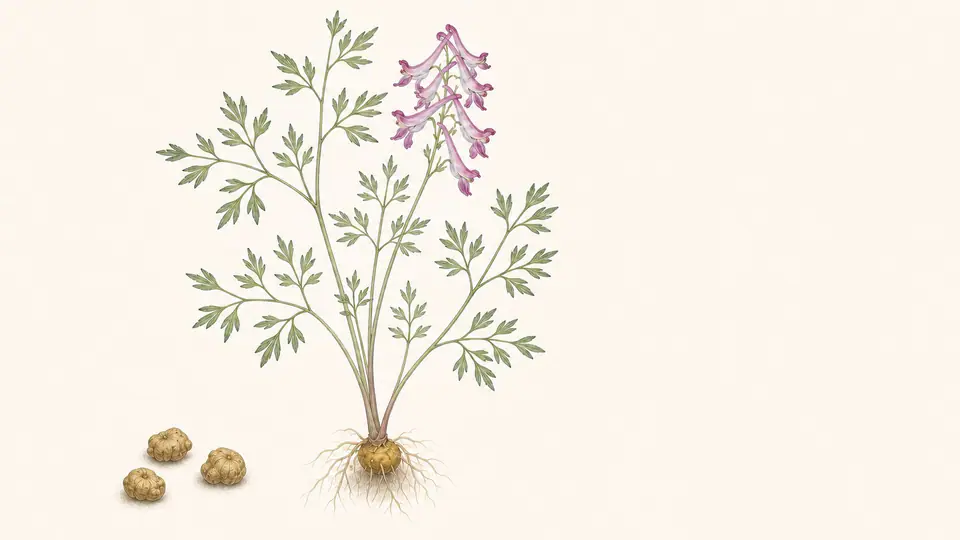
From tubers under spring flowers to pain-relieving medicinal herbs
Can I take Corydalis extracts like painkillers for menstrual cramps, abdominal pain, or neuralgia? In short, it is difficult to simply substitute them. While Corydalis begins as a medicinal herb made by boiling and drying the tubers of Corydalis ternata or Corydalis yanhusuo, the pain-relief capsules found today are concentrated forms different from the raw material. Because small-scale human trials on cold pressalgia, animal pain models, and signals of liver damage carry different weights, the mere memory that it is 'good for pain' is insufficient.
It is essential to distinguish that gap. The Standard Korean Medicine Terminology defines Corydalis as the boiled and dried tubers of Corydalis ternata or Corydalis yanhusuo. Above-ground parts, ornamental Corydalis species, raw products, acetic acid-processed products, total alkaloid extracts, and isolated components such as tetrahydropalmatine do not share the same composition or evidence.
Which type of Corydalis are you looking at?
Under the name Corydalis, there are tubers from two origin species: Corydalis ternata and Corydalis yanhusuo. For both, the processed state of being boiled and dried is the standard unit for the medicinal herb. However, what you encounter on the market may be raw products, acetic acid-processed products, total alkaloid extracts, or single components. These can hardly be viewed as the same raw material. In particular, isolated components like tetrahydropalmatine and raw material extracts differ in composition and exposure, so results from one cannot be directly applied to the other. When looking at a product, you must first check whether it is C. ternata or C. yanhusuo, whether it is the raw tuber or a concentrated extract, and whether it is an isolated component. So, what should you look for? First, the origin species and the processing method listed on the label.
Why there are expectations for pain relief
Literature on Corydalis for pain relief summarizes over 80 types of alkaloids and various mechanisms. This diverse composition led to pain research, and today, it is available in capsule forms concentrating specific alkaloids. However, there is a lack of large-scale trials by specific disease to confirm clinical application. Signals from animal pain models are not the same as the treatment of chronic pain in humans. One cannot conclude that a high alkaloid content necessarily reduces the desired pain in humans.
What is the level of evidence in humans?
A 2004 human cold pressalgia trial administered extracts of C. yanhusuo and Angelica dahurica together in a single dose. Therefore, the independent effect of Corydalis cannot be isolated, nor can the response to cold pain from a single dose be expanded to the treatment of chronic pain such as menstrual cramps or neuralgia. This trial remains a 'small-scale complex extract trial.' In other words, direct human evidence for Corydalis has not yet reached the level of a validated pain-relieving medicinal herb. To what extent should alkaloid research and animal models be referenced? They should be read separately from the therapeutic effects on human diseases.
Where are the signals of liver damage?
A systematic review of herb-induced liver injury included C. yanhusuo as one of the primary related herbs. A 2025 mechanism study also suggested the possibility of idiosyncrasy-related hepatotoxicity under inflammatory activation conditions. This does not mean it will necessarily occur in everyone, but it is a signal that long-term, concentrated self-administration should not be taken lightly. Since concentrated products may differ from raw materials in alkaloid exposure, they should not be assumed to have the same safety profile. If jaundice, dark urine, severe fatigue, persistent vomiting, or pain in the upper right abdomen occurs, stop use immediately and receive a liver damage evaluation.
When taking with medications or supplements
It is important not to arbitrarily combine concentrated Corydalis products with painkillers, sedatives, or sleeping pills. You must inform your healthcare provider or pharmacist about any medications and products you are taking. Because human data is lacking regarding pregnancy, lactation, children, long-term high-concentration use, and drug interactions, the more substances you use together, the more important it is to verify first. If you are currently taking painkillers or sleeping pills, it is better to consult a professional before adding a Corydalis product.
Individual circumstances and warning signs
The location and duration of pain, possibility of pregnancy, and sudden severe abdominal pain, heavy bleeding, fainting, new paralysis, or decreased consciousness are matters that require immediate emergency evaluation rather than trying more Corydalis. You must first determine if these warning signs are present. Corydalis does not identify the cause of pain. The cause could be a critical illness, and the label of a 'pain-relieving herb' could mask it.
Differences between similar names
When evaluating Corydalis, four comparisons are helpful.
| Comparison Axis | Why is it important? |
|---|---|
| Tubers of Corydalis ternata and Corydalis yanhusuo | Different source species may result in different exposure to ingredients. |
| Raw or acetic acid-processed products and total alkaloid extracts | The alkaloid composition may vary depending on the processing and extraction method. |
| Corydalis alone versus combined extracts of Corydalis and Angelica dahurica | In combined tests, the individual effect of Corydalis cannot be isolated. |
| Cold press algia and animal pain signals versus treatment of menstrual pain and neuralgia | There is a difference between whether the research subject is a pain response or a disease treatment. |
If you judge efficacy or safety based solely on the name 'Corydalis' without these distinctions, you will conflate raw materials with concentrates, single ingredients with complexes, and acute pain responses with chronic disease treatments.
Criteria to Check Today
Rather than simply remembering it as a pain-relieving herb, first verify the species, processing method, alkaloid concentration, and the cause of the pain. Small-scale combined extract tests should not be extrapolated as a replacement for analgesics, and signals of liver damage must not be ignored. When choosing a product, the starting point for properly evaluating Corydalis is to check whether it is C. ternata or C. yanhusuo, whether it is the raw tuber or an extract/isolated component, and what potential interactions it may have with current medications or supplements.
References
- Corydalis entry based on the Standard Korean Medicine Terminology of the Society of Korean Medicine.
- Corydalis yanhusuo and Angelica dahurica in a human cold-pressor trial.
- Analgesic properties and alkaloids of Corydalis yanhusuo review.
- Systematic review of herb-induced liver injury.
- Corydalis yanhusuo idiosyncratic hepatotoxicity mechanisms.
This text explains the origin of the raw materials, the scope of research, and precautions before consumption. As this cannot replace individual diagnosis or treatment, please consult a medical professional if you are taking medication or if symptoms persist. If sudden and severe symptoms such as difficulty breathing or decreased consciousness occur after consumption, seek help from 119 or the emergency room.

Medical Staff Review
Director Choi Yeon-seung
Chief Director of Baekrokdam Korean Medicine ClinicCorydalis Dictionary Entry, reviewed the safety of expressions and the scope of verification before administration.
Review scope: Ingredient origin, human studies, concomitant medications, safety of intake · Last reviewed 2026-08-17
- Graduated from Kyung Hee University College of Korean Medicine
- Providing Korean medicine treatment since 2010
- Consultations for Gongjindan, Gyeongokgo, Nokyong (Deer Antler) restorative medicine, and customized restorative herbal medicine