From the flower that gives beer its bitterness to its use as a sleep aid
When I have trouble sleeping, can I drink hop tea or take hop extract? Is it the same effect as a glass of beer?
In short, while both start from the same raw material, they cannot be seen as having the same effect because the alcohol exposure and ingredient concentrations differ. More importantly, there is a gap between the image of hops helping sleep and the actual clinical evidence from human subjects. Following that gap clarifies how we should perceive this ingredient.
The flower that comes to mind when you cannot sleep
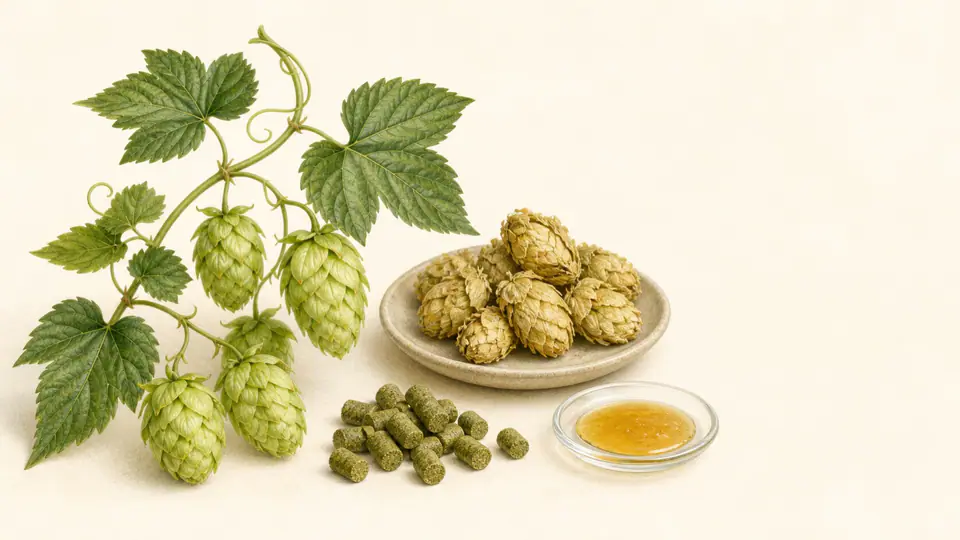
Hops are the female inflorescence, or flowers, Humulus lupulusof a perennial climbing plant in the Cannabaceae family. They are the ingredients that provide the bitterness and aroma of beer and are also used in the form of dried flowers, teas, or extracts. Thinking of hops when unable to sleep is like an intuition formed by the overlap of the rich aroma experienced at breweries and a long history of herbal use. However, the experience of smelling the aroma and the clinical effect of a standardized extract are not based on the same evidence. So, what evidence should we be looking at?
In what types of products can I find hops?
The components exposed in hops vary depending on the form. Beer, hop flower single-ingredient products, valerian complexes, and prenylflavonoid standardized products all start from the same plant, but alcohol and ingredient exposure differ. Beer undergoes a fermentation process, tea is made by steeping dried flowers, and capsules contain concentrated extracts. Sleep-related flower preparations and standardized extracts for menopause should be viewed differently in terms of purpose and ingredient focus. Since hop extracts may contain xanthohumol and 8-prenylnaringenin, which has estrogenic activity, choosing a product is essentially deciding which question you are asking.
Where does the image of hops as a sleep aid come from?
The image of hops as a sleep aid comes from breweries and a history of traditional use. The European Medicines Agency (EMA) describes the medicinal part of hops as the hop strobile, or flower, and recognizes its traditional use for the relief of mild nervous tension and as a sleep aid. However, this is not an established use based on sufficient clinical trials, but a conclusion based on experience of safe use in specific preparations and conditions for over 30 years. Here, 'traditional use' is a regulatory distinction meaning there is a history of use supporting a specific purpose, not that the efficacy and safety of all hop products have been proven.
What have human studies shown?
Most human sleep studies have used valerian and hops together. A 2010 review reported signals in some sleep indicators for valerian alone or hop complexes, but concluded that more rigorous trials are needed before making a definitive recommendation due to large differences in design. A 2025 feasibility study of 40 people reported an average increase in sleep time of 21.7 minutes with a valerian-hop complex, but this was a small-scale exploratory study and not the effect of hops alone. The difficulty of isolating the contribution of hops alone remains. In other words, the signals seen in complex products cannot be expected from a single cup of hop tea.
How do I distinguish between hop single-ingredient products and valerian complexes?
Just because a product is a hop single-ingredient product does not mean that hops alone aid sleep. The EMA also states that there is insufficient evidence from clinical trials for hops alone. On the other hand, while there are more studies on valerian-hop complexes, applying those results directly to hop single-ingredient products is an overinterpretation of the evidence. Traditional use and clinical establishment, as well as sleep aids and the treatment of chronic insomnia, should not be viewed as the same. Then, what criteria can be used to evaluate products?
When using with medications or supplements
Hops may cause drowsiness, so it is safer not to use them before driving or operating machinery. They should not be combined arbitrarily with sleeping pills, sedating antihistamines, or alcohol. If one views a glass of beer and hop extract as having the same effect, the overlap with alcohol could actually become a new risk. If you are taking medication or other supplements, you should first verify what form of hop product you are using.
Who should be more cautious?
There is insufficient safety data on concentrated extracts for use during pregnancy, lactation, in children, or for those with hormone-sensitive conditions. EMA traditional herbal medicinal products are intended for individuals aged 12 and older; if symptoms persist for more than 2 weeks or worsen, medical evaluation should be prioritized over self-medication. Immediate assistance is required for severe shortness of breath, facial swelling, decreased consciousness, or abnormally severe drowsiness after intake.
What is the difference between this and similar ingredients?
Hops are often discussed alongside valerian. While both are associated with sleep aid, they differ in the volume and quality of research, as well as the evidence structure for standalone versus combined use. Although hop flowers and beer originate from the same source, beer is a food containing alcohol, whereas hop extracts involve exposure to concentrated components. It is important not to categorize traditional use and clinical establishment, or sleep aids and the treatment of chronic insomnia, within the same category.
Criteria to Check Today
Rather than focusing on the image of hops as a beer ingredient or a sleep herb, you must check for alcohol content, complex components, next-day drowsiness, and the duration of symptoms. First, determine whether you are using dried flowers, tea, a single extract, a valerian complex, or beer; whether you are experiencing temporary difficulty falling asleep or insomnia, snoring, apnea, depression, or medication-related issues lasting over 2 weeks; and whether you are using sleeping pills, sedatives, antihistamines, or alcohol, or if you have pregnancy, lactation, or hormone-sensitive conditions. A realistic criterion for selecting this ingredient is to avoid extrapolating traditional use or complex product research to the treatment of insomnia with hops alone.
References
- Kew Plants of the World Online: Humulus lupulus.
- EMA: Lupuli flos herbal medicinal product.
- Valerian and hops for primary insomnia: review.
- Valerian-hops combination in occasional insomnia: feasibility RCT.
- Hop supplement pharmacokinetic interaction study.
This text explains the origin of the raw materials, the scope of research, and precautions before consumption. As this cannot replace individual diagnosis or treatment, please consult a medical professional if you are taking medication or if symptoms persist. If sudden and severe symptoms such as difficulty breathing or decreased consciousness occur after consumption, seek help from 119 or the emergency room.

Medical Staff Review
Director Choi Yeon-seung
Chief Director of Baekrokdam Korean Medicine ClinicHops Dictionary Entry, reviewed the safety of expressions and the scope of verification before administration.
Review scope: Ingredient origin, human studies, concomitant medications, safety of intake · Last reviewed 2026-08-17
- Graduated from Kyung Hee University College of Korean Medicine
- Providing Korean medicine treatment since 2010
- Consultations for Gongjindan, Gyeongokgo, Nokyong (Deer Antler) restorative medicine, and customized restorative herbal medicine