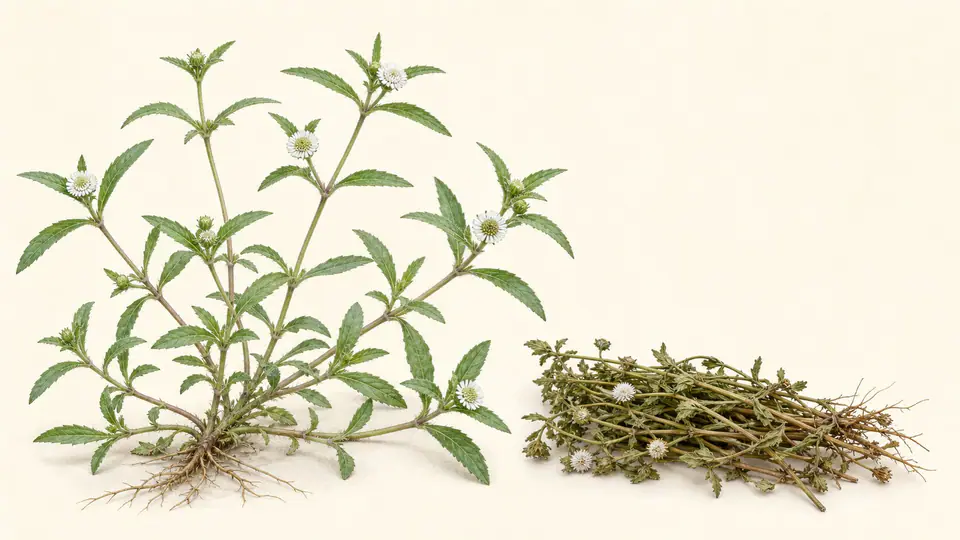
A plant that stains black when the stem is broken: Does this symbolism translate to human evidence?
Can I take Eupatorium japonicum (Hanryeoncho) or apply it to my scalp for gray hair, hair loss, or liver health? This question is asked repeatedly, but the answer is not simple. The observation that Eupatorium japonicum produces a black sap leads to an association with hair color, and when that association shifts toward hair loss or liver health products, one must first verify whether there is definitive evidence based on human subjects.
Then, what should be verified first between the symbolism of the plant and the evidence in humans?
What to look for first: Formulation and route of administration
The first thing to distinguish when discussing Eupatorium fortunei is the form of the product. Dried whole plant, powder, oral extracts, topical scalp products, and complex prescriptions all differ in their method of exposure and purpose. According to the definition based on the Standard Korean Medicine Terminology, Eupatorium fortunei is a medicinal herb made from the dried whole plant Eclipta prostratacollected in summer and autumn from the Asteraceae family. Muk-hanryeon is another name for the same medicinal herb. The important point here is that the medicinal unit is the whole plant, not just the flowers, leaves, or roots.
However, in the market, various forms appear under the name Eupatorium fortunei, such as extracts of only flowers and leaves, essential oils, isolated components like wedelolactone, and topical products for dyeing or the scalp. These are not the same as the oral use of the whole plant. In other words, the single name 'Eupatorium fortunei' covers different exposure routes and component concentrations, so the first question to ask is which specific product is being used.
The plant that turns black and the shift in its symbolism
When the stem of Eupatorium japonicum is broken, a black sap emerges. It is a natural shift in symbolism for this image to be linked to black hair, leading to expectations regarding hair color or hair loss. However, symbolism is different from experience. A 2021 literature review broadly summarized traditional uses, chemical components, and various biological activities, but it failed to present clinical trials that confirmed the treatment of hair loss, gray hair, or liver disease in humans. A 2019 literature review was also merely a document summarizing pharmacological possibilities; results from isolated components, cells, or animals cannot be generalized as the effects of oral whole-plant products.
In other words, the fact that Eupatorium fortunei turns black is an interesting botanical characteristic, but it is not evidence that this characteristic acts directly on human hair pigment or follicles.
The extent of research findings
The core of the activities related to the liver, hair, and inflammation listed in literature reviews consists of component, cell, and animal studies. For example, just because signals related to liver protection were observed in animal models does not mean it treats liver disease in humans. Similarly, just because a certain reaction appeared in topical scalp or dyeing products, it cannot be concluded that the same effect occurs through oral administration.
A recent acute oral toxicity evaluation of an active fraction derived from leaves was also merely a preclinical study using a rat arthritis model, not data for determining the long-term safe dose for humans. In this regard, Eupatorium fortunei is a raw material that shows potential, not one that has proven therapeutic effects for specific diseases.
Oral vs. topical, whole plant vs. isolated components
The whole plant of Eupatorium fortunei and isolated components such as wedelolactone are not the same. Oral extracts and topical scalp products also have different exposure routes. There is a large gap between the symbolism of a plant turning black and clinical effects on hair. The same distance exists between liver protection signals in animals and the treatment of liver disease in humans.
| Category | What is the difference? |
|---|---|
| Eupatorium fortunei whole plant | A traditional medicinal herb using the dried whole plant for oral or external use |
| Wedelolactone | Specific components isolated from the whole plant; not identical to the whole plant |
| Oral extract | Exposure absorbed through the gastrointestinal tract |
| Topical scalp products | Acts locally on the skin; requires different purposes and evidence than oral administration |
This table does not simply list forms, but summarizes the point that different evidence is required under the same name.
Precautions when taking or applying together
When using Eclipta prostrata with other medications or supplements, several factors must be checked first. There is a lack of human data regarding pregnancy, breastfeeding, children, long-term oral use, and drug interactions. If you have liver disease or are taking medication that may affect liver enzyme levels, it is necessary to consult a medical professional or pharmacist before using oral concentrates.
Additionally, if you have an allergy to the Asteraceae family or experience a rash, swelling, or difficulty breathing, stop use immediately; in severe cases, seek help from 119 or the emergency room. For sudden alopecia areata, scalp inflammation, general hair loss, or abnormal liver enzyme levels accompanied by fatigue or jaundice, prioritizing a cause evaluation is more important than self-testing the product.
Why Checking Your Individual Situation Comes First
Since the causes of hair loss and abnormal liver enzyme levels are diverse, the cause cannot be attributed to Eclipta prostrata alone. Before trying Eclipta prostrata products, you should first check whether the pattern of symptoms, current medications, and accompanying diseases have been evaluated.
These questions are not simple safety procedures, but a way to bridge the gap between expectations and evidence. Attempting to cover up symptoms without identifying the cause may delay necessary evaluations.
Not hiding the gaps in human evidence
Expectations for Eclipta prostrata are strongly formed by symbolism and traditional use. However, in a situation where clinical trial data on humans is lacking, concluding that it is effective is an act of filling the gap in evidence. This is precisely the limitation emphasized by both the 2021 and 2019 literature reviews. Research on isolated components, cells, and animals may suggest pharmacological possibilities, but they do not confirm the efficacy of oral use of the whole plant or specific products.
What then should be looked at? It is checking the exact formulation of the product, the route of administration, the manufacturing method, and the corresponding type and level of evidence.
Final Decision Criteria
The most realistic standard when considering Eclipta prostrata is to verify the exact formulation, route of administration, and the cause of hair loss or abnormal liver enzyme levels, rather than relying on associations between black juice and hair. An attitude of not hiding the gaps in human clinical data is necessary. First, determine whether it is the whole plant, powder, extract, scalp product, or a complex prescription; whether an evaluation of the cause of hair loss or liver enzyme levels has been performed; and whether there are pregnancies, breastfeeding, liver disease, allergies, or current medications.
Eclipta prostrata is a raw material with potential. However, that potential does not automatically translate into the effect of a specific product. Recognizing the symbolic power of the name while remembering that such power does not replace evidence is the final criterion for judgment.
References
- Eclipta prostrata entry based on the Standard Korean Medicine Terminology of the Society of Korean Medicine.
- Eclipta prostrata ethnomedicinal uses, constituents and biological activities review.
- Eclipta prostrata traditional uses, phytochemistry and pharmacology review.
- Eclipta prostrata active fraction and acute oral toxicity in a rat model.
This text explains the origin of the raw materials, the scope of research, and precautions before consumption. As this cannot replace individual diagnosis or treatment, please consult a medical professional if you are taking medication or if symptoms persist. If sudden and severe symptoms such as difficulty breathing or decreased consciousness occur after consumption, seek help from 119 or the emergency room.

Medical Staff Review
Director Choi Yeon-seung
Chief Director of Baekrokdam Korean Medicine ClinicEclipta prostrata Dictionary Entry, reviewed the safety of expressions and the scope of verification before administration.
Review scope: Ingredient origin, human studies, concomitant medications, safety of intake · Last reviewed 2026-08-17
- Graduated from Kyung Hee University College of Korean Medicine
- Providing Korean medicine treatment since 2010
- Consultations for Gongjindan, Gyeongokgo, Nokyong (Deer Antler) restorative medicine, and customized restorative herbal medicine