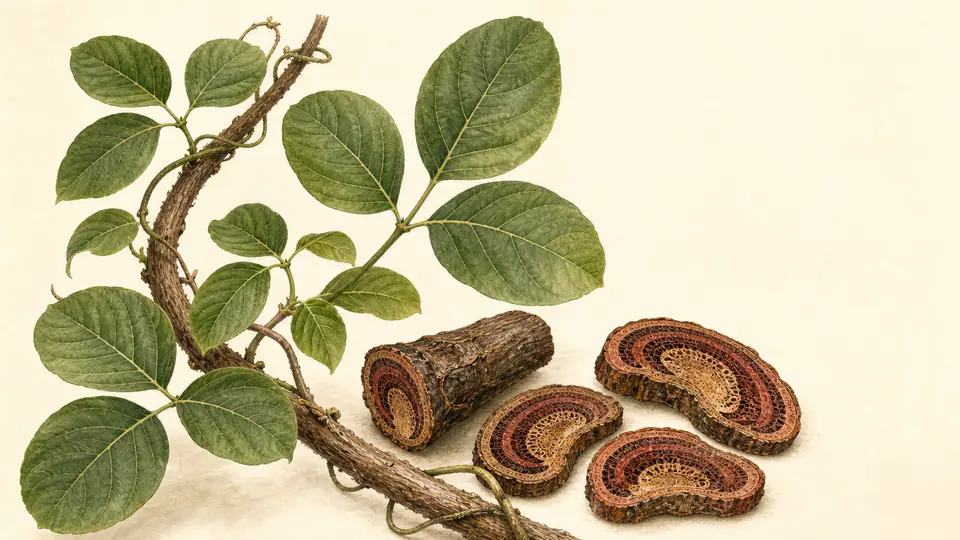
Red sap does not guarantee blood-boosting effects
Can I drink a decoction of Gye-hyeol-deung for anemia or irregular menstruation? In short, it is difficult to decide based solely on the red cross-section and the name.
While Gye-hyeol-deung is a plant traditionally used for blood and menstruation, human-based standalone clinical trials, pharmacokinetics, and toxicity studies are limited. The core judgment is that color and name are not evidence of efficacy.
Why is this question asked first?
Gye-hyeol-deung is a climbing stem that releases red sap when cut. Its color resembles blood, and its name is believed to derive from this red hue. Traditionally, it has been used for anemia and irregular menstruation, making it easy to perceive as a 'blood-boosting plant.' However, color or name is not evidence of physiological action. It is important to first recognize that a red cross-section cannot be interpreted as evidence of iron content or hematopoietic ability.
What exactly is Gye-hyeol-deung (Spatholobus suberectus)?
The National Institute of Food and Drug Safety Evaluation defines Gye-hyeol-deung as Spatholobus suberectus the climbing stem of Spatholobus suberectus. Since standards for heavy metals and pesticides have been established in addition to its morphology, it is clear that the stem of this plant is an officially handled raw material. The medicinal part is the stem, and the concentric rings and displaced pith of the cross-section serve as clues for species identification. Roots, leaves, flowers, or other vines that share the name of red sap are not the same raw material. Just because the names are similar, can we consider them the same plant, the same part, or subject to the same standards?
Reasons for the Expectations
A 2023 comprehensive review summarized 145 components and various preclinical activities of Gye-hyeol-deung. Another systematic review covered traditional uses for anemia and menstruation, along with approximately 243 components. Spatholobus Reviews on the genus also introduced limited data showing that no distinct toxicity was observed. Such research creates expectations. However, three things must be considered together. First, most studies are at the cellular, animal, or extract stage. Second, ADMET and toxicity studies are very scarce. Third, conclusions repeatedly state that more toxicity, pharmacokinetic, and quality research is needed. Preclinical activity cannot be directly translated into treatment effects for anemia or irregular menstruation in humans.
Different considerations for each product form
Raw materials, concentrated extracts, and isolated isoflavonoids are not the same raw material. Decocting the raw climbing stem is different from using concentrated extracts or products with isolated specific components in terms of composition and concentration. The standards of the National Institute of Food and Drug Safety Evaluation S. suberectus apply to the climbing stem. Concentrated products outside those standards may act differently, and human safety data is even more lacking. Therefore, the form of the product and the duration of intake are critical points of verification.
Precautions When Using Concurrently
Gye-hyeol-deung must not be used as a substitute for iron supplements, anticoagulants, antiplatelet agents, or chemotherapy. You must inform your medical team of your medication list before combined use. Those with a tendency to bleed or those taking blood-related medications should be especially cautious. If you experience symptoms such as shortness of breath, palpitations, feeling of fainting, severe pallor, black or bloody stools, or excessive menstruation, blood tests and bleeding evaluations must take priority over trying Gye-hyeol-deung.
Who should be more cautious?
In cases of pregnancy, breastfeeding, childhood, or liver and kidney disease, self-administration of concentrated products should be avoided due to insufficient human safety data. The same applies to long-term, high-dose intake. It is also dangerous to directly decoct raw red vines where species identification is unclear and heavy metal or pesticide testing has not been properly conducted. Safety standards can only be applied to verified species, parts, and tested raw materials.
The Gap Between Human Evidence and Expectations
Reports regarding cancer or viruses are also primarily at the cellular, animal, or extract stage. Translating this into treatment effects for human anemia or irregular menstruation is a leap in evidence. The traditional concept of blood deficiency (Hyeol-heo) and anemia diagnosed by medical tests are different frameworks. While traditional use can be an interesting starting point, using it for disease treatment without modern verification creates a gap between expectation and evidence.
Similar Names, Different Ingredients
Other red-sap vines may be distributed under the name Gye-hyeol-deung. One must distinguish between the Spatholobus suberectus stem and other red vines, between raw materials and isolated flavonoids, and between traditional blood deficiency and actual hematopoietic evidence. Just as a red cross-section is not evidence of iron or hematopoietic ability, a similar name does not mean it is the same raw material.
Criteria to Check Today
In other words, accurate species, stem type, formulation, blood tests, and the cause of bleeding must be verified before considering the red color and name. If considering Gye-hyeol-deung, check the following: S. suberectus Whether it is the climbing stem and not another plant distributed as Gye-hyeol-deung. Whether the cause of anemia, such as iron deficiency, bleeding, or chronic disease, has been tested, and whether you are taking iron supplements or anticoagulants. Whether you are pregnant or breastfeeding, and whether you plan to take raw material or concentrated extract, and for how long. If these three points are not resolved, the answer is 'unknown.'
References
- National Institute of Food and Drug Safety Evaluation Crude Drug Standard: Gye-hyeol-deung.
- Spatholobus suberectus vine stem comprehensive review.
- Spatholobi caulis systematic review.
- Genus Spatholobus pharmacology and toxicology review.
This text explains the origin of the raw materials, the scope of research, and precautions before consumption. As this cannot replace individual diagnosis or treatment, please consult a medical professional if you are taking medication or if symptoms persist. If sudden and severe symptoms such as difficulty breathing or decreased consciousness occur after consumption, seek help from 119 or the emergency room.

Medical Staff Review
Director Choi Yeon-seung
Chief Director of Baekrokdam Korean Medicine ClinicGye-hyeol-deung Dictionary Entry, reviewed the safety of expressions and the scope of verification before administration.
Review scope: Ingredient origin, human studies, concomitant medications, safety of intake · Last reviewed 2026-08-17
- Graduated from Kyung Hee University College of Korean Medicine
- Providing Korean medicine treatment since 2010
- Consultations for Gongjindan, Gyeongokgo, Nokyong (Deer Antler) restorative medicine, and customized restorative herbal medicine