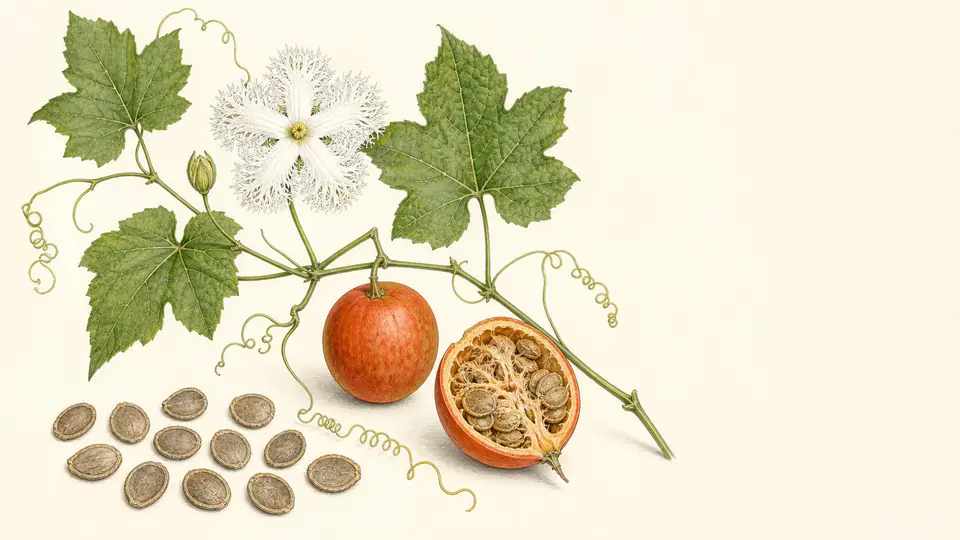
Flat seeds inside autumn fruit: Who is Gualuin?
Can I eat Gualuin like food for a cough or constipation? In short, there is insufficient reliable evidence from human studies to consider it as such. Gualuin is Trichosanthes kirilowii or Trichosanthes rosthorniia medicinal unit referring to the ripe seeds of the plant, not a food product for easily resolving coughs and constipation.
It is crucial to distinguish this gap. Under the name Gualuin, seeds, whole fruits, pericarps, roots, seed oils, and isolated proteins all appear. Each part differs in the components and dosages exposed, and animal tests or isolated component research do not guarantee the treatment of coughs or constipation in humans. Therefore, the first step in this discussion is to distinguish the names.
Why Gualuin comes to mind for coughs and constipation
Gualuin is an ingredient associated with traditional expectations for treating coughs and constipation. The flat, oily seeds inside the Trichosanthes fruit that ripen in autumn are linked to an image of 'moisturizing,' leading to expectations for cough relief and intestinal lubrication. However, these expectations are not derived from human clinical results of the seed alone. There is a tendency for considerations of the whole fruit, animal research, and isolated component research to be naturally transferred to the efficacy of the raw seed. High expectations often mean high confusion.
The identity of Gualuin: A name referring to a single seed
The English monograph of the Korean Pharmacopoeia defines Gualuin as Trichosanthes kirilowii or Trichosanthes rosthorniithe ripe seeds of the plant. In other words, Gualuin is not the whole fruit, nor is it the pericarp, the root, or the seed oil. The whole fruit is handled as a separate medicinal unit called Gualusil, the pericarp as Gualupi, and the root as Cheonhwabun. It is dangerous to view them as the same ingredient just because they come from the same plant. This is because the component composition and exposure amount change depending on the part used.
Differences in product form: Seed oil and isolated proteins
Research on proteins or oils isolated from the seed differs in composition and dosage from decocting the raw seed. Therefore, results from seed oil, defatted powder, or isolated proteins cannot be generalized as the efficacy or safety of the raw Gualuin seed. This is why you must first check whether a commercial product is the raw seed, oil, concentrated extract, or a capsule. The components and amounts vary by form, and the corresponding safety evaluations also differ.
| Category | Ingredient | Points to Note |
|---|---|---|
| Raw seed | Gualuin | Insufficient evidence for human clinical efficacy |
| Whole fruit | Gualusil | Cannot be transferred based on seed evidence alone |
| Pericarp | Trichosanthes fruit peel | Different parts/components from the seed |
| Root | Cheonhwabun | Same plant but a separate medicinal ingredient |
| Seed oil / isolated protein | Extracted or isolated form | Different dosage and composition from original seed decoction |
Between Animal Toxicity Tests and Human Safety
In 2026, toxicity evaluations for the seed test substance found no clear harmful signals in the Ames test, acute toxicity, 90-day repeated dose, or teratogenicity animal tests. However, these are only animal results for a specific test substance, not human clinical safety tests. Safety signals from animals do not confirm the long-term dosage for all commercial products. There is a difference between having positive safety signals and being able to take it routinely without concern.
Cough and Constipation: When to Prioritize Medical Evaluation
If you experience shortness of breath, chest pain, coughing up blood, high fever, or a persistent cough, prompt medical evaluation is the priority before considering Trichosanthes seeds. Severe abdominal pain, vomiting, simultaneous blockage of gas and stool, or bloody stools also require evaluation for bowel obstruction or other causes. These symptoms are beyond the scope of what Trichosanthes seeds can address. Attempting to soothe an unknown cough or constipation using only raw materials is a risky choice.
Pregnancy, Breastfeeding, and Allergy Considerations Along with Current Medications
There is a lack of human data regarding long-term high doses for pregnant women, breastfeeding women, and children. It is reasonable for those with gourd family seed allergies or a tendency toward diarrhea to avoid self-administration. Because Trichosanthes seeds are oil-rich materials, they may be burdensome to a sensitive digestive system. If you are taking other medications, it is necessary to consult a professional even when using this as a supplementary ingredient rather than a medication replacement.
Similar Names, Different Materials: Trichosanthes Seed vs. Cheonhwabun
Trichosanthes seeds and Cheonhwabun should not be viewed as the same product. Cheonhwabun is the root of the same plant. While there is research on the protein components of the root, those results cannot be extended to the safety or efficacy of the seed. If you choose a product based only on the name 'Trichosanthes' on a commercial label, it can be confusing whether it is the seed, the root, or a mixture. The first step is to accurately verify the name of the raw material.
Criteria to Check Today
What then should be verified? Rather than the general name 'Trichosanthes', a practical standard is to first distinguish between the seed, fruit, root, and oil, and then check for danger signals regarding coughs and constipation. When choosing a product, check whether it is the raw seed, oil, extract, or a mixture of other parts. If accompanied by shortness of breath, coughing up blood, high fever, bloody stools, or severe abdominal pain, postpone choosing raw materials and seek medical evaluation first. While expectations for Trichosanthes seeds began with traditional images and research on animals and isolated components, remember that there is a lack of independent human clinical evidence.
References
- Korean Pharmacopoeia English Monograph: Trichosanthes Seed.
- Trichosanthis Fructus review: part-boundary reference.
- Trichosanthes seed toxicological assessment in animals.
- Medicinal and edible seed safety systematic review.
This text explains the origin of the raw materials, the scope of research, and precautions before consumption. As this cannot replace individual diagnosis or treatment, please consult a medical professional if you are taking medication or if symptoms persist. If sudden and severe symptoms such as difficulty breathing or decreased consciousness occur after consumption, seek help from 119 or the emergency room.

Medical Staff Review
Director Choi Yeon-seung
Chief Director of Baekrokdam Korean Medicine ClinicTrichosanthes Seed Dictionary Entry, reviewed the safety of expressions and the scope of verification before administration.
Review scope: Ingredient origin, human studies, concomitant medications, safety of intake · Last reviewed 2026-08-17
- Graduated from Kyung Hee University College of Korean Medicine
- Providing Korean medicine treatment since 2010
- Consultations for Gongjindan, Gyeongokgo, Nokyong (Deer Antler) restorative medicine, and customized restorative herbal medicine