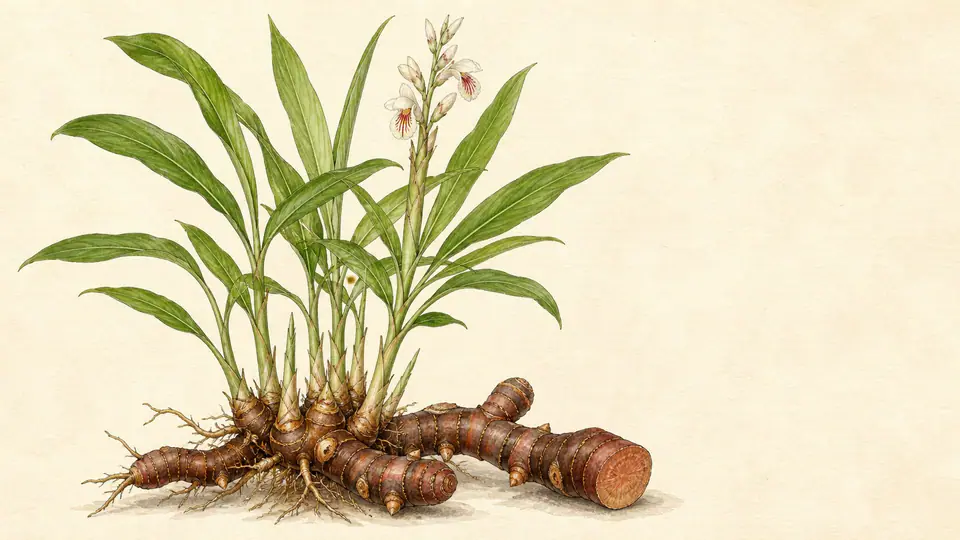
The Warm Name of a Small Rhizome
Can I drink galangal as a tea if my stomach feels cold and painful? In short, brewing a small amount as food is a different matter from arbitrarily adding concentrated extracts. While galangal is familiar as a spice, that familiarity cannot be directly translated into treatment or safety.
The name of this ingredient carries a warm and spicy feeling. Because of this name, people with a cold and painful stomach often seek a cup of tea. However, there is a gap between the comfort provided by the name and the actual evidence. The story begins in that gap.
Why This Question Is Repeated
Abdominal pain is a common signal that anyone can experience. The feeling of hot tea warming the stomach is immediate, making it easy to interpret that sensation as 'helpful.' Galangal is often mentioned in this context. However, repeated questions do not necessarily mean the answer is clear. Rather, it is a signal that there is a great need to distinguish the identity of the ingredient, the product form, and the consumption context.
Identity of Galangal: Rhizome of Alpinia officinarum
Galangal, as defined by the National Institute of Food and Drug Safety Evaluation, is the rhizome of Alpinia officinarum. The scientific name must come first because various ingredients are often mixed under the same name 'galangal.' Greater galangal (Alpinia galanga), common ginger, turmeric, food spices, essential oils, and concentrated extracts are not all the same ingredient. They differ in species, the part of the plant used, or the concentration. This distinction is not a simple academic issue, but a criterion for determining which research results can be applied to which product.
Reason for Expectations: Abundance of Preclinical Studies
A 2018 comprehensive review summarized over 90 components and various cellular and animal activities. A 2024 review covered 337 components and digestive, anti-inflammatory, and analgesic activities. Looking only at the numbers, galangal appears to be a treasure trove of active substances. However, both reviews point out the need for expanded clinical trials. It cannot be concluded that the possibilities observed in cells and animals act with the same magnitude in humans. A large amount of research means it is interesting, not that its efficacy has been proven.
Differences in Product Form: Tea, Powder, Essential Oil, Concentrated Extract
The ways of encountering galangal can be broadly categorized.
| Form | Characteristics | Points to Consider |
|---|---|---|
| Small food amounts / Tea | Levels familiar as a spice | Discontinue if symptoms worsen |
| Powder | Processed forms of the raw material | Dosage and quality may be inconsistent |
| Essential oil | High-concentration volatile components | Different parts or concentrations than the raw rhizome medicinal material |
| Concentrated extracts / Capsules | Concentrated active ingredients | First check for drug interactions and bleeding risks |
Using a small amount as food and taking concentrated extracts have different risk profiles, even if the raw material is the same. Essential oils are in a different form than the raw rhizome, and concentrated extracts may have stronger effects, as their name suggests.
When Consuming Together: Distance from Medications
Studies on the Alpinia genus have raised concerns regarding potential antiplatelet effects and drug interactions. However, the magnitude of human interactions for raw Lesser Galangal has not been established. Therefore, a precautionary distance is necessary. As a rule, concentrated extracts should not be added arbitrarily if you are taking anticoagulants, antiplatelet agents, or anti-inflammatory analgesics, or if you have a scheduled surgery. A 'natural ingredients' label does not exempt a product from drug interactions.
Individual circumstances and safety signals
If symptoms worsen due to spicy seasonings in cases of gastritis or reflux, use should be discontinued and the cause of recurrent abdominal pain must be evaluated. Since human safety data for long-term concentrated intake is lacking for pregnant women, breastfeeding women, and children, it is better to consult medical staff first. If you experience vomiting blood, black stools, persistent vomiting, severe upper abdominal pain, or jaundice, immediate medical evaluation takes priority over drinking tea. These signals reaffirm that Lesser Galangal does not diagnose or treat abdominal pain of unknown origin, gastric ulcers, or gallbladder and pancreatic diseases.
The Gap Between Human Evidence and Expectations
Possibilities regarding digestion, pain, and inflammation were primarily observed in cell and animal studies. Systematic clinical trials in humans are lacking. What then should be looked at? One must look at the stage of the research. Cell and animal studies only provide clues for designing the next stage of research; they are not the basis for making dosage recommendations. Expectations for Lesser Galangal must transparently reveal this difference in stages.
Differences from similar raw materials
Lesser Galangal is often compared to Greater Galangal, common ginger, and turmeric. While all belong to the spicy category, they differ in species, part used, and primary context of use. Raw rhizomes also differ in concentration and purpose of use from essential oils and concentrated extracts. The gap between preclinical signals for digestion and pain and actual human treatment applies commonly to all these materials. Similarity in name does not mean they are interchangeable.
Criteria to Check Today
Do not interpret the sensation of warmth and spiciness as a therapeutic effect; first verify the species, product form, the cause of abdominal pain, and the risk of bleeding. A cup of Lesser Galangal tea may provide comfort, but it is not the answer to recurrent or severe abdominal pain. In particular, if you are taking medication or awaiting surgery, do not arbitrarily add concentrated extracts. Remembering the cold steps of judgment as much as the warmth of the name is the proper way to approach this material.
References
- National Institute of Food and Drug Safety Evaluation Herbal Medicine Standards: Lesser Galangal.
- Alpinia officinarum ethnomedicine and pharmacology review.
- Alpinia officinarum comprehensive review.
- Alpinia anti-inflammatory and interaction review.
This text explains the origin of the raw materials, the scope of research, and precautions before consumption. As this cannot replace individual diagnosis or treatment, please consult a medical professional if you are taking medication or if symptoms persist. If sudden and severe symptoms such as difficulty breathing or decreased consciousness occur after consumption, seek help from 119 or the emergency room.

Medical Staff Review
Director Choi Yeon-seung
Chief Director of Baekrokdam Korean Medicine ClinicLesser Galangal Dictionary Entry, reviewed the safety of expressions and the scope of verification before administration.
Review scope: Ingredient origin, human studies, concomitant medications, safety of intake · Last reviewed 2026-08-17
- Graduated from Kyung Hee University College of Korean Medicine
- Providing Korean medicine treatment since 2010
- Consultations for Gongjindan, Gyeongokgo, Nokyong (Deer Antler) restorative medicine, and customized restorative herbal medicine