A name attached to a rock, the distance to human clinical trials
I've been told my bones are weak; would taking Golsaebo help with bone density or fracture recovery? In short, while Golsaebo is an ingredient that provides interesting signals regarding bone density, there is still insufficient human clinical evidence to prove it as a replacement for fracture prevention or treatment. If so, what should be checked before looking at the name?
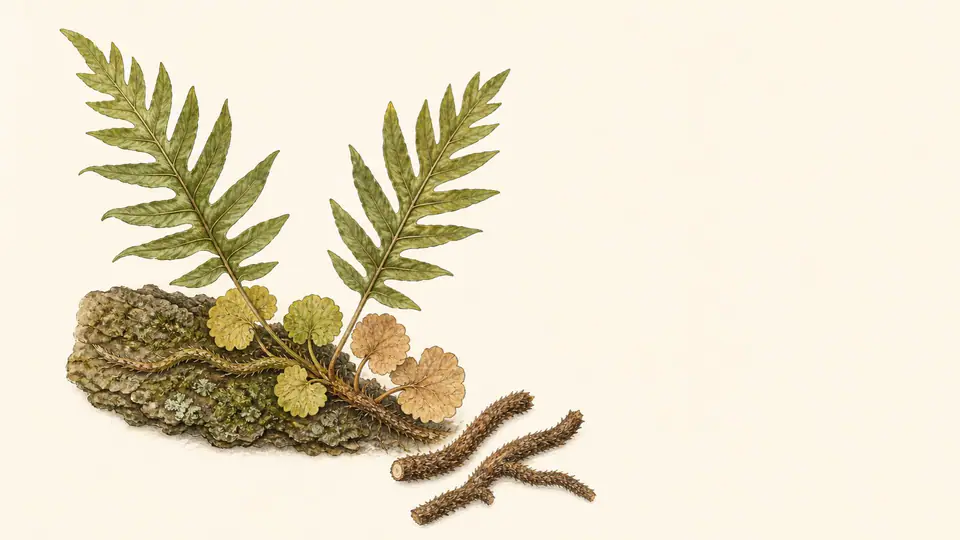
Golsaebo is the dried rhizome of the fern Drynaria fortuneiDrynaria fortunei of the Polypodiaceae family. Items based on the Standard Korean Medicine Terminology follow this definition. Leaves, scales, ornamental ferns, total flavonoids or specific extracts, and complexes with other medicinal herbs are not considered the same medicinal unit. In other words, when referring to Golsaebo, it must specifically refer to the dried rhizome of Drynaria fortunei.
The name makes a promise first
The name 'Golsaebo' carries the meaning of 'connecting broken bones.' This name has left a strong image of traditional use for bone and skeletal health. However, the meaning of a name does not immediately translate into efficacy in the human body. It is essential to distinguish this gap.
The medicinal part is not the leaf
The medicinal part of Golsaebo is the dried rhizome, not the leaf. This is the first distinction to verify when selecting the ingredient. While common names like 'four-line fern' or ornamental ferns may belong to the same family, the medicinal unit as Golsaebo is limited to the rhizome of Drynaria fortuneiDrynaria fortunei. If this point is overlooked when checking product labels or ingredient names, a completely different part or species may be mistaken for Golsaebo.
Reasons for expectation: Flavonoids and preclinical studies
A 2025 comprehensive literature review summarized over 60 flavonoids and various preclinical activities in Golsaebo. In cell and animal experiments, changes in bone formation signals and related indicators were reported. These results are why expectations for bone density and bone health are encouraged. However, preclinical results do not equate to actual fracture reduction or treatment replacement. There is a clear distance between possibility and proof.
Human studies are still small and limited
In a randomized trial of 80 women with postmenopausal osteoporosis and hyperlipidemia, changes in bone density and lipid indicators were reported. However, the study scale and subjects were limited, and it is not a trial that proved fracture prevention. Therefore, it is difficult to generalize these results to all postmenopausal women or general osteoporosis patients.
Another 12-week randomized double-blind study in healthy adults evaluated a complex of Acanthopanax gracilistylus leaf and Golsaebo rhizome water extract. In this case, the cognitive effect of Golsaebo alone cannot be isolated. That is, this study does not demonstrate the effect of Golsaebo itself.
Medicinal units vary by product form
Raw rhizomes, total flavonoids, water extracts, and complex products with other medicinal herbs must all be treated as different forms. As noted in the literature review, more rigorous research is needed because the active substance basis and quality control standards are insufficient. Therefore, when choosing a product, it is important to check the label to see what form the ingredient is in and which part it was extracted from. Even under the same name 'Golsaebo,' the actual contents can differ significantly.
Please notify your provider when taking this with other medications or supplements
You must not arbitrarily reduce or replace osteoporosis medications, calcium, or vitamin D. It is necessary to inform your medical staff or pharmacist when using Golsaebo products concurrently. In particular, there is insufficient data regarding human safety and drug interactions for pregnant or breastfeeding women, children, and long-term concentrated use. You should first verify your current medications, supplements, and whether you have liver or kidney disease.
In certain situations, emergency evaluation takes priority over the ingredient
If a fracture is suspected or if there is sudden severe pain, deformity, or inability to walk, priority should be given to imaging tests and emergency evaluation rather than seeking herbal ingredients. Additionally, if serious warning signs such as rash, difficulty breathing, persistent vomiting, or jaundice appear, stop use immediately and seek evaluation. These safety standards apply to any ingredient, including Golsaebo.
Distinguish between similar names and different ingredients
There are three common confusions when discussing Golsaebo. First is the difference between the rhizome of Drynaria fortunei and the common name for the fern. Second is the difference between the raw material and total flavonoid extracts. Third is the difference between Golsaebo as a single agent and complexes containing Acanthopanax sessiliflorus. Finally, changes in bone density indicators are not the same as actual fracture prevention. By clarifying these four distinctions, you can look at the actual evidence rather than the certainty suggested by the name.
Criteria to Check Today
If you are considering Golsaebo, first verify the species, part used, and extraction method. Next, check your bone density test results, whether you have had fractures, your current standard treatment, and your calcium and vitamin D intake. Finally, consult a medical provider or pharmacist regarding pregnancy, breastfeeding, pediatric status, liver or kidney disease, and any medications or supplements you are taking. The realistic standard for viewing this ingredient is to first verify accurate ingredient information and bone density/fracture risk evaluation rather than the name implying 'joining bones,' and to ensure it does not replace standard osteoporosis treatment.
References
- Golsaebo entry based on the Standard Korean Medicine Terminology of the Society of Korean Medicine.
- Drynariae rhizoma botany, flavonoids and quality-control review.
- Drynaria fortunei in postmenopausal osteoporosis with hyperlipemia: randomized trial.
- Eleutherococcus-Drynaria combined extract and cognition: randomized trial.
This text explains the origin of the raw materials, the scope of research, and precautions before consumption. As this cannot replace individual diagnosis or treatment, please consult a medical professional if you are taking medication or if symptoms persist. If sudden and severe symptoms such as difficulty breathing or decreased consciousness occur after consumption, seek help from 119 or the emergency room.

Medical Staff Review
Director Choi Yeon-seung
Chief Director of Baekrokdam Korean Medicine ClinicGolsaebo Dictionary Entry, reviewed the safety of expressions and the scope of verification before administration.
Review scope: Ingredient origin, human studies, concomitant medications, safety of intake · Last reviewed 2026-08-17
- Graduated from Kyung Hee University College of Korean Medicine
- Providing Korean medicine treatment since 2010
- Consultations for Gongjindan, Gyeongokgo, Nokyong (Deer Antler) restorative medicine, and customized restorative herbal medicine