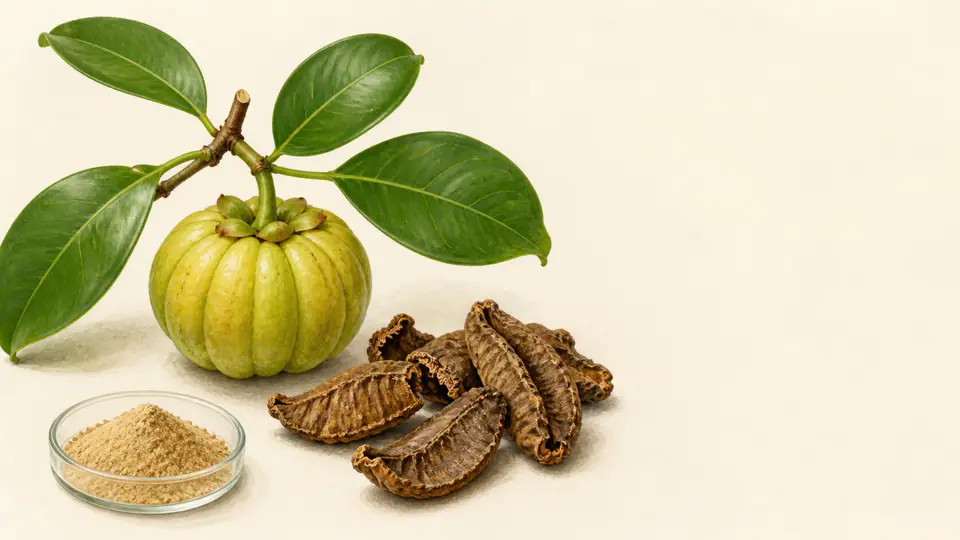
Garcinia: From fruit peel to capsules, and the signals of liver damage on the scale
Does Garcinia, which is said to reduce appetite and body fat, actually lead to weight loss? Is it safe to take despite reports of liver damage?
Simply put, human studies show signals of slightly more weight loss, but the difference is small and inconsistent. Since rare cases of severe liver damage have been reported, it is not an ingredient to be taken carelessly. The story of this ingredient begins with expectations and caution sitting on the same scale.
How a sour taste from South Asia became a diet ingredient
Garcinia is a fruit that has long been used in South Asia for adding sourness to food and for preservation. In particular, the peel of Garcinia gummi-gutta contains hydroxycitric acid, commonly referred to as HCA. As the mechanism was revealed that this component inhibits citrate lyase, an enzyme involved in fat synthesis, the fruit peel was transformed into concentrated extracts and capsules. Animal experiments have shown changes in appetite and weight. However, the mechanism in animals is not the same as weight loss in humans. This is why we must look more accurately at the reality of the ingredient the moment expectations grow.
How do raw materials with similar names differ?
The name 'Garcinia' is used quite broadly in the market. It is often distributed under the scientific name Garcinia gummi-gutta and is also given the alias 'Garcinia Cambogia'. However, what is actually contained under the same name could be a single extract, HCA in the form of calcium or potassium salts, or a multi-component product mixed with caffeine, green tea, or other weight loss ingredients. Based on the name alone, it is impossible to know the form, the daily amount of HCA, or what other ingredients are present. Therefore, when discussing Garcinia, one must first ask, 'What kind of Garcinia is this?'
Using the fruit in food is different from taking capsules on an empty stomach
Using the fruit or peel as a food ingredient is not the same exposure as repeatedly taking capsules of an extract with a calibrated HCA ratio. In food, small amounts enter the body along with various nutrients, whereas in capsules, a specific concentrated component enters the body at regular intervals. In particular, when taken on an empty stomach or mixed with other stimulating ingredients, the possibility of gastrointestinal discomfort or other reactions changes. If Garcinia is thought of only as a 'natural food,' this difference is easily missed. Raw materials and extracts, as well as single-component and multi-component products, must each undergo different safety evaluations.
What Do Human Studies Show?
Human studies summarized by the NCCIH and NIH ODS state that weight loss results are mixed. In one 12-week trial, approximately 1.3 kg more was lost than with a placebo along with a low-calorie diet, but in another trial of 135 people, no significant additional weight loss was found with a high-fiber, low-calorie diet. Meta-analyses of randomized trials report signals of a small decrease in average weight, but because the study periods are short, the studies are heterogeneous, and there are publication biases and product differences, long-term weight maintenance or disease outcomes cannot be concluded. In other words, it is difficult to confirm that Garcinia produces meaningful weight loss. Without separating the differences in diet and products, it is difficult to properly interpret even small effects or a lack of effect.
How should we view the reports of liver damage?
The NCCIH explains that several cases of liver damage, some of which were severe, have been reported in users of Garcinia products, although these are rare. Since many of these occurred with multi-component products containing various ingredients, it is difficult to pinpoint Garcinia alone as the cause. However, there are cases reported even with single-component Garcinia products, so the warning signs cannot be ignored. Long-term safety is also unknown. If jaundice, dark urine, gray stools, pain in the upper right abdomen, severe fatigue, or persistent vomiting occur during use, stop immediately and receive a liver damage evaluation. If decreased consciousness, seizures, high fever, or severe jaundice appear, seek help from 119 or the emergency room, and bring the product container and the full ingredient list.
The interaction with mental health medications must not be overlooked
Plant-based diet products should not be viewed as unrelated to mental health. There are reports of toxicity and cases of mania after taking Garcinia products together with serotonin-related medications. While incidence rates or causality cannot be confirmed by case reports alone, if you are taking serotonin-related medications such as antidepressants, do not combine them arbitrarily and consult your prescribing healthcare provider first. If agitation, tremors, sweating, diarrhea, high fever, confusion, or excessive energy with almost no sleep occurs, seek prompt medical evaluation. If you have liver disease or are taking medications that affect the liver, avoid arbitrary use and inform your healthcare provider of all product ingredients before starting.
Why should it be avoided during pregnancy and breastfeeding?
There is insufficient safety data for Garcinia during pregnancy and breastfeeding. Furthermore, using it for the purpose of weight loss is not appropriate during this period. Therefore, the principle is to avoid it during this time. When safety has not been confirmed, it is more reasonable to consider other options first when attempting weight control.
Three questions to check before choosing
Then, what should you look for? First, check whether the product is Garcinia gummi-gutta fruit or an extract, the daily amount of HCA and whether it is in calcium or potassium salt form, and what other weight loss ingredients are present. Second, check how many weeks you plan to use it along with diet and exercise, and whether you have an expected weight loss goal and criteria for discontinuation. Third, consult a healthcare provider regarding any history of liver disease, pregnancy, breastfeeding, or bipolar disorder, or if you are taking antidepressants, serotonin-related medications, or medications that affect the liver. Without going through these three steps, a judgment cannot be made based on the name 'Garcinia' alone.
The criteria change when comparing with similar ingredients
Four axes are useful for comparison: the difference between fruit/peel foods and standardized HCA extracts, the difference between single Garcinia and multi-ingredient diet products, the difference between animal mechanisms/appetite surveys and human weight/waist circumference results, and the difference between short-term weight loss trials and cases of liver damage or mania. This comparison is used not to determine 'which ingredient is better,' but to distinguish 'what kind of evidence is being viewed.' The more an ingredient is hyped, the more necessary it is to develop a habit of distinguishing the type and limitations of the evidence.
Final Decision Criteria
Rather than focusing on phrases like 'blocking fat synthesis,' first check the exact HCA content, complex ingredients, liver and mental health, and any medications you are currently taking. A realistic approach to this ingredient is to weigh a few weeks of small, inconsistent weight loss signals against rare but serious risks. Please decide your next steps while remembering that Garcinia is not just a simple diet supplement, but an ingredient where expectations and safety concerns coexist.
References
- NCCIH: Garcinia cambogia usefulness and safety.
- NIH ODS: Dietary supplements for weight loss.
- Garcinia cambogia and obesity indices: systematic review and dose-response meta-analysis.
- Garcinia extract for weight loss: systematic review and meta-analysis.
This text explains the origin of the raw materials, the scope of research, and precautions before consumption. As this cannot replace individual diagnosis or treatment, please consult a medical professional if you are taking medication or if symptoms persist. If sudden and severe symptoms such as difficulty breathing or decreased consciousness occur after consumption, seek help from 119 or the emergency room.

Medical Staff Review
Director Choi Yeon-seung
Chief Director of Baekrokdam Korean Medicine ClinicGarcinia Dictionary Entry, reviewed the safety of expressions and the scope of verification before administration.
Review scope: Ingredient origin, human studies, concomitant medications, safety of intake · Last reviewed 2026-08-17
- Graduated from Kyung Hee University College of Korean Medicine
- Providing Korean medicine treatment since 2010
- Consultations for Gongjindan, Gyeongokgo, Nokyong (Deer Antler) restorative medicine, and customized restorative herbal medicine