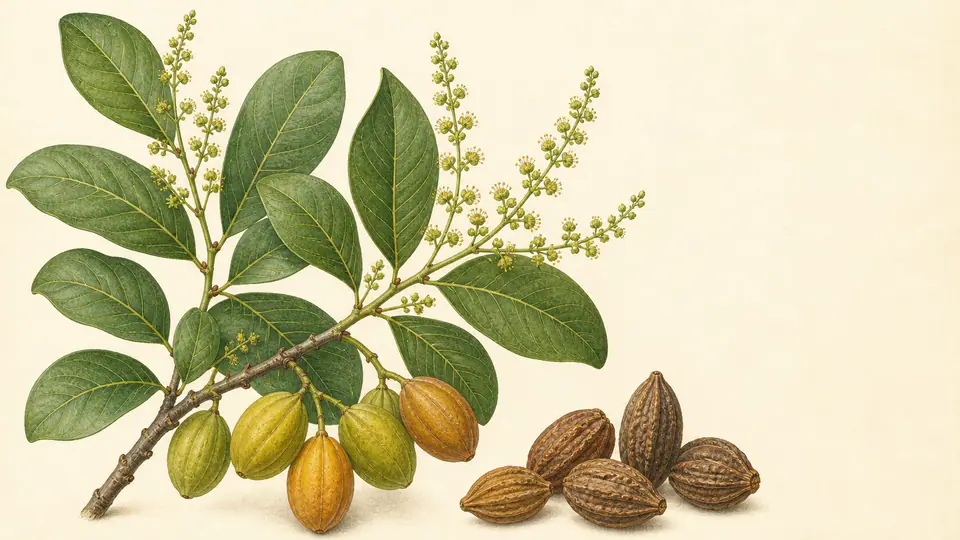
A sweet taste remaining after astringency; you must first identify the identity of that fruit
Is it okay to consume astringent Haritaki (Gaja) fruit, which is said to be good for the throat or intestines, as a tea or powder for a long time?
To answer briefly, it is difficult to conclude whether long-term intake is appropriate if you do not know which species, which part, and how the product you are currently taking was processed. Contrary to the impression of being an astringent fruit followed by a sweet taste, various raw materials and products are mixed under the single name 'Gaja', so the identity must be verified first.
Which species and which fruit is it?
What the domestic pharmacopoeia recognizes as Gaja is Terminalia chebula Retzins, or its pubescent variety Terminalia chebula Retzins var. tomentella only the ripe fruit of Kurt. Unless the scientific name is clearly stated, it is difficult to consider it the same raw material. Seeds only, pulp only, Gaja-yuk processed products, Belleric Gaja Terminalia bellirica, and Triphala complexes mixing three raw materials are not the same raw material. Standardized tannin extracts are also different products from the raw fruit. Among those called Gaja, the evidence we will review is limited to the entire ripe fruit.
Why there are high expectations for the astringent fruit followed by a sweet taste
A 2024 comprehensive review summarized approximately 149 components and various preclinical activities in Gaja fruit. This is the background for expectations such as antioxidant, anti-inflammatory, and antibacterial effects. However, this review simultaneously points out significant gaps in pharmacokinetics, mechanism of action, and safety. The fact that the range of components and cell/animal experiments is wide does not mean the same effects have been proven in humans. This is where the source of expectation and the level of proof must be distinguished.
Human studies are limited to specific extracts
A trial of 110 people with hyperuricemia and a joint trial of 105 overweight adults are often cited. However, both trials targeted specific trademarked and standardized water-soluble extracts. The hyperuricemia trial evaluated 500 milligrams twice a day for 24 weeks, which is not evidence for Gaja tea or an alternative to gout treatment. The joint trial is also a study on a specific extract evaluating discomfort during activity, so it cannot be applied directly to general raw materials or arthritis treatment. In other words, these clinical trials cannot be repurposed as evidence for treating diarrhea, cough, or voice issues with Gaja tea.
The gap between raw materials, extracts, concentrates, and complexes
The first thing to ask when encountering Gaja is the product form. Is it a fruit decoction, powder, Gaja-yuk, or a standardized extract with a fixed tannin content? Each form is not the same raw material. Even if a short-term rat toxicity test of a specific ethanol extract fraction showed no distinct toxicity, this does not guarantee the safety of all products or long-term intake of raw materials by humans. Particular caution is needed when taking astringent powder in high doses for a long period.
| Category | Key Question |
|---|---|
| Species | Is it the ripe fruit of T. chebula or pubescent Gaja? |
| Part | Is it the whole fruit, or are the Gaja-yuk and seeds separated? |
| Form | Is it a raw material decoction/powder, or a standardized tannin extract? |
| Whether it is a complex | Is it a single ingredient, or a mixture of Triphala/T. bellirica? |
When taking with other medications
If you are taking prescription medications such as diabetes medication, uric acid-lowering agents, or anticoagulants, the general rule is not to add Haritaki (Terminalia chebula) or replace your medication based solely on research regarding specific extracts. There is insufficient data on long-term safety, high-concentration safety, and interactions for pregnant or breastfeeding women, children, and those with liver or kidney disease. The important point here is the fact that 'data is insufficient.' This also means there is no evidence to conclude that safety has been proven.
Listen to your body's signals first
Discontinue use if you experience abdominal pain, severe constipation, or persistent diarrhea. If bloody stools, black stools, high fever, severe dehydration, persistent hoarseness, difficulty swallowing, or weight loss occur, a cause evaluation takes priority over trying to consume more Haritaki. These symptoms often signal other problems rather than being related to Haritaki. It is necessary to follow the sequence of identifying why such a condition occurred before increasing supplement intake.
Similar names, different ingredients
A common confusion when choosing Haritaki involves ingredients with similar names. Haritaki and Belleric Myrobalan (T. bellirica) are different species. Single Haritaki and Triphala complexes are different products. The whole fruit, the pulp, and the seed are different parts, and raw decoctions are different forms from standardized tannin extracts. These distinctions are not mere taxonomic differences, but refer to product groups with different evidence and different safety profiles.
Criteria to Check Today
Check the exact Terminalia species, part used, extraction specifications, and the cause of your symptoms rather than relying on the astringent taste or clinical numbers on the product. The key to selecting this ingredient is not to generalize research on a specific extract to the efficacy of Haritaki tea as a whole. So, what should you look for? Start by checking the product label to see if it is the ripe fruit of T. chebula or Terminalia chebula var. chebula, and whether it is not Haritaki pulp or Triphala; if it is a standardized extract, check the specifications. You must also consider your current medications and symptoms to determine whether long-term use is appropriate.
References
- Ministry of Food and Drug Safety Korean Pharmacopoeia: Haritaki.
- Terminalia chebula fruit comprehensive review.
- Terminalia chebula standardized extract in hyperuricemia.
- Terminalia chebula standardized extract joint trial.
- Terminalia chebula mutagenicity and oral toxicity study.
This text explains the origin of the raw materials, the scope of research, and precautions before consumption. As this cannot replace individual diagnosis or treatment, please consult a medical professional if you are taking medication or if symptoms persist. If sudden and severe symptoms such as difficulty breathing or decreased consciousness occur after consumption, seek help from 119 or the emergency room.

Medical Staff Review
Director Choi Yeon-seung
Chief Director of Baekrokdam Korean Medicine ClinicHaritaki Dictionary Entry, reviewed the safety of expressions and the scope of verification before administration.
Review scope: Ingredient origin, human studies, concomitant medications, safety of intake · Last reviewed 2026-08-17
- Graduated from Kyung Hee University College of Korean Medicine
- Providing Korean medicine treatment since 2010
- Consultations for Gongjindan, Gyeongokgo, Nokyong (Deer Antler) restorative medicine, and customized restorative herbal medicine