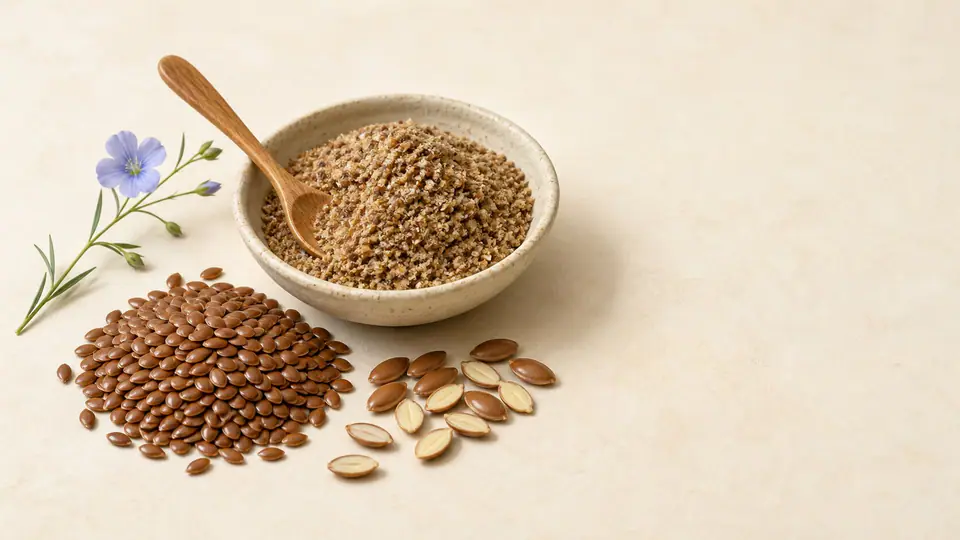
How a seed used for weaving fabric became a spoonful of 'superfood'
"I am planning to eat ground flaxseeds for cholesterol or constipation; can I replace them with flaxseed oil capsules?"
In short, flaxseed oil capsules have a different nutrient composition than whole or ground seeds. If you are expecting benefits for constipation or cholesterol, they are not easily replaceable. So, what remains and what is removed the moment the seeds are pressed? That difference becomes the criterion for choosing a product.
Flax is a plant that has long been used to weave linen from its fibers, as well as for its seeds and oil. Today, those seeds are often referred to as symbols of 'plant-based omega-3' or 'women's health.' However, under the name 'flaxseed,' there are various forms, whole seeds, ground seeds, mucilage powder that absorbs water, lignan extracts, and flaxseed oil, and each differs in the amount and absorption of fiber, lignans, and ALA, as well as in storage methods. A single name can obscure these distinctions.
What is flaxseed: Seeds, oil, and their names
Flaxseed is the seed of a plant Linum usitatissimumin the Linaceae family. It is also called flaxseed or linseed. Whole seeds, ground seeds, mucilage powder, lignan extracts, and flaxseed oil all come from the same plant, but they differ in their content and absorption of fiber, lignans, and alpha-linolenic acid (ALA), as well as their storage methods. In particular, while flaxseed oil contains ALA, it does not preserve the fiber and lignans found in whole or ground seeds.
Plant-based ALA is not the same fatty acid as the EPA and DHA found in fish. The mere fact that it contains ALA does not mean it will produce the same blood changes or clinical effects as the EPA and DHA in fish oil. This distinction is the first thing to consider when choosing flaxseed products.
Why flaxseed is promising: Fiber, Lignans, and ALA
Interest in flaxseed is largely driven by three components: fiber, lignans, and ALA. Whole or ground seeds are forms that provide all three. In contrast, while flaxseed oil contains ALA, fiber and lignans do not remain in the oil. Therefore, it is difficult to expect the same effects simply under the name 'flaxseed.'
Here, a single term obscures the issue again. The phrase 'plant-based omega-3' brings ALA to mind, but it does not mean it performs the same role as EPA and DHA. Although ALA and EPA/DHA are in the same family, they follow different pathways in the body.
Different results by formulation: Whole seeds, ground seeds, mucilage, lignans, and oil
The components provided by flaxseed products vary depending on their form.
| Form | Main Components Provided | Considerations for Selection |
|---|---|---|
| Whole seeds | Contains fiber, lignans, and ALA | May pass through the system undigested due to the hard shell |
| Ground seeds | Increased exposure to fiber, lignans, and ALA | Grinding state and storage period affect rancidity management |
| Mucilage powder | Centered on fiber that increases volume by absorbing water | Must be consumed with sufficient water |
| Lignan extract | Concentrated lignans | Other components are removed |
| Flaxseed oil | Centered on ALA | Almost no fiber or lignans |
In lipid research, there were signals that whole flaxseeds and some lignan preparations slightly lowered total and LDL cholesterol, but flaxseed oil did not show the same effect. A meta-analysis of 2,427 people across 33 trials found that various flaxseed preparations lowered systolic and diastolic blood pressure by an average of approximately 3 and 2.6 mmHg, but there was very high heterogeneity between studies. These figures do not provide a basis for replacing blood pressure medication.
In trials of specific flaxseed mucilage powder for overweight or obese adults, there were signals of weight loss, but lignan extracts and oil did not show the same results. Even with the same raw material, the specific form determines the outcome.
Quality and Limitations of Human Studies: Points Summarized by NCCIH
The NCCIH summarizes that the quality of human studies on flaxseed and flaxseed oil varies, and results differ depending on the health objective. The answer changes based on the purpose, the formulation, the dosage, and the duration of consumption. Therefore, it is difficult to group various formulations into a single sentence stating that 'flaxseed is good for ~'.
A large number of studies does not necessarily mean the effect is proven. Even in meta-analyses, heterogeneity is high, and small changes in surrogate markers do not directly translate to a reduction in cardiovascular events. There is a gap between surrogate markers, such as bowel movements, lipids, and blood pressure, and actual disease events.
For Safe Consumption: Water, Medical History, Medication, Pregnancy and Breastfeeding
While flaxseed is used as food, caution is required for concentrated products or specific forms.
Raw or under-ripe immature flaxseeds are not consumed as they may contain potentially toxic compounds. Seeds high in fiber or mucilage must be taken with sufficient water; those with a history of dysphagia, intestinal stenosis, or bowel obstruction should not use them arbitrarily. Large amounts may cause abdominal bloating, satiety, or diarrhea, so it is recommended to start with a small amount to monitor the reaction.
Since potential interactions with medications such as anticoagulants and antiplatelet agents have been raised, please consult a professional before starting concentrated products if you are taking such medications. Due to safety concerns during pregnancy and a lack of data during breastfeeding, supplement doses exceeding normal food amounts should not be used arbitrarily.
Choosing Complementary Supplements and Medications: What to Ask First
When choosing a flaxseed product, it is recommended to first check three things. First, whether it is whole seeds, freshly ground seeds, mucilage, lignan extract, or oil. Second, the purpose of consumption, whether it is for constipation, cholesterol, blood pressure, weight, or menopause. Third, whether you can drink sufficient water, and if you have a history of dysphagia or bowel obstruction, are pregnant or breastfeeding, or are taking anticoagulants or antiplatelet agents.
Only when these three factors are aligned can you realistically determine if 'this product is right for me'.
Differences from Similar Ingredients: ALA vs. EPA and DHA
Although ALA in flaxseed oil and EPA/DHA in fish oil both belong to the 'Omega-3' family, they are different fatty acids. The presence of ALA does not mean it produces the same blood-level changes or clinical effects as EPA and DHA. Therefore, if you attempt to replace fish oil based solely on the name 'plant-based Omega-3,' the results may not meet your expectations.
Realistic criteria to check today
When choosing flaxseed, rather than looking for labels like 'plant-based Omega-3' or 'women's superfood,' first identify which specific component you need: fiber, lignans, or ALA. Then, compare the formulation, actual dosage, water intake requirements, storage methods, small changes in surrogate markers, and the differences in medication replacement.
In other words, flaxseed oil capsules may be considered when targeting ALA, but if you are focusing on constipation or cholesterol, they are a different starting point compared to whole seeds, ground seeds, or mucilage forms. Even if the name is the same, the contained ingredients and research results differ. Recognizing these differences is the way to choose this ingredient wisely.
References
- NCCIH: Flaxseed and flaxseed oil usefulness and safety.
- NCCIH: Flaxseed products and cholesterol.
- Flaxseed and blood pressure: dose-response meta-analysis of 33 trials.
- Flaxseed interventions and blood lipids: meta-analysis.
This text explains the origin of the raw materials, the scope of research, and precautions before consumption. As this cannot replace individual diagnosis or treatment, please consult a medical professional if you are taking medication or if symptoms persist. If sudden and severe symptoms such as difficulty breathing or decreased consciousness occur after consumption, seek help from 119 or the emergency room.

Medical Staff Review
Director Choi Yeon-seung
Chief Director of Baekrokdam Korean Medicine ClinicFlaxseed Glossary, reviewed the safety of expressions and the scope of verification before administration.
Review scope: Ingredient origin, human studies, concomitant medications, safety of intake · Last reviewed 2026-08-17
- Graduated from Kyung Hee University College of Korean Medicine
- Providing Korean medicine treatment since 2010
- Consultations for Gongjindan, Gyeongokgo, Nokyong (Deer Antler) restorative medicine, and customized restorative herbal medicine