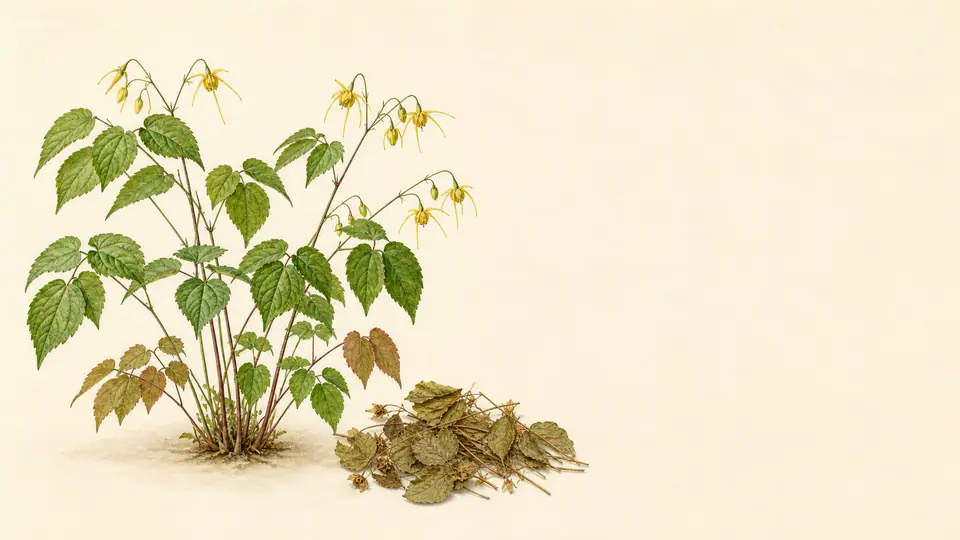
A Medicinal Herb with One Name but Many Faces
Can I take Epimedium or icariin products for sexual function or bone health? The short answer is that you must first verify exactly what product you are intending to take. Even if the name is the same, the contents may differ, and if the contents differ, the supporting evidence also differs.
Epimedium is often simplified as 'Epimedium = icariin = sexual function.' However, according to standard terminology, Epimedium is not a single component, but Epimedium koreanum, Epimedium brevicornum, Epimedium pubescens, Epimedium wushanense, Epimedium sagittatuma medicinal herb made from the dried aerial parts of the plant during summer and autumn. From this point, the question is already complex. Products using only the leaves of a specific species, herbs processed via Yang-ji (traditional processing), total flavonoid extracts, and isolated components such as icariin or icarietin are all grouped under the name 'Epimedium,' but their components and evidence are not the same.
If so, to what extent can we read research conducted under the same name together?
The Identity of Epimedium: Not Just One Species of Leaf
Based on the domestic Standard Korean Medicine Terminology, Epimedium is defined as the aerial parts of E. koreanum, E. brevicornum, E. pubescens, E. wushanense, and E. sagittatum. In other words, Epimedium is not a name referring to the leaf of a single species. It is a medicinal herb name that encompasses the dried aerial parts of five origin species.
This is important because the raw materials used in commercial products can vary, which of these five species is used, whether it is just the leaf or the aerial parts (dried stems and leaves together), and whether it has undergone traditional processing. Even if the name is the same, if the actual raw materials differ, the flavonoid composition or icariin content may also vary. Therefore, choosing a product based solely on the name 'Epimedium' is insufficient.
Where Do the Expectations for Sexual Function Come From?
Expectations for sexual function regarding Epimedium rely heavily on icariin. Literature on the erectile function of icariin and its synthetic derivatives focuses on molecular mechanisms and preclinical studies. This means there is a significant amount of literature on the mechanisms of action demonstrated in test tubes or animal models.
However, an important distinction is necessary here. The existence of molecular mechanisms and preclinical studies does not mean that commercial Epimedium products will produce the same sexual function effects in humans. In the absence of sufficient clinical trial evidence in humans, claiming that icariin capsules or Epimedium extracts improve erectile dysfunction or decreased libido is an exaggeration of the evidence.
Bone Health Research is a Different Story
Human studies are mainly concentrated on total flavonoids or standardized prenylflavonoids for osteoporosis. A 2024 systematic review of total flavonoids included 6 randomized trials and 838 participants. However, the level of evidence was moderate or low, and no difference in femoral neck bone mineral density was confirmed.
Additionally, a 6-week randomized trial of 58 healthy postmenopausal women examined the short-term safety, pharmacokinetics, and bone metabolism marker signals of a specific prenylflavonoid extract. This trial did not evaluate fracture prevention. A change in bone metabolism markers is a different result from a reduction in fractures. Similarly, the absence of change in bone mineral density requires a different interpretation than the risk of fracture remaining the same.
Therefore, human evidence is still insufficient to conclude that Epimedium can replace osteoporosis medication, calcium, vitamin D, or prescribed hormones.
Raw Material, Extract, Isolated Component: Same Name, Different Products
Things called 'Epimedium' include raw materials, processed products, total flavonoid extracts, and isolated components of icariin and icarietin. Their components and evidence are not the same.
| Category | Characteristics |
|---|---|
| Raw aerial parts of the five origin species | Corresponds to the definition of Epimedium in the Standard Korean Medicine Terminology |
| Specific leaves of Epimedium grandiflorum | Form with narrowed source species and plant parts |
| Processed Epimedium | Medicinal herb with added processing methods |
| Total flavonoid extract | Form primarily used in osteoporosis research |
| Icariin · Icarietin | Isolated components; many preclinical and mechanistic studies available |
This table is simply for distinguishing between different forms. It does not mean one form is superior to another, but rather that the evidence you can expect varies depending on the form. For example, the effects of icariin capsules on sexual function cannot be claimed based on research conducted on total flavonoids.
Concurrent Use and Personal Circumstances: Things to Disclose First
What should be checked first when using Epimedium with other medications or supplements? You must accurately inform your medical provider or pharmacist about the source species, whether the aerial parts were used, whether it was processed, and whether it contains total flavonoids, icariin, or icarietin. Additionally, disclose the results you are expecting, such as libido, erection, infertility, bone density, or fractures, and whether you have liver disease or hormone-sensitive conditions, or are taking osteoporosis medication, hormone therapy, erectile dysfunction medication, or other concentrates.
In particular, you must not arbitrarily reduce or replace osteoporosis medication, calcium, vitamin D, prescribed hormones, or erectile dysfunction medication with Epimedium. If you have liver disease or are using medications or concentrated supplements that may affect liver enzymes, it is necessary to inform your medical provider or pharmacist of the exact product before starting.
Liver Safety: Coexistence of Protective Signals and Potential Toxicity
A 2025 liver safety literature review addresses both the protective signals and potential hepatotoxicity of Epimedium flavonoids. These results demonstrate uncertainty regarding concentration, metabolites, and the safety of long-term use. In other words, while protective signals for the liver are seen under certain conditions, there is also a possibility that different concentrations or metabolites may place a burden on the liver.
There is insufficient human data regarding pregnancy, breastfeeding, children, long-term high-concentration use, and drug interactions. If jaundice, dark urine, persistent vomiting, chest pain, fainting, severe palpitations, facial swelling, or difficulty breathing occur, stop use and seek a prompt medical evaluation immediately.
The Gap Between Human Evidence and Expectations
Epimedium is defined as a medicinal herb consisting of the aerial parts of five source species. Human research is focused on total flavonoids or prenylflavonoids for osteoporosis, while the core evidence for sexual function expectations still relies heavily on mechanistic and preclinical data. A 6-week trial of 58 healthy postmenopausal women observed safety, pharmacokinetics, and bone metabolism markers, not a reduction in fractures.
In other words, statements like 'Epimedium is good for bones' or 'Icariin is good for men's health' are merely summaries of research directions; they do not mean that specific individual results, such as fracture prevention, improvement in erections, or increased libido, have been proven.
Distinguishing Similar Names from Different Ingredients
Four axes of comparison are useful for understanding Epimedium. First, the difference between the aerial parts of the five source species and the leaves of specific Epimedium grandiflorum. Second, the difference between raw/processed Epimedium and total flavonoid extracts. Third, the difference between isolated components like icariin/icarietin and the whole medicinal herb. Fourth, the difference in outcome indicators between bone metabolism markers/bone density and fracture prevention/sexual function improvement.
This distinction helps one recognize that products may actually be different even if the raw materials look similar. Because the name 'Epimedium' covers all of these, consumers need to develop the habit of examining the labels.
Criteria to Check Today
Check the exact species, part, formulation, and desired outcome first, rather than just the name and icariin content. Do not extrapolate small short-term trials or low-quality bone density evidence to sexual function, fracture prevention, or as a replacement for standard treatment.
Specifically, it is advisable to check the product label for the source species, part, processing method, and component notation, whether it is total flavonoids or icariin/icarietin, and determine if the result you expect has actually been evaluated in human clinical trials. If you are taking concurrent medications or have liver disease, consult a medical provider or pharmacist before use.
References
- Epimedium entry based on the Standard Korean Medicine Terminology of the Korean Society of Korean Medicine.
- Epimedium total flavonoids for primary osteoporosis: systematic review and meta-analysis.
- Epimedium prenylflavonoids in postmenopausal women: randomized trial.
- Icariin and erectile function: molecular evidence review.
- Epimedii Folium flavonoids and liver efficacy-toxicity review.
This text explains the origin of the raw materials, the scope of research, and precautions before consumption. As this cannot replace individual diagnosis or treatment, please consult a medical professional if you are taking medication or if symptoms persist. If sudden and severe symptoms such as difficulty breathing or decreased consciousness occur after consumption, seek help from 119 or the emergency room.

Medical Staff Review
Director Choi Yeon-seung
Chief Director of Baekrokdam Korean Medicine ClinicEpimedium Dictionary Entry, reviewed the safety of expressions and the scope of verification before administration.
Review scope: Ingredient origin, human studies, concomitant medications, safety of intake · Last reviewed 2026-08-17
- Graduated from Kyung Hee University College of Korean Medicine
- Providing Korean medicine treatment since 2010
- Consultations for Gongjindan, Gyeongokgo, Nokyong (Deer Antler) restorative medicine, and customized restorative herbal medicine