Until the Astringent Polyphenols of the Fruit Gain a Different Name in the Gut
Would taking ellagic acid from pomegranates as an antioxidant help prevent cancer or aging? In short, while it appears to act on various cellular pathways in test tubes, there is still insufficient direct evidence regarding the actual amount that reaches the human body and whether it prevents cancer or aging. It is crucial to distinguish this gap.
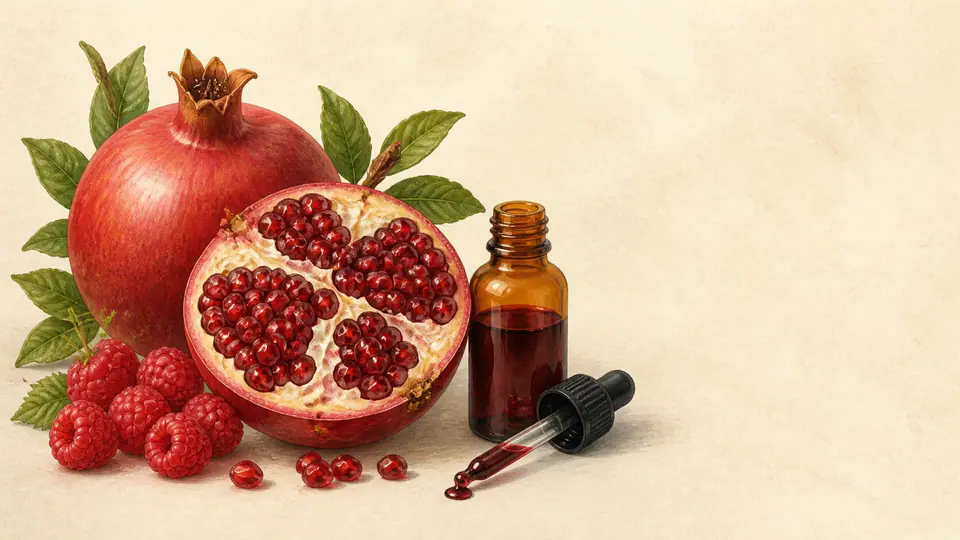
Ellagic acid is a polyphenol found in pomegranates, strawberries, raspberries, blackberries, walnuts, and more. However, when eating whole fruit, it is not just free ellagic acid that is present. Ellagitannins, which release ellagic acid during digestion, are also present. Pomegranate extracts, high-purity ellagic acid products, and urolithin A (a metabolite produced by gut microbiota) are all easily lumped together under the name 'ellagic acid,' but they are not the same raw materials.
How Far Do Antioxidant Components from Test Tubes Actually Translate?
PubChem classifies ellagic acid as a polyphenol present in various fruits and vegetables. While the database lists many in vitro (test tube) actions, this does not immediately translate to clinical efficacy. The concentration observed in cell cultures is a different matter from the concentration that reaches the blood or tissues after human ingestion. Ellagic acid and ellagitannins have low absorption rates and can be converted into urolithins in the large intestine by gut microbiota, which are better absorbed. In other words, there is a gateway called the gut between ingestion and cellular contact, and the raw material changes form as it passes through that gateway.
Different Urolithin Levels for Each Person, Even When Eating the Same Pomegranate
A 2022 comprehensive review pointed out that people differ in their metabolic types for urolithin A, B, and 0. It added that caution is needed in interpreting some actions because many test tube studies were conducted under conditions outside of physiological concentrations. Even when eating the same pomegranate, some people produce a lot of urolithin A, while others produce almost none. Therefore, the sentence 'taking ellagic acid has such-and-such effects' hides the fact that the actual substance exposed to the body differs by individual.
The Distinction Between Pomegranate Juice, Extracts, and Isolated Ellagic Acid
Clinical results for pomegranate juice or berry blends are the result of consuming various components together, such as fiber, sugar, and anthocyanins. These cannot be isolated as the efficacy of ellagic acid alone. Pomegranates, berries, and walnuts in food differ in exposure from high-purity supplements, and safety data for long-term, high-dose use of concentrated products are limited. A piece of fruit, a glass of juice, an extract capsule, and high-purity ellagic acid are called by the same name, but they are each different forms of raw materials.
| Category | Characteristics | Points to Note |
|---|---|---|
| Foods Rich in Ellagitannins | Whole foods such as pomegranates, strawberries, raspberries, blackberries, walnuts, etc. | Difficult to reduce to the effect of a single component |
| Isolated Ellagic Acid | High-purity supplement form | Limited safety data for long-term, high-dose use |
| Gut Microbiota-Derived Urolithin | Metabolites with significant individual variation | Actual exposure differs even with the same intake amount |
Between Expectations of Cancer Prevention and Treatment and Human-Based Evidence
In a trial of 183 patients with recurrent prostate cancer organized by the NCI, there was no difference in the rate of PSA increase between pomegranate juice/extracts and a placebo. It is concluded that there is insufficient evidence that pomegranate prevents or treats cancer. Research on isolated ellagic acid for disease prevention and treatment in humans is limited, and because the formulations, subjects, and results vary, it is difficult to determine the long-term effects of food intake versus high-dose supplements. There is still a gap between anticancer mechanisms observed in test tubes and actual cancer treatment outcomes in humans. It is also difficult to conclude that changes in blood markers directly lead to disease prevention or survival.
Avoid arbitrary combination when taking medication
Although inhibition of drug-metabolizing enzymes was observed in test tubes, the clinical significance in humans is unclear. Nevertheless, as a rule, it should not be combined arbitrarily with anticancer drugs, anticoagulants, or medications where the therapeutic concentration is critical. For juices, gummies, and complex formulations, you must check for sugars, other extracts, and allergenic ingredients. If you have a nut allergy, you must distinguish ingredients derived from walnuts. Do not use supplements to monitor suspected cancer symptoms, abnormal test results, or cancer currently under treatment, nor should you discontinue prescribed treatment.
Questions to ask yourself before choosing
When choosing an ellagic acid product, first distinguish between three things. First, check if it is a food such as pomegranate, berries, or walnuts; whether it is juice, a complex extract, high-purity ellagic acid, or urolithin A; and what the actual content is. Second, ask whether you are seeking general antioxidant effects or trying to replace treatment for specific conditions such as cancer treatment, recurrence prevention, fatty liver, or cholesterol. Third, check if you are using prescription drugs such as anticancer agents or anticoagulants, or if you are pregnant, breastfeeding, or have liver or kidney disease. So, what should you look at? The answer is your own purpose and combination status, even before the product label.
Final Decision Criteria
To summarize the discussion on ellagic acid: it is more important to distinguish the identity of the food, extract, or metabolite than to focus on terms like 'antioxidant' or 'anticancer,' and to ensure that ellagic acid products do not replace cancer screenings, treatments, or healthy lifestyle habits. Interesting actions in a test tube do not translate directly to disease prevention in humans; various ingredients may be hidden under the same name, and even the same ingredient is converted into different substances depending on gut microbiota. The realistic criteria to check today are simple: determine what form of ellagic acid the product is, whether your expectations are supported by clinical evidence, and whether it interferes with your current medications or medical conditions.
References
- PubChem: Ellagic acid.
- NCI: Prostate cancer, nutrition and dietary supplements — pomegranate.
- Urolithins: metabolism, bioactivity and gut microbiota metabotypes.
- Metabolic fate and bioavailability of ellagitannins.
This text explains the origin of the raw materials, the scope of research, and precautions before consumption. As this cannot replace individual diagnosis or treatment, please consult a medical professional if you are taking medication or if symptoms persist. If sudden and severe symptoms such as difficulty breathing or decreased consciousness occur after consumption, seek help from 119 or the emergency room.

Medical Staff Review
Director Choi Yeon-seung
Chief Director of Baekrokdam Korean Medicine ClinicEllagic Acid Dictionary Entry, reviewed the safety of expressions and the scope of verification before administration.
Review scope: Ingredient origin, human studies, concomitant medications, safety of intake · Last reviewed 2026-08-17
- Graduated from Kyung Hee University College of Korean Medicine
- Providing Korean medicine treatment since 2010
- Consultations for Gongjindan, Gyeongokgo, Nokyong (Deer Antler) restorative medicine, and customized restorative herbal medicine