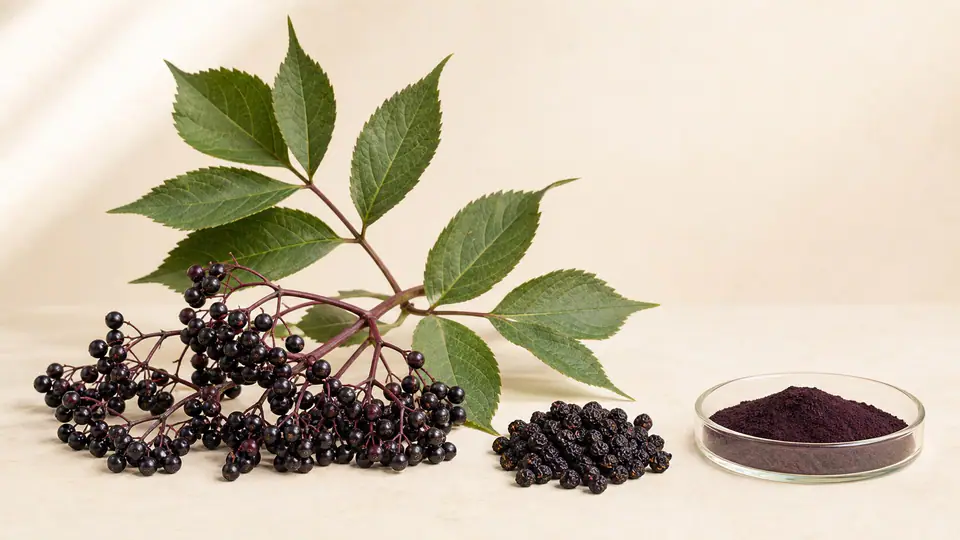
Questions Asked Before a Bottle of Winter Syrup
Will taking elderberry syrup help me recover faster when a cold or flu starts, and is it safe to give raw berries or gummies to my child?
In short, while small studies show signals that processed black berry products may reduce the duration or severity of upper respiratory symptoms, the evidence is still thin; raw berries, unripe berries, leaves, stems, and bark must not be consumed. As this name becomes a symbol of winter immunity, we will examine the evidence, which parts are dangerous, and why it is difficult to compare different products.
The Season When Questions Begin
Elderberry supplements are primarily syrups, gummies, or extracts processed from the ripe black berries of the European black elderberry, Sambucus nigra. As more people keep a bottle at home during flu or cold seasons, these black berries are naturally perceived as something that 'helps you recover faster.' However, research on this ingredient is still in the early stages, and safety varies depending on the product form and the part of the plant used. Therefore, the first question should not be 'What is elderberry?' but 'Which part of the plant is this, and how was the product processed?'
Identity of the Ingredient: The Whole Plant, Not Just Ripe Berries
Elderberry research mainly concerns processed berry products of Sambucus nigra. Flowers, leaves, stems, and other species cannot be viewed based on the same evidence. Most commercial products are concentrates or extracts of ripe black berries, but it is difficult to distinguish whether a product contains berries, leaves, stems, or a different species by name alone. Processed ripe berry products for consumption have different safety profiles than raw berries, unripe berries, leaves, stems, and bark.
Reasons for High Expectations: Signals from Small Trials
The NCCIH states that while there are preliminary signals for the relief of upper respiratory symptoms such as colds and flu, the number of studies is small and there is a lack of human research for other purposes. A systematic review including 5 randomized trials reported a potential reduction in the duration or severity of colds and flu but rated the certainty of evidence as low. Early small-scale flu trials reported rapid symptom relief, but since the scale was only 60 people, confirmation from larger independent trials is needed. In other words, a reduction in symptom duration in small early trials does not mean that it boosts immunity to prevent infection or eliminates the virus. There is a gap between possibility and proof.
COVID Exaggerations and Concerns Over Cytokine Storms
There is no clinical evidence that elderberry causes a cytokine storm, nor is there strong evidence that it prevents or treats COVID-19. During the pandemic, this ingredient spread in contexts suggesting immune enhancement or virus suppression, but evidence from human studies is insufficient. As expectations have grown, judgment must be more cautious.
Differences in Product Form: Syrups and Gummies Are Not Simple Extracts
Syrups and gummies contain sugars, other vitamins, and herbs in addition to berry extracts, making it difficult to compare products. Single berry extracts cannot be placed on the same level as complex cold syrups or gummies. Some products use elderberry concentrate as the main ingredient, while others include zinc, vitamin C, and other herbal extracts. In such cases, it is impossible to isolate whether the change in symptoms is due to the elderberry or other ingredients. This is why you should check the full ingredient list first.
When Using with Medications or Supplements
If you have diabetes, check the sugar content of syrups and gummies, and inform your healthcare provider or pharmacist of the full ingredients before using them with medications. The sugars or complex herbal ingredients in the product may pose more direct issues for interactions or blood glucose management than the elderberry itself. Especially when taking cold medicine, you must check that the ingredients of the two products do not overlap.
Individual circumstances and safety signals
There is insufficient safety data for use for medical purposes during pregnancy or breastfeeding. Do not consume raw berries, unripe berries, leaves, stems, or bark, and ensure children do not pick and eat wild berries. Raw or unripe berries, leaves, and stems contain cyanogenic substances that can cause nausea, vomiting, and severe diarrhea, making proper cooking essential. Seek medical evaluation for repeated vomiting, severe diarrhea, or dehydration; for shortness of breath, blue lips (cyanosis), changes in consciousness, or facial swelling, call 119 or seek help at an emergency room. Processed ripe berry products are relatively safe, but this is relative to the raw parts of the plant.
The Gap Between Human Evidence and Expectations
To date, human studies on elderberry are few and small in scale. Reducing symptom duration is a different concept from preventing infection or treating a virus. Elderberry should not be placed in the same category as flu vaccines or antiviral drugs. If you miss the window for vaccines, testing, or prescribed antiviral evaluation and only take elderberry, you may delay more critical treatment opportunities. You must consider whether you are in a high-risk group for flu or COVID and whether you are missing the timing for antiviral evaluation.
Similar Names, Different Ingredients
It is necessary to distinguish between cooked, processed black berries and raw or unripe berries, leaves, and stems. Toxicity varies depending on the part of the plant and the state of processing, even for the same tree. Furthermore, other elderberry species, extracts from different plant parts, or complex herbal products cannot be explained using the evidence available for the ripe berries of Sambucus nigra. So, what should you look for? Start by checking the product label to see if it contains cooked berries of Sambucus nigra, or if it is a raw berry, leaf, stem, or complex herbal product.
Criteria to Check Today
Rather than focusing on the word 'immunity,' verify the exact species, plant part, processing state, and sugar content; do not use uncertain signals of symptom relief as a substitute for vaccines, testing, or antiviral treatments. If choosing elderberry, first consider whether it is a product made from cooked Sambucus nigra berries, what the sugar content and single dose per age group are for syrups or gummies, and what cold medicine ingredients are included. While there are possibilities suggested by small studies, these possibilities should not be mistaken for certainty in prevention and treatment.
References
- NCCIH: Elderberry usefulness and safety.
- Elderberry for viral respiratory illness: systematic review.
- Elderberry extract for influenza A and B: randomized trial.
This text explains the origin of the raw materials, the scope of research, and precautions before consumption. As this cannot replace individual diagnosis or treatment, please consult a medical professional if you are taking medication or if symptoms persist. If sudden and severe symptoms such as difficulty breathing or decreased consciousness occur after consumption, seek help from 119 or the emergency room.

Medical Staff Review
Director Choi Yeon-seung
Chief Director of Baekrokdam Korean Medicine ClinicElderberry Dictionary Entry, reviewed the safety of expressions and the scope of verification before administration.
Review scope: Ingredient origin, human studies, concomitant medications, safety of intake · Last reviewed 2026-08-17
- Graduated from Kyung Hee University College of Korean Medicine
- Providing Korean medicine treatment since 2010
- Consultations for Gongjindan, Gyeongokgo, Nokyong (Deer Antler) restorative medicine, and customized restorative herbal medicine