Cold Season: Various Questions Hidden Behind the Name 'Echinacea'
If I start feeling a cold coming on, will taking Echinacea help me recover faster? In short, it is difficult to definitively say that it "speeds up recovery." This is because a single name covers multiple plant species, different plant parts, different manufacturing methods, and two overlapping questions: prevention and treatment.
Echinacea is a name frequently mentioned alongside the common cold. Some think of it as a way to prevent colds, while others see it as a way to reduce symptoms that have already appeared. However, misconceptions arise from the fact that this raw material is not a single, standardized substance. First, we must separate the various materials and questions that have been lumped together under one name.
How do raw materials with similar names differ?
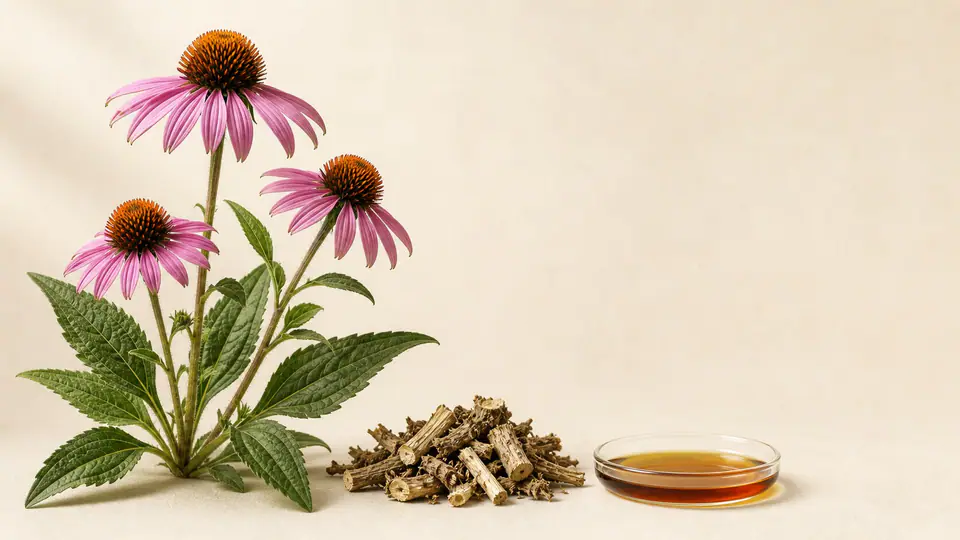
Echinacea is not a single species or a single product. Echinacea purpurea, E. angustifolia, E. pallida It is a group of plants, and the extracts and manufacturing methods, whether using the aerial parts, roots, or a mixture of both, all differ. This is why it is difficult to apply research results to other products that simply share the same name.
Even if two products are both labeled as 'Echinacea,' the actual plant species, parts used, and extraction methods may differ. Therefore, research from one formulation cannot be applied directly to another. It is important to remember first that having the same name does not mean they are the same raw material.
Whether it reduces the frequency of colds or shortens their duration are different questions
The NCCIH states that while Echinacea may slightly reduce the likelihood of catching a cold, it is unclear whether it shortens the duration of the cold. A Cochrane review, including 24 double-blind trials, did not rule out the possibility of a weak effect for some formulations, but found that the benefits for cold treatment were not convincingly proven.
There is an important distinction here. 'Whether one catches fewer colds' and 'Whether a cold that has already started is shortened' are not the same question. Because species, root/aerial parts, and extraction/manufacturing methods vary by study, making it difficult to apply the results of one product to another, prevention and treatment should not be explained in a single sentence. There is insufficient evidence that it helps with the flu, and the flu should not be treated as the same question as the common cold.
Studies on children are even more inconsistent
Studies on children are difficult to draw clear conclusions from because the results are inconsistent and the products vary. It must also be noted that studies on adults cannot be viewed as having the same safety and efficacy as studies on children.
It is necessary to consult a healthcare provider before giving it to children. This is because an increase in rashes has been observed in children's trials. Mild gastrointestinal symptoms seen in adults cannot be explained using the same criteria as reactions observed in children.
Differences in product forms are not simple
Echinacea products vary E. purpureadepending on the Echinacea species, and whether they use root, aerial part, or mixed extracts. The criteria for comparing cold prevention and the shortening of symptom duration also differ. Under the same name, one must check which species was used, which part was used, and whether it is a mixture or a single extract.
If the manufacturing method differs, the composition of the product and the scope to which research results can be applied also change. Therefore, the statement that results from one study do not apply directly to another product is not just a simple caution, but the primary criterion to consider when choosing this raw material.
Current medications and individual circumstances must be checked first
While some E. purpurea extracts are generally safe for adults for short-term use, digestive symptoms such as abdominal pain and nausea may occur. As it is closely related to plants in the Asteraceae (daisy) and Ambrosiaceae (ragweed) families, allergic reactions may occur and can be severe in rare cases.
Extra caution is required if you are taking prescription medications. Due to potential interactions with certain drugs metabolized in the liver, immunosuppressants, and caffeine, those taking prescription medications should check with a professional first. Consult a healthcare provider during pregnancy; safety during breastfeeding is not well-established.
So, what should you consider? It is advisable to first check whether you are trying to prevent a cold or reduce existing symptoms, whether you have allergies to the daisy or ragweed families, whether you are taking immunosuppressants or medications metabolized in the liver, and whether you are a child, pregnant, or breastfeeding.
How to View the Gap Between Expectations and Evidence
A large number of studies does not necessarily mean the conclusion is simple. In the case of Echinacea, it is difficult to summarize in a single line because the species, plant parts, manufacturing methods, and research questions vary as much as the number of studies. Rather than concluding that it is 'effective,' it is more accurate to distinguish which preparations showed a slight possibility of effect and for which questions the results remained unclear.
Expectations naturally grow when cold prevention, reduction of symptom duration, adults and children, and different product forms are all explained together. Evidence appears only limitedly under specific conditions.
Distinguishing Similar Names from Different Ingredients
Under the name Echinacea, E. purpureavarious other Echinacea species exist. Root extracts, aerial part extracts, and mixed extracts should also be viewed as different ingredients. When comparing cold prevention and the reduction of symptom duration, it is only meaningful to look at the same product.
In other words, saying 'Echinacea is good' provides almost no information without specifying which species, which part, which manufacturing method, and for what purpose it is being used.
Realistic criteria to check today
When choosing Echinacea, look at the species, part used, and manufacturing method before the name. Also check whether you are seeking an answer for prevention or treatment, and whether you have allergies or concurrent medications. In particular, if you are taking prescription drugs or are a child, pregnant, or breastfeeding, it is necessary to decide after consulting a healthcare provider.
This ingredient is one that can only be properly understood by accurately dividing the questions, rather than seeking a single fixed answer.
References
- NCCIH Echinacea.
- Echinacea for preventing and treating the common cold: Cochrane review.
- Echinacea purpurea in children with upper respiratory infections: systematic review and meta-analysis.
This text explains the origin of the raw materials, the scope of research, and precautions before consumption. As this cannot replace individual diagnosis or treatment, please consult a medical professional if you are taking medication or if symptoms persist. If sudden and severe symptoms such as difficulty breathing or decreased consciousness occur after consumption, seek help from 119 or the emergency room.

Medical Staff Review
Director Choi Yeon-seung
Chief Director of Baekrokdam Korean Medicine ClinicEchinacea Dictionary Entry, reviewed the safety of expressions and the scope of verification before administration.
Review scope: Ingredient origin, human subject research, concomitant medications, intake safety · Last reviewed 2026-08-16
- Graduated from Kyung Hee University College of Korean Medicine
- Providing Korean medicine treatment since 2010
- Consultations for Gongjindan, Gyeongokgo, Nokyong (Deer Antler) restorative medicine, and customized restorative herbal medicine