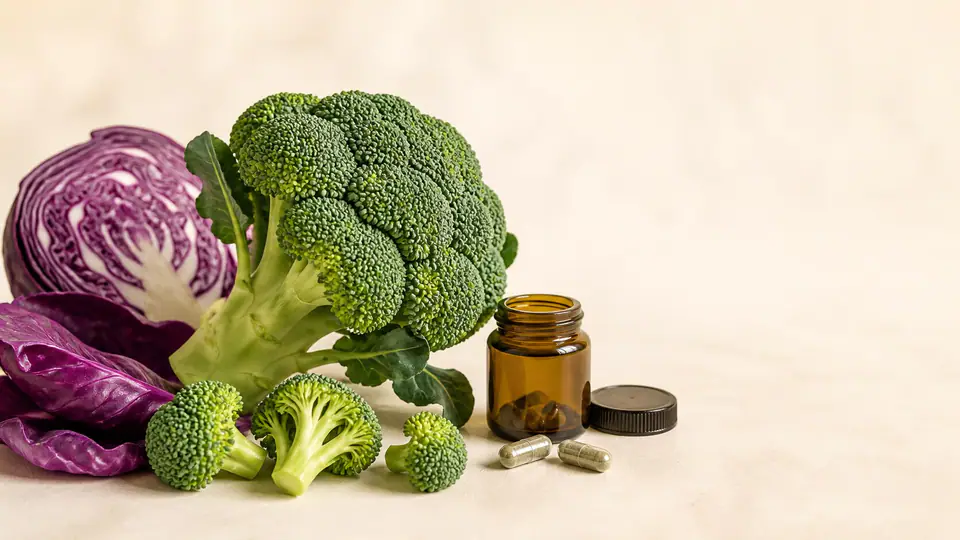
Cruciferous Indoles in the Stomach: DIM
Can I take DIM for estrogen balance or acne, and is it the same as eating broccoli? This is the most common question from those curious about DIM. In short, a plate of broccoli and a DIM capsule do not provide the same exposure. When targeting hormones or skin symptoms, you must first verify your current medications as well as the exact formulation and dosage.
DIM is 3,3’-diindolylmethane. During the process of chewing and digesting cruciferous vegetables, indole-3-carbinol (I3C) is produced from glucobrassicin; DIM is one of several products created when I3C binds in the acidic environment of the stomach. DIM does not exist in vegetables in the same concentrations found in supplement dosages. Therefore, it is difficult to simply compare the amount produced in the body from eating broccoli or cabbage with the exposure provided by absorption-enhanced DIM capsules.
Where the Questions Begin
Questions about DIM usually fall into two categories. One is the expectation that it will manage hormone-linked symptoms such as acne, PMS, or menopausal discomfort. The other is a comparison of whether supplements are the same as eating broccoli or cabbage. Both questions stem from the phrase 'estrogen balance,' but this expression is not a medical diagnosis. An individual evaluation is required to determine if the cause of the symptoms is solely an estrogen issue or if other hormones or lifestyle factors are acting together.
What is DIM: Not Directly Derived from Vegetables
DIM starts from glucobrassicin found in cruciferous vegetables. I3C is produced during chewing, and I3C is converted into various indole components in the acidic environment of the stomach, one of which is DIM. The National Cancer Institute (NCI) describes DIM as a dimer of I3C, but its anticancer activity remains potential and limited to preclinical contexts. It is not a definition that confirms efficacy for cancer prevention or treatment in humans.
While names like 'broccoli extract' or 'DIM' naturally link to vegetables, they are actually products of chemical transformation occurring in the stomach. It is impossible to convert a plate of vegetables into the mg count of a capsule.
Why Expectations Exist: Biomarkers vs. Symptom Improvement
Interest in DIM stems from research on estrogen metabolic pathways. In a 12-month trial of 130 women taking tamoxifen, DIM altered estrogen metabolic markers and SHBG. However, breast density did not change. While a change in the ratio of estrogen metabolites in urine is a measurable biomarker, it does not mean that patient-centered outcomes, such as acne, PMS, or cancer recurrence, have improved.
In other words, a change in a certain value within the body does not necessarily mean a change in symptoms or disease. The number of studies is limited, and the consistency of results has not yet been established.
Between Vegetables and Capsules: Not the Same Exposure
When eating broccoli or cabbage, glucobrassicin, I3C, and various indole components produced in the stomach enter the body together. In contrast, DIM capsules contain a concentrated, pre-formed single compound. Furthermore, absorption-enhanced formulations and standard DIM formulations may have different bioavailability. A single-dose trial in healthy adults reported that up to 200 mg of a specific absorption-enhanced DIM was generally tolerable, but this is a small-scale single-dose result and cannot be used to determine long-term safety.
What should you look for then? When choosing a product, you should first check whether it is standard DIM or an absorption-enhanced formulation, the actual daily amount of DIM, and the accompanying ingredients. You should not expect the same exposure as vegetables based solely on the phrase 'broccoli-derived'.
Taking it with Medication: Interactions are Not Simple
In humans, DIM is rapidly converted into various oxidative and conjugated metabolites, some of which are also active. Therefore, it is difficult to predict effects and interactions based on the mechanism of DIM alone. Caution is especially needed if you are taking tamoxifen. In the aforementioned tamoxifen trial, DIM decreased the concentration of tamoxifen metabolites, including the active metabolite endoxifen. This suggests a potential weakening of clinical benefit, but these results require further confirmation.
Therefore, if you are using tamoxifen, anticancer drugs, oral contraceptives, or hormone therapy, the general rule is not to take DIM without the approval of your attending medical staff. It may affect the efficacy of your treatment.
Individual circumstances and safety signals
There is a lack of data on long-term repeated use of DIM and comparisons between standard commercially available formulations. Reported adverse reactions include gastrointestinal and neurological symptoms such as headache, nausea, and vomiting. The safety of concentrated DIM has not been established for pregnancy, lactation, children, or hormone-sensitive diseases.
If abnormal bleeding, severe abdominal pain, jaundice, persistent vomiting, or new symptoms during treatment occur, you must stop the product and seek prompt medical evaluation. This is a common warning signal applicable not only to DIM but to all hormone-related supplements.
I3C and DIM: Similar but Different Indoles
Although DIM and I3C start from the same point, they differ in many ways. I3C is a precursor that converts into various products in the stomach, while DIM is one of those stable products. Because I3C produces multiple components during conversion, its predictability is low; DIM targets a single compound but is converted into other metabolites during metabolism. Both are sold under the name 'estrogen balance,' but the distance between expectation and actual evidence differs for each.
Realistic criteria to check today
If you are considering DIM, it is advisable to check the following three things first. First, clarify your goal. Ask whether it is for acne, PMS, menopause, prostate health, or cancer prevention, and whether it is intended to replace diagnosis and treatment. Second, check your current medications. Consult a medical professional if you are using tamoxifen, oral contraceptives, hormone therapy, anticancer drugs, or are being treated for a hormone-sensitive disease. Third, look at the exact formulation and daily dose of the product. Verify whether it is standard DIM or absorption-enhanced and what the accompanying ingredients are.
It is more important to verify the exact formulation, daily dose, target symptoms, and whether you are undergoing hormone or anticancer treatment than to rely on the phrase 'estrogen balance.' The key to viewing this ingredient is to avoid extending changes in biomarkers to mean prevention or treatment effects.
References
- NCI Drug Dictionary: Diindolylmethane.
- DIM with tamoxifen: randomized placebo-controlled trial.
- Absorption-enhanced DIM single-dose pharmacokinetics and tolerability.
- DIM metabolism after oral dosing in humans.
This text explains the origin of the raw materials, the scope of research, and precautions before consumption. As this cannot replace individual diagnosis or treatment, please consult a medical professional if you are taking medication or if symptoms persist. If sudden and severe symptoms such as difficulty breathing or decreased consciousness occur after consumption, seek help from 119 or the emergency room.

Medical Staff Review
Director Choi Yeon-seung
Chief Director of Baekrokdam Korean Medicine ClinicDIM Glossary Entry, reviewed the safety of expressions and the scope of verification before administration.
Review scope: Ingredient origin, human studies, concomitant medications, safety of intake · Last reviewed 2026-08-17
- Graduated from Kyung Hee University College of Korean Medicine
- Providing Korean medicine treatment since 2010
- Consultations for Gongjindan, Gyeongokgo, Nokyong (Deer Antler) restorative medicine, and customized restorative herbal medicine