If I take collagen for my skin and knees, does it actually go there?
If I take collagen for my skin and knees, does it actually go there? In short, there are ingredients with the same name but different destinations, and there is a gap between what research shows and what commercial products promise.
Collagen is a family of proteins widely present in the connective tissues of human and animal skin, bones, and cartilage. When that name is put into powders and jellies, it comes with the promise of destinations like skin hydration and joint pain relief. However, one must distinguish between the name of the protein ingested and the results observed in clinical trials.
Same Name, Different Ingredients
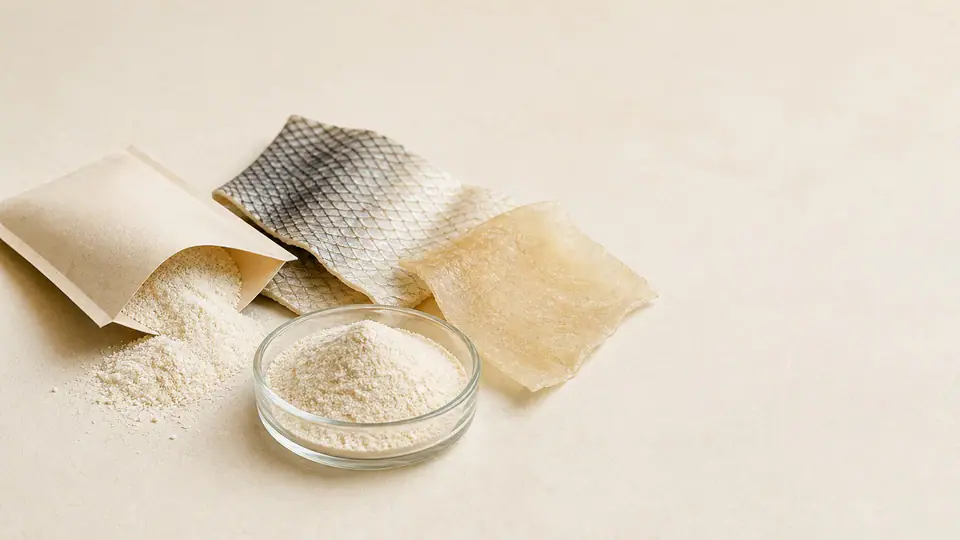
Under the category name 'collagen,' there are different raw materials. Food-grade gelatin, hydrolyzed collagen peptides, and undenatured type 2 collagen differ in their manufacturing and research conditions. These cannot be used interchangeably in skin and knee research. The key point is that formulations used in skin and joint research cannot be swapped, nor can the results be generalized to all commercially available collagen products.
What did skin research show?
Expectations for skin beauty are high. A 2026 review of 25 randomized trials showed signals of improvement in skin hydration, elasticity, and wrinkles. However, most studies were rated as having a high risk of bias, noting the need for larger, standardized, long-term trials. A 2021 meta-analysis on skin aging involving 19 studies and 1,125 participants reported improvements in hydration, elasticity, and wrinkles, but 95% of participants were women, and the products and durations varied. In other words, this does not mean there is no effect, but that the number of studies, consistency, and limitations must be considered together.
Knee studies use different evaluation indicators
A meta-analysis of 35 randomized trials on collagen derivatives for osteoarthritis reported small to moderate improvements in pain and function. Skin studies and knee studies differ in their subjects, formulations, and evaluation indicators. While one measures skin moisture and elasticity, the other measures pain and function. Therefore, these two cannot be combined into a single universal effect. This is why we first ask whether the goal is for the skin or for joint symptoms.
Collagen is not the only thing that differs by product
The source animal also varies by product, with fish, cows, pigs, and chickens being used. Additionally, powders and jellies used for flavoring may contain sugars and other vitamins or minerals, which can change the total intake. This is why it is necessary to distinguish between single-ingredient products and complex products containing vitamins and sugars. If you choose based only on the total amount of collagen, you may overlook other ingredients actually present in the product.
Why you should check for allergies and ingredient labels
If you have allergies to the source animal or other included ingredients, you must check the raw materials and manufacturing facility labels. You should examine the product's additives alongside personal allergies to fish, crustaceans, eggs, etc. In clinical trials, collagen supplementation was generally well-tolerated, but long-term safety and differences between products have not been fully established. Since manufacturing conditions and included ingredients differ even for the same raw material, it is important to develop a habit of checking the labels for each product.
Signals that should not be deferred with supplements
Persistent joint swelling, heat sensation, post-traumatic pain, or rapidly changing skin symptoms should be evaluated rather than deferred with supplements. Collagen supplementation does not replace the evaluation of the cause of knee pain, basic skin aging care, or sufficient overall protein intake. In other words, supplementation is only a supplement and cannot replace diagnosis, treatment, or basic nutritional management.
How to View Differences from Similar Ingredients
When looking at gelatin, hydrolyzed collagen peptides, and undenatured type 2 collagen side by side, the similarity in their names can actually cause confusion. Skin indicators and osteoarthritis pain/function are different goals, and single-ingredient materials differ from complex products containing vitamins and sugars. This is because it is easy to mistakenly believe that the word 'collagen' encompasses all formulations and all effects.
When choosing alongside other supplements or medications
When taking collagen alongside other supplements or medications, it is helpful to first clarify your objective. Formulations targeting the skin differ from those targeting joint symptoms, and the source animals and additives vary by product. By checking whether it is a hydrolyzed peptide or undenatured type 2, and what the source animal is, you can determine if it aligns with your goal. This is also the stage where you check the product's additives against personal allergies, such as fish, crustaceans, or eggs.
Criteria to Check Today
So, what should you look for? Rather than the total amount of collagen, check the problem you are trying to solve, the actual formulation and raw materials, the research period and product composition, and whether it is being used as a substitute for diagnosis and treatment. Check whether it is a hydrolyzed peptide or undenatured type 2, what the source animal is, and the additives and allergy information. While research opens up possibilities, separate verification is needed to see how closely those possibilities align with the product in your hand.
References
- NCI Dictionary of Cancer Terms: collagen.
- Hydrolyzed collagen and skin outcomes: systematic review of randomized trials.
- Hydrolyzed collagen supplementation on skin aging: systematic review and meta-analysis.
- Collagen derivatives for osteoarthritis: trial sequential meta-analysis.
This text explains the origin of the raw materials, the scope of research, and precautions before consumption. As this cannot replace individual diagnosis or treatment, please consult a medical professional if you are taking medication or if symptoms persist. If sudden and severe symptoms such as difficulty breathing or decreased consciousness occur after consumption, seek help from 119 or the emergency room.

Medical Staff Review
Director Choi Yeon-seung
Chief Director of Baekrokdam Korean Medicine ClinicCollagen Glossary, reviewed the safety of expressions and the scope of verification before administration.
Review scope: Ingredient origin, human subject research, concomitant medications, intake safety · Last reviewed 2026-08-16
- Graduated from Kyung Hee University College of Korean Medicine
- Providing Korean medicine treatment since 2010
- Consultations for Gongjindan, Gyeongokgo, Nokyong (Deer Antler) restorative medicine, and customized restorative herbal medicine