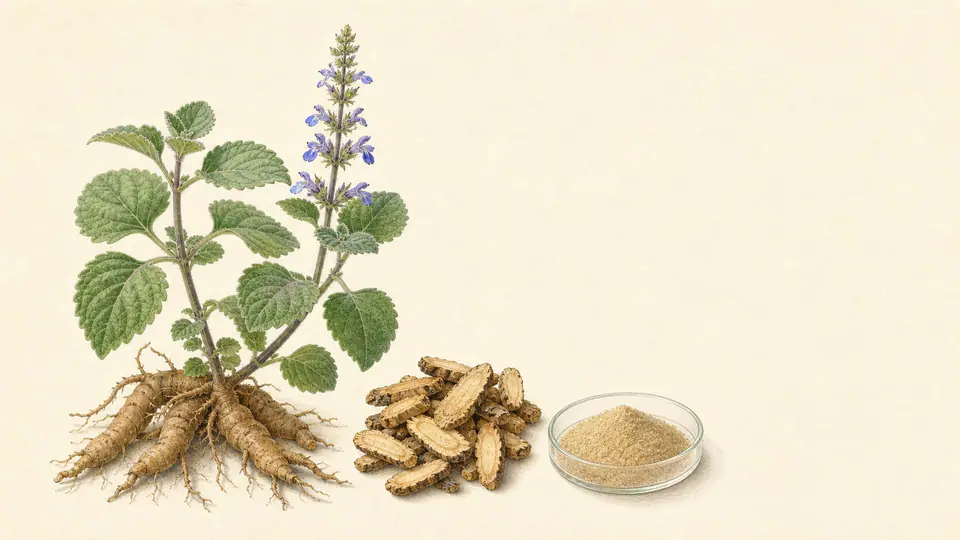
From a signal in the root to a capsule
Will taking Coleus forskohlii weight loss products reduce fat without exercise or dietary control? In short, based on current evidence in humans, it is difficult to conclude so.
This ingredient is extracted from the root of the Lamiaceae plant Coleus barbatus. While components involved in cell signaling have been identified in the laboratory, this does not immediately mean that body fat is reduced. The names, forms, mechanisms, and results follow different paths, so they must be viewed carefully.
The confusion starts with the name
Can the exact ingredient be determined by the name Coleus forskohlii alone? Kew records Coleus barbatus as the accepted scientific name and suggests Plectranthus barbatus as a synonym. Commercial products sometimes mix these two names or include various forms under the general term 'forskohlii.' Therefore, one should not assume it is the same plant or the same extract based on a single scientific name.
'Forskolin' is a specific component isolated from this plant, but the whole plant, root extract, and purified forskolin cannot be viewed as the same thing. Even if 'Coleus forskohlii' is written on the product label, you must separately verify what is actually contained inside.
Why the interest in weight loss?
The reason Coleus forskohlii entered the weight management supplement market is due to the cellular-level mechanism of the component called forskolin. Research showed that forskolin activates adenylate cyclase to increase intracellular cAMP, leading to the inference that this signaling pathway is linked to adipose tissue function. However, an increase in signals within a cell does not mean that body fat in a whole human is selectively burned and weight is reduced.
Mechanisms and clinical results exist on different levels. To directly link phenomena seen in cell cultures or animal experiments to long-term weight changes in humans, appropriate design and sufficiently large-scale trials are required. Coleus forskohlii was commercialized without filling those intermediate steps.
Root extracts and purified ingredients are different
Plant identification, extraction methods, forskolin content, and complex ingredients vary by product. Some products use root powder, some use extracts standardized to a certain ratio of forskolin, and others are sold mixed with various weight loss ingredients. This difference is not just a matter of concentration. Root extracts contain other components besides forskolin, whereas purified forskolin is close to a single component.
Therefore, the results of an extract used in a specific small-scale trial cannot be applied to all commercial products. One must first verify the scientific name, the part of the plant used, the extraction ratio, and the forskolin content of the raw material used in the research. Otherwise, the statement 'Coleus forskohlii reduces weight' is merely a hollow general term.
What did human trials show?
In a 12-week randomized trial involving overweight women, 250 mg of a 10% forskolin extract was administered twice daily. However, no significant reduction in body fat mass or body fat percentage was confirmed. In another 12-week trial combined with a low-calorie diet, only 30 participants completed the study, and waist and hip indices changed in both groups, making it difficult to isolate the weight loss effect of the extract itself.
Systematic and critical literature reviews in 2019 concluded that there is insufficient evidence to support consistent and clinically meaningful weight loss for natural weight loss supplements, including Coleus. These were small, short-term trials with very few participants, some of which included dietary interventions. These results cannot be extrapolated to independent long-term weight loss effects.
When Taken with Other Medications or Supplements
When using Coleus forskohlii with other supplements or medications, you must check the entire label. In particular, products mixed with various weight loss ingredients may contain other components like caffeine, which can cause throbbing, insomnia, or changes in blood pressure. You must look at the combination of ingredients in the entire product, not just the safety of the raw material itself.
Since the possibility of affecting blood pressure or platelet function has been raised, you should consult a healthcare provider before use if you have hypotension, bleeding disorders, or are taking blood pressure medication, anticoagulants, or antiplatelet agents. If you have an upcoming surgery or procedure, it is advisable to mention this in advance considering the risk of bleeding.
What signals indicate it is time to stop?
Long-term safety data for humans are insufficient. If symptoms such as gastrointestinal discomfort or dizziness occur, stop use immediately and identify the cause. As there is insufficient safety data during pregnancy or breastfeeding, the general rule is to avoid arbitrary use.
If you experience fainting, chest pain, difficulty breathing, uncontrollable bleeding, or severe allergic symptoms, you must immediately call 119 or seek evaluation at an emergency room. These emergency criteria apply to supplements in general, not just Coleus forskohlii.
Similar Names, Distinct Boundaries
Several distinctions are necessary when understanding Coleus forskohlii: the synonyms Coleus barbatus and Plectranthus barbatus; root powder/standardized extracts versus purified forskolin; the adenylate cyclase/cAMP mechanism versus actual body fat/weight results; and short-term small-scale trials versus sustainable long-term weight loss. These four pairs are not interchangeable.
In other words, just because a mechanism is interesting does not mean its efficacy has been proven, nor does an extract from one trial apply to all products. It is easy to assume they are the same raw material if the names are similar, but in reality, different substances are mixed in.
Criteria to Check Today
If you are considering a Coleus forskohlii product, check the following first: whether the scientific name, root part, extraction ratio, and standardized forskolin content are indicated; whether it is used alongside a low-calorie diet and exercise; whether your expected change is in weight, waist circumference, or blood glucose; and whether you have hypotension, cardiovascular disease, bleeding disorders, or are taking blood pressure or anti-thrombotic medication and have an upcoming surgery.
Rather than focusing on the mechanism of burning fat, a realistic approach to this ingredient is to verify the exact scientific name, root, forskolin content, and the dietary interventions performed alongside it, and to avoid extrapolating small short-term signals into independent long-term weight loss effects.
References
- Kew Plants of the World Online: Coleus barbatus.
- Herbal medicines for weight loss: systematic review.
- Natural supplements in weight loss: critical review.
- Coleus forskohlii with a hypocaloric diet: randomized trial.
- Coleus forskohlii in mildly overweight women: randomized trial.
This text explains the origin of the raw materials, the scope of research, and precautions before consumption. As this cannot replace individual diagnosis or treatment, please consult a medical professional if you are taking medication or if symptoms persist. If sudden and severe symptoms such as difficulty breathing or decreased consciousness occur after consumption, seek help from 119 or the emergency room.

Medical Staff Review
Director Choi Yeon-seung
Chief Director of Baekrokdam Korean Medicine ClinicColeus forskohlii Dictionary Entry, reviewed the safety of expressions and the scope of verification before administration.
Review scope: Ingredient origin, human studies, concomitant medications, safety of intake · Last reviewed 2026-08-17
- Graduated from Kyung Hee University College of Korean Medicine
- Providing Korean medicine treatment since 2010
- Consultations for Gongjindan, Gyeongokgo, Nokyong (Deer Antler) restorative medicine, and customized restorative herbal medicine