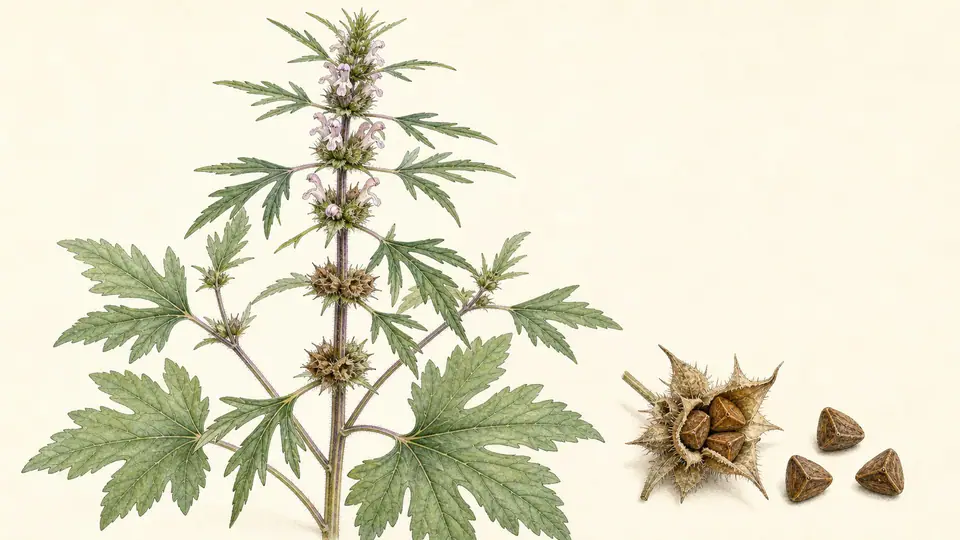
Small Fruits at the Tip of the Stem: Questions Beyond the Name
Can I take Chungulja or Motherwort seeds for irregular menstruation or eye fatigue? In short, there is insufficient evidence regarding the safety and efficacy of the raw seeds in humans; in particular, if there is a possibility of pregnancy or unexplained bleeding, a medical evaluation at a hospital must come first. Because this raw material is easily confused across various parts and formulations under a single name, you must first ask what is being used and in what form before considering its efficacy.
The plant known as Motherwort produces small fruits at the tips of its stems, and the dried seeds from these fruits are called Chungulja. Data from the National Institute of Biological Resources identifies the scientific name of Motherwort as Leonurus japonicus Houttuyn, and traditional records list Chungulja as its seeds. However, many current discussions stem from research conducted on the whole plant of Motherwort, including the leaves and stems. While the seeds and the whole plant come from the same species, the medicinal parts are different.
Seeds or Whole Plant: Same Plant, Different Medicinal Parts
Chungulja is a medicinal herb made from the dried ripe fruits and seeds of Motherwort. Research on the whole plant (including leaves and stems), injectables, concentrated extracts, or essential oils cannot be directly applied as evidence for the raw seeds. This distinction is not merely an academic detail, but the most important criterion to check first when choosing a product as a consumer.
Motherwort products available on the market appear in various forms, such as whole plant powder, seed powder, concentrated extracts, essential oil components, and injectables. Although they share the same plant name, the research evidence differs if the part used or the formulation is different. Component analysis or pharmacological signals derived from whole plant extracts cannot be applied directly to the raw seeds.
Reasons for Expectations and the Actual Focus of Research
A 2019 review of Motherwort summarized various components and pharmacological signals, but a significant portion of the data consisted of whole plant extracts and preclinical studies. This means there were many results from cell or animal experiments, as well as studies targeting the whole plant. While these results led to expectations regarding women's health and eye health, studies directly evaluating the effects of oral intake of Chungulja seeds by humans were not the primary focus of the review.
Modern data related to uterine contraction or postpartum hemorrhage focuses on whole plant extracts, injectables, or combination therapies. While it is understandable that Motherwort is linked to 'women's health' in this context, that link does not naturally extend to the raw seeds.
Seeds, Whole Plant, or Injectables: Different Product Forms Mean Different Evidence
A meta-analysis on the use of Motherwort injectables alongside oxytocin for postpartum hemorrhage after miscarriage showed very low certainty of evidence and was not a study evaluating the oral effects of raw seeds. Similarly, a 2025 study on uterine contraction deals with the context of postpartum hemorrhage using injectable components, so it cannot be used as safety evidence for taking Chungulja during pregnancy.
While the name 'Motherwort' encompasses the whole plant, seeds, injectables, and extracts, each study was conducted on different subjects and under different conditions. Injectables are formulations used in specific medical settings, and postpartum hemorrhage is a different context from everyday irregular menstruation. Therefore, research on injectables does not support the efficacy of seed powders or capsules.
In the Context of Pregnancy and Bleeding, Identifying the Cause Comes First
During pregnancy or when preparing for pregnancy, it is a general rule not to self-administer these, as there is a lack of human safety data for the seeds themselves and research on the whole plant or injectables involves uterine contraction. Irregular menstruation or excessive bleeding requires evaluation for pregnancy, anemia, endocrine issues, or uterine diseases. Sudden visual abnormalities should not be viewed simply as eye fatigue.
If you have heavy menstrual bleeding, unexplained bleeding, are taking anticoagulants or antiplatelet agents, or have a scheduled surgery, it is advisable not to arbitrarily add concentrates or powders. Bleeding that soaks more than one pad per hour, feelings of fainting, severe pelvic pain, or bleeding when pregnancy is possible require immediate medical evaluation. Sudden vision loss, visual field obstruction, or severe eye pain should be prioritized for an ophthalmology evaluation on the same day rather than using Chungulja.
What to Check First When Using with Other Medications or Supplements
When considering Chungulja, three things should be checked first. First, determine if it is Chungulja seeds or the whole plant (leaves and stems), and whether it is an oral powder, essential oil, or injectable. Second, check for the possibility of pregnancy, pregnancy preparation, breastfeeding, and the presence of bleeding, anemia, or pelvic pain. Third, check if anticoagulants, antiplatelet agents, hormone medications, or other menstruation-related herbal medicines are being used concurrently.
These questions are not simple precautions for concurrent use, but criteria for judging the evidence upon which this raw material is based. If you are taking anticoagulants or antiplatelet agents, the risk of bleeding must be considered, and if used with hormone medications or other menstruation-related herbal medicines, the possibility of interactions must remain open. However, since specific interactions are not explicitly stated in the reviewed data, it is reasonable not to combine them arbitrarily.
The Gap Between Human Evidence and Expectations
Human clinical trials specifically targeting Chungulja seeds are limited. Most modern data focus on whole-plant extracts, injectable forms, or preclinical studies. Therefore, expectations that it 'helps with irregular menstruation' or 'improves eye fatigue' stem from traditional nomenclature or research on the whole plant and extracts, rather than proven effects of oral intake of the raw seeds.
What should you look for then? First, check the plant part and formulation listed on the product label. If it only says 'Ikmocho,' it is unclear whether it is the whole plant or the seeds. Second, first check for the possibility of pregnancy or bleeding patterns. Third, look for safety precautions rather than expecting specific effects.
Similar names, different selection criteria
A distinction must be made between Chungulja seeds and the Ikmocho whole plant, oral raw seeds and Ikmocho injectables, combined treatment in postpartum medical environments and daily self-administration, and traditional nomenclature versus the diagnosis of irregular menstruation or visual symptoms. These four comparisons reveal different evidence hidden under the same name.
Traditionally, Chungulja was recorded as the seed, while the Ikmocho whole plant was used as a different part. Modern research is more concentrated on the whole plant and injectables. Combined treatment in a postpartum medical environment has a different risk-benefit structure than daily self-administration. While traditional nomenclature can be referenced, the actual cause of irregular menstruation or visual symptoms must be confirmed through a diagnosis.
Realistic criteria to check today
Do not combine evidence for seeds, whole plants, and injectables under the single name 'Ikmocho'; first check for the possibility of pregnancy, bleeding patterns, and the actual formulation. If choosing Chungulja, check if 'seed' or 'Chungulja' is specified on the label and whether it is an oral powder or another formulation. If there is a possibility of pregnancy or unexplained bleeding, postpone intake and seek medical evaluation first. Do not add it arbitrarily if you are using anticoagulants, antiplatelet agents, or hormone medications.
While starting from the traditional nomenclature where Chungulja was called the seed for women's health and the eyes, we remain cautious as modern research is more focused on the whole plant and injectables. Before speaking of the efficacy of a single small seed, the most honest approach to this ingredient is to first question the plant part and the reproductive context.
References
- National Institute of Biological Resources: Ikmocho Plant Information.
- Traditional Records of Chungulja based on the Encyclopedia of Korean Culture.
- Leonurus japonicus phytochemistry and pharmacology review.
- Motherwort injection after abortion meta-analysis.
- Leonurus japonicus injection uterotonic components.
This text explains the origin of the raw materials, the scope of research, and precautions before consumption. As this cannot replace individual diagnosis or treatment, please consult a medical professional if you are taking medication or if symptoms persist. If sudden and severe symptoms such as difficulty breathing or decreased consciousness occur after consumption, seek help from 119 or the emergency room.

Medical Staff Review
Director Choi Yeon-seung
Chief Director of Baekrokdam Korean Medicine ClinicChungulja Dictionary Entry, reviewed the safety of expressions and the scope of verification before administration.
Review scope: Ingredient origin, human studies, concomitant medications, safety of intake · Last reviewed 2026-08-17
- Graduated from Kyung Hee University College of Korean Medicine
- Providing Korean medicine treatment since 2010
- Consultations for Gongjindan, Gyeongokgo, Nokyong (Deer Antler) restorative medicine, and customized restorative herbal medicine