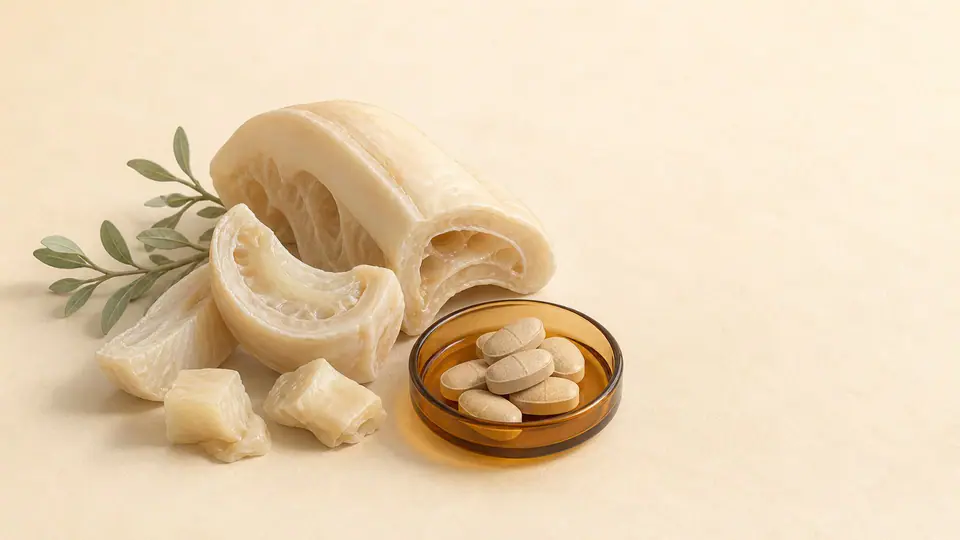
The Story Between Cartilage and Its Name, Told by Long Sugar Chains
If I take chondroitin for knee arthritis, does it only reduce pain, or does the worn-down cartilage actually grow back? In short, while some studies have reported small changes in pain or function scores, there is insufficient evidence to conclude that worn-down cartilage has actually regenerated. More importantly, because the source of raw materials, purity, molecular weight, and formulation vary by commercial product, the results of one study cannot be applied directly to your own case.
Chondroitin is a sulfated glycosaminoglycan found in the proteoglycans of the cartilage extracellular matrix. Simply put, it is part of the long sugar chains that make cartilage firm. Naturally, people think, 'If I eat a cartilage component, wouldn't it help my knee cartilage?' However, structural components of the body and ingested raw materials may share the same name, but they do not follow the same path. Eating a component of cartilage does not mean that molecule attaches directly to the knee cartilage. This distinction is easily blurred because of the familiarity the name provides.
Then, what makes this raw material so complex? The key lies in the various types of formulations hidden under one name and the expectations surrounding them.
Why This Question Is Not Simple
Questions about chondroitin seem simple: Is it good to take or not? However, behind this question lie 'what is being taken' and 'what is expected.' We must start with the fact that eating a component of cartilage does not mean that molecule attaches directly to the knee cartilage. Just because they have the same name does not mean they perform the same role in the body. If this distinction is missed, it is easy to mistakenly apply research results directly to one's own product.
Identity of Raw Materials: Animal Cartilage, Microorganisms, and Differences in Formulations
Commercial chondroitin may be chondroitin sulfate derived from animal cartilage such as cows, pigs, or sharks, or it may be a microbial fermentation product. When you add pharmaceutical-grade formulations and glucosamine complexes to this, the purity, molecular weight, and supporting evidence all change. Many types of raw materials and products exist under the single name 'chondroitin.' Therefore, stating that results from one specific formulation cannot be applied to all commercial products is not just a simple caution, but the core to understanding this material.
Why the Expectation of 'Cartilage Regeneration' Exists
The fact that cartilage does not easily return once worn down actually creates high expectations for supplements. The fact that chondroitin is an actual component of cartilage is a powerful message both marketing-wise and intuitively. However, the NCCIH states that research results for chondroitin in knee osteoarthritis conflict and that guideline recommendations are inconsistent. If studies do not point in the same direction, concluding 'cartilage regeneration' is premature.
Pain Scores and Cartilage Regeneration are Different Outcomes
A Cochrane review reported the possibility of small improvements in short-term pain, but pointed out that the quality of many studies was low and heterogeneity was high. Pain scores or changes in joint space do not directly prove that worn-down cartilage has been clinically regenerated. A reduction in pain does not mean cartilage has grown back, and a joint space that looks slightly wider on an image cannot be viewed as actual cartilage restoration. These three are different outcomes and each requires different evidence.
Pharmaceutical Grade vs. Supplement Grade, Single-Ingredient vs. Complex Formulations
If high-purity pharmaceutical-grade formulations, supplement-grade products, single-ingredient products, and glucosamine/MSM complexes are all grouped under the single word 'chondroitin,' it becomes impossible to know which formulation the evidence came from. Because test results are mixed among prescription-grade high-purity formulations, various supplements, single-ingredients, and complexes, product quality changes the interpretation. Therefore, when choosing a product, rather than just the name 'chondroitin,' you should first check whether it is a single chondroitin or a glucosamine/MSM complex, and what the actual daily dose and source of raw materials are.
| Category | Points to Check |
|---|---|
| Single vs. Complex | Whether other ingredients such as glucosamine or MSM are included |
| Source of Raw Materials | Whether derived from animal cartilage or microbial fermentation |
| Formulation Grade | Whether it is pharmaceutical grade or supplement grade |
| Target outcome | Whether you expect pain relief or cartilage regeneration |
Precautions when taking with other substances
When using chondroitin with other supplements or medications, you must verify what is being taken concurrently. Particular caution is required if you are taking anticoagulants such as warfarin. Using it with warfarin may increase the risk of bleeding, so it is safer not to start without INR monitoring. Caution is also necessary if you have a scheduled surgery, a bleeding disorder, or an allergy to animal cartilage raw materials. There is insufficient data regarding safety during pregnancy and breastfeeding.
Individual circumstances and safety signals
Before starting chondroitin, it is necessary to distinguish whether you have diagnosed osteoarthritis or if there are signs of acute edema, joint locking, trauma, or inflammatory joint disease. If you have red and hot joints, sudden severe swelling, an inability to bear weight, or a fever, a medical evaluation takes priority over supplements. While few serious issues were found in large-scale trials, gastrointestinal discomfort, headaches, or skin reactions may occur. Allergies to animal cartilage raw materials, as well as religious or dietary restrictions, should also be verified.
The Gap Between Human Evidence and Expectations
When reviewing research results, one must distinguish between 'possibility' and 'proof'. While the possibility of small improvements in short-term pain has been reported, the quality of the studies is low and the results are inconsistent. The clinical effect of regenerating worn-out cartilage has not been established. Recognizing this gap brings expectations for chondroitin closer to reality.
Differences from similar raw materials
Four distinctions work together when understanding chondroitin. First, the difference between the chondroitin in the body's cartilage and oral chondroitin sulfate. Second, the difference between pharmaceutical grade and supplement grade. Third, the difference between a single agent and a glucosamine combination. Fourth, the difference between pain relief and cartilage regeneration. You must keep these four points in mind simultaneously to determine the actual meaning of the phrasing on a product label.
Criteria to Check Today
In other words, the most important thing when choosing chondroitin is not the name 'cartilage component'. You must verify the quality of the formulation, whether it is a single agent or a combination, and what target outcome you expect. It is also necessary not to use it as a substitute for exercise, weight management, or diagnosis, and not to assume cartilage regeneration. Finally, if you are taking anticoagulants such as warfarin or have a scheduled surgery, please consult a professional first.
References
- NCCIH: Glucosamine and chondroitin for osteoarthritis.
- Cochrane: Chondroitin for osteoarthritis.
- Knee osteoarthritis supplements network meta-analysis.
This text explains the origin of the raw materials, the scope of research, and precautions before consumption. As this cannot replace individual diagnosis or treatment, please consult a medical professional if you are taking medication or if symptoms persist. If sudden and severe symptoms such as difficulty breathing or decreased consciousness occur after consumption, seek help from 119 or the emergency room.

Medical Staff Review
Director Choi Yeon-seung
Chief Director of Baekrokdam Korean Medicine ClinicChondroitin Glossary Entry, reviewed the safety of expressions and the scope of verification before administration.
Review scope: Ingredient origin, human studies, concomitant medications, safety of intake · Last reviewed 2026-08-17
- Graduated from Kyung Hee University College of Korean Medicine
- Providing Korean medicine treatment since 2010
- Consultations for Gongjindan, Gyeongokgo, Nokyong (Deer Antler) restorative medicine, and customized restorative herbal medicine