The boundaries of 'brain nutrients' starting from egg yolks
If you are concerned about memory or fatty liver, or if you are pregnant, would supplementing with choline help brain function and liver health? In short, choline is certainly a necessary nutrient. However, the question of whether 'someone who is not deficient can improve their brain or clear their liver by taking more' is a different question. You must first distinguish between these two points.
Choline is an essential nutrient used for cell membrane phospholipids, acetylcholine, and lipid transport. While the body produces a small amount on its own, it must be supplemented to some extent through food or supplements. However, several different forms are mixed under the name 'choline.' Dietary choline, choline bitartrate, phosphatidylcholine, alpha-GPC, and citicoline all share the name choline, but they differ in content, metabolism, and the clinical questions they address. This confusion over names is one of the factors that inflates expectations.
Why choline came to be called 'brain food'
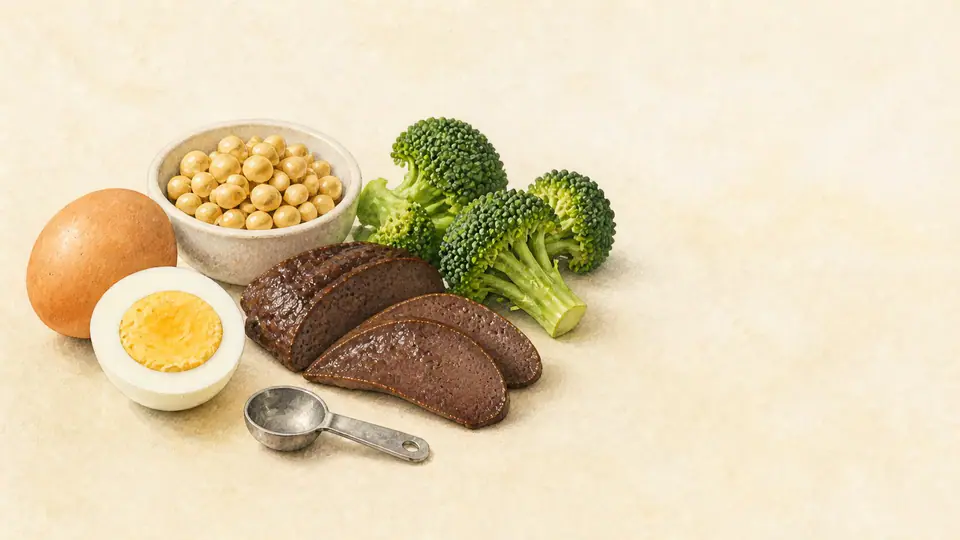
The expectations surrounding choline stem from its biological role. Acetylcholine is involved in neurotransmission, and phosphatidylcholine is a primary component of cell membranes. Because it is found in egg yolks, soybeans, liver, and nuts, it has a strong image as a 'natural nutrient.' This background makes it easy to expand expectations toward memory enhancement, fetal brain development, and the improvement of fatty liver.
However, having a biological role does not mean that clinical benefits always follow when more is added via supplements. It cannot be guaranteed that memory or liver health will improve when someone who is not deficient increases their intake.
Adequate intake and cognitive enhancement are different goals
The NIH ODS suggests adequate intake levels of 425 mg for women, 550 mg for men, 450 mg for pregnancy, and 550 mg for lactation. However, individual requirements vary. These numbers are benchmarks for healthy individuals to avoid deficiency.
A systematic review of cognitive enhancement supplements for healthy adults evaluated that the certainty of evidence, including for choline, is low, making it difficult to create recommendations. In other words, there is currently a lack of definitive clinical evidence to justify taking extra choline to boost everyday memory. Meeting the adequate intake and boosting cognitive ability may share a name, but they are different goals.
Choline during pregnancy: The difference between adequate intake and 'more'
Choline during pregnancy receives attention regarding fetal neurodevelopment. In a 2025 literature review on pregnancy choline and childhood neurodevelopment, most of the evaluated results did not support the benefits of higher choline, with signals appearing only in some indicators.
There is an important distinction here. The fact that adequate choline intake is important during pregnancy is not the same as the claim that the more you eat, the better the child's cognition will be. Since prenatal products may have little or no choline, it is reasonable to check the total amount along with your diet. However, arbitrarily adding high doses is a different matter.
Fatty liver and choline: The link to deficiency and the distance to treatment
Choline deficiency is linked to liver and muscle damage. However, clinical deficiency is rare in healthy individuals, and the causes of fatty liver are diverse. Therefore, moving from the fact that choline may be one of the causes of fatty liver to the claim that choline supplements treat fatty liver is an overextension.
Liver damage due to nutritional deficiency and the treatment of general fatty liver are different contexts. While choline is an essential nutrient, it cannot be concluded that fatty liver will be resolved by choline alone.
Same name, different things: Differences by choline formulation
When choosing a choline supplement, you should first look at what form it is in. Choline bitartrate, phosphatidylcholine, alpha-GPC, and citicoline all share the name choline, but they differ in their pathways into the body and the clinical questions they address.
In particular, alpha-GPC or citicoline have been addressed in studies of specific diseases. However, those research results cannot be applied directly to general choline supplements. Content and metabolism differ by formulation, and the study subjects also differ. Viewing them as 'all having the same effect because it is choline' is precisely where choices become clouded.
| Category | Points to Check |
|---|---|
| Dietary choline vs. single supplements | Total amount combining diet and supplements |
| Choline bitartrate vs. Phosphatidylcholine, Alpha-GPC, Citicoline | The specific form, and the resulting differences in content and metabolism |
| Meeting adequate intake vs. cognitive enhancement | What the goal is |
| Nutritional deficiency-related liver damage vs. fatty liver treatment | The basis for the expected outcome |
Combined Intake and Individual Circumstances
Choline is known to be a relatively safe nutrient, but excessive amounts can cause problems. The adult upper limit of 3,500 mg is the total amount combining food and supplements, not a target intake goal. Excessive intake may lead to a fishy body odor, vomiting, excessive sweating and salivation, low blood pressure, and liver damage.
During pregnancy, check the choline content of prenatal products and do not arbitrarily add high doses. If you have liver disease or low blood pressure, or if you are taking multiple choline-containing products, you must consult a healthcare provider. If severe vomiting, fainting, confusion, or jaundice occurs, seek medical evaluation immediately.
So, what should be checked first? Priority should be given to checking the total amount of choline combining diet and prenatal vitamins, the specific form of choline, whether you are pregnant or breastfeeding, and whether you have symptoms of liver disease or low blood pressure.
The gap between evidence and expectation
Choline is a necessary nutrient. Meeting the required amount and pharmacological supplementation to improve daily memory are different questions. The importance of adequate intake during pregnancy is not the same as the claim that more intake leads to better cognitive development for the child. Research on diseases involving Alpha-GPC or Citicoline cannot be simply applied to general choline supplements.
These distinctions are necessary to be cautious with the term 'brain food.' While choline is involved in the brain and liver, this does not automatically translate into the efficacy of a supplement.
Criteria to Check Today
When choosing choline, let's check three things first. First, the total amount combining diet and supplements. Second, what form of choline the product contains. Third, individual circumstances such as pregnancy, breastfeeding, liver disease, or low blood pressure.
A rational approach to this ingredient is to avoid extending the fact that it is an essential nutrient to claims of memory improvement, dementia prevention, or fatty liver treatment effects. Choline is a nutrient that should be replenished if deficient, not a substance that improves the brain and liver the more you consume.
References
- NIH ODS: Choline health professional fact sheet.
- Cognitive-performance supplement ingredients in healthy adults: systematic review.
- Choline during pregnancy and child neurodevelopment: systematic review.
This text explains the origin of the raw materials, the scope of research, and precautions before consumption. As this cannot replace individual diagnosis or treatment, please consult a medical professional if you are taking medication or if symptoms persist. If sudden and severe symptoms such as difficulty breathing or decreased consciousness occur after consumption, seek help from 119 or the emergency room.

Medical Staff Review
Director Choi Yeon-seung
Chief Director of Baekrokdam Korean Medicine ClinicCholine Dictionary Entry, reviewed the safety of expressions and the scope of verification before administration.
Review scope: Ingredient origin, human studies, concomitant medications, safety of intake · Last reviewed 2026-08-17
- Graduated from Kyung Hee University College of Korean Medicine
- Providing Korean medicine treatment since 2010
- Consultations for Gongjindan, Gyeongokgo, Nokyong (Deer Antler) restorative medicine, and customized restorative herbal medicine