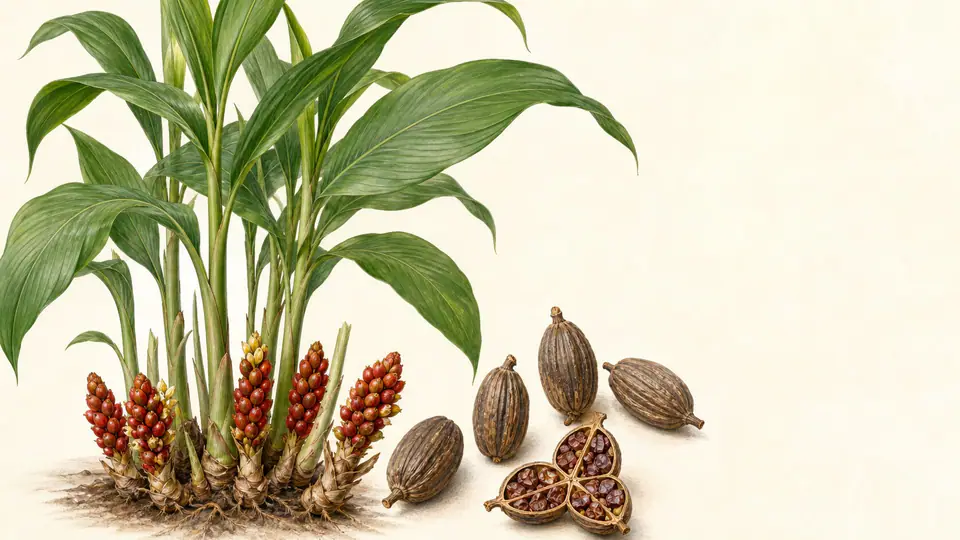
A fruit with a smoky aroma, but a single spice and research speak different languages
When feeling bloated, is it okay to boil Amomum villosum strongly like a tea? In short, there is currently insufficient evidence for people to do so. Amomum villosum is a reddish-brown fruit that moves between the cooking pots of Southern Chinese cuisine and medicinal decoction pots. Because of its smoky aroma, it gives the impression that it would aid digestion, but there is a gap between that impression and therapeutic efficacy regarding formulation, exposure amount, and research subjects.
It is necessary to distinguish that very gap. We will examine where the scientific name, fruit part, formulation, and the evaluation of the cause of recurring gastrointestinal symptoms meet.
Context of the question: Attempting to relieve digestive discomfort with a spice tea
When feeling bloated, the option to boil and drink spices used in cooking naturally comes to mind. Since Amomum villosum has a strong aroma and is used in small quantities in food, there is an intuition that 'boiling it strongly will increase the effect.' However, small-scale exposure in food, strong decoctions, concentrated extracts, and essential oils are different forms. Turning the fact that an aroma is strong into a digestive therapeutic effect is a leap in evidence.
Identity of the ingredient: Based on the whole ripe fruit
The Korean Pharmacopoeia defines Amomum villosum as Amomum tsao-ko the ripe fruit of Crevost et Lemaire. Quality standards are set for essential oils, benzopyrene, and other factors. The important point here is the identity of the 'whole fruit.' Products that extract only the fruit peel, only the seed, only the essential oil, or only isolated components such as cineole are not the same ingredient and do not provide the same exposure.
When discussing Amomum villosum, the scientific name and the part used must be verified first. It must also be distinguished from other ginger family fruits with similar names, such as Amomum tsementzes, Cardamom, and Elettaria.
How do ingredients with similar names differ?, Differences from Amomum tsementzes, Cardamom, and Elettaria
Amomum tsao-ko, Amomum villosum, Amomum kravanh, and Alpinia katsumadai have similar names and are all fruits of the ginger family, so they are easily understood as being in the same category. However, their origin species and essential oil compositions differ. While they may share some aromatic components like cineole, the research data for one cannot be used as a direct substitute for another.
The moment ingredients are substituted or grouped by the same efficacy based on name alone, the boundary of Amomum villosum as an ingredient becomes blurred. When choosing a product, it is not sufficient if the label only says 'Amomum villosum'. A. tsao-koOne must first check whether it is the ripe fruit of the specific species, or another species or a mixed spice.
Reasons for expectation: 209 components and in vitro/animal studies
A 2022 comprehensive review identified more than 209 components in Amomum villosum and showed signals related to antibacterial, anti-inflammatory, and antioxidant effects. These results create expectations. However, most of the research is at the in vitro and animal level, and the review points out gaps in the mechanism of action and quality standards.
Reviews of essential oils only cover the components and cellular or animal activity of two species in the ginger family; they do not provide evidence of therapeutic effects in humans for Amomum villosum. Anti-inflammatory research on methanol extracts also yielded results from macrophages and septic mouse models. Tea brewed with water at home differs in both extraction solvent and dosage.
In other words, the fact that there are many components and signals are seen in cells does not necessarily mean that digestive symptoms in humans will be improved.
Differences in Formulation: One or two seeds, tea, powder, concentrated extract, essential oil
Nutmeg is a spice used in quantities of one or two seeds in food. Even with the same raw material, exposure varies depending on the formulation.
| Form | Characteristics |
|---|---|
| One or two seeds in food | Experience as a small amount of spice |
| Tea | Water decoction, different solvent/dosage than research |
| Powder / Concentrated extract | Concentration and part used may differ from the scientific name definition |
| Essential oil | Highly concentrated volatile components, prohibited for oral, skin, or mucosal use |
Experience with small amounts as food cannot be extended to the safety of highly concentrated products. In particular, pure essential oils must not be taken orally or applied to the skin or mucous membranes. It is reasonable to avoid concentrated products with unclear sources, scientific names, or single-dose amounts.
When using with medications or supplements: Questions to verify
Before using nutmeg with other health products or medications, several things must be verified. Check whether the product A. tsao-kois a ripe fruit, or if it is mace, cardamom, black cardamom, or a mixed spice. It is also important to determine if it is one or two seeds in food, tea, powder, concentrated extract, or essential oil, and how frequently it is used.
Additionally, you must consider whether there is persistent abdominal pain, diarrhea, or weight loss; if you are pregnant or breastfeeding; if you have liver or kidney disease; or if you are taking medications or have an allergy to the ginger family. There is insufficient data on long-term use of medicinal doses and drug interactions for pregnant women, breastfeeding women, children, and those with liver or kidney disease.
Individual Circumstances and Safety Signals: When to stop and prioritize medical evaluation
If hives, swelling of the lips and throat, or difficulty breathing occur after intake, stop immediately. Severe reactions require evaluation by 119. However, beyond the side effects of Amomum villosum itself, there is a more important distinction.
If there is severe abdominal pain, repeated vomiting, bloody stools, black stools, high fever, dehydration, or unexplained weight loss, this is a signal that medical evaluation takes priority over whether to continue using Amomum villosum. Recurring gastrointestinal symptoms must first undergo a cause evaluation.
The Gap Between Human Evidence and Expectations
Expectations for nutmeg center on antibacterial, anti-inflammatory, and metabolic effects. However, most of these expectations are based on in vitro and animal studies of essential oils, extracts, or isolated components. The efficacy of general nutmeg tea in humans has not been confirmed.
Exposure differs between small amounts as a spice and concentrated decoctions, concentrates, or essential oils. There is still a gap between the possibilities shown in research and the proven relief of digestive discomfort in humans.
Comparison with Similar Ingredients: Four Distinctions
When evaluating nutmeg, four distinctions operate simultaneously.
One must distinguish between nutmeg and mace/cardamom/black cardamom; the whole fruit and the seed/hull; food spices and concentrated decoctions/essential oils; and preclinical extracts and human digestive symptoms.
Each of these distinctions raises a different question: Is the species the same? Is the part used the same? Is the exposure amount the same? Is the research subject human? For products where it is difficult to answer 'yes' to all four questions, it is difficult to justify expectations based solely on the name 'nutmeg'.
Realistic criteria to check today
Then, what should be looked at? Instead of equating a strong aroma with a digestive therapeutic effect, verify the scientific name, the part of the fruit used, the formulation, and the intake amount in order. Check if the product Amomum tsao-koCheck whether it is a well-ripened fruit or a different species or part. Distinguish whether it is a small amount of food spice, a tea, a concentrate, or an essential oil.
If there are recurring gastrointestinal symptoms, prioritize an evaluation of the cause. While the aroma of Tsao-ko exists between food and herbal medicine decoction pots, that aroma itself is not the treatment.
References
- Ministry of Food and Drug Safety Korean Pharmacopoeia: Tsao-ko.
- Amomum tsao-ko comprehensive review.
- Amomum fruit essential oil review.
- Amomum tsao-ko extract in macrophages and septic mice.
- Traditional Knowledge Portal: Tsao-ko.
This text explains the origin of the raw materials, the scope of research, and precautions before consumption. As this cannot replace individual diagnosis or treatment, please consult a medical professional if you are taking medication or if symptoms persist. If sudden and severe symptoms such as difficulty breathing or decreased consciousness occur after consumption, seek help from 119 or the emergency room.

Medical Staff Review
Director Choi Yeon-seung
Chief Director of Baekrokdam Korean Medicine ClinicTsao-ko Dictionary Entry, reviewed the safety of expressions and the scope of verification before administration.
Review scope: Ingredient origin, human studies, concomitant medications, safety of intake · Last reviewed 2026-08-17
- Graduated from Kyung Hee University College of Korean Medicine
- Providing Korean medicine treatment since 2010
- Consultations for Gongjindan, Gyeongokgo, Nokyong (Deer Antler) restorative medicine, and customized restorative herbal medicine