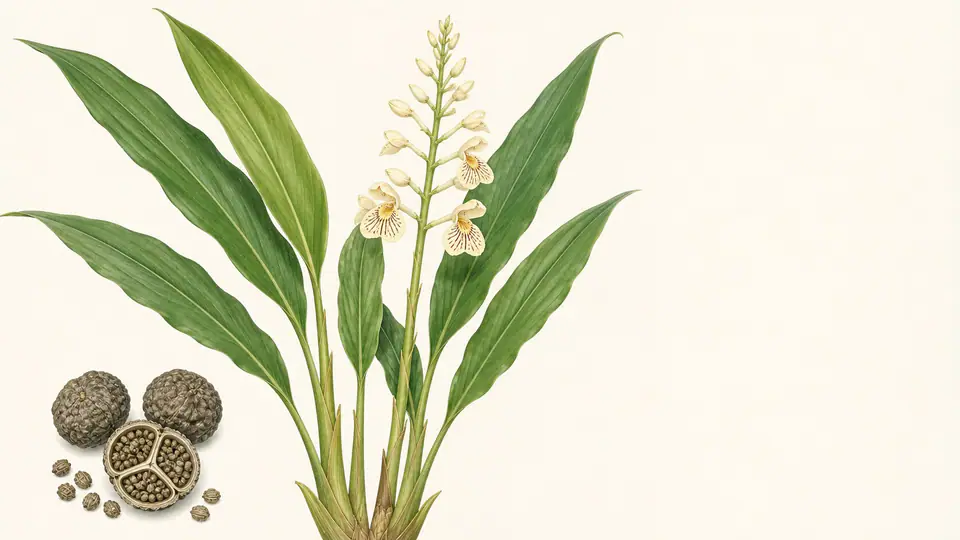
A Familiar Name Like a Spice, Specifically a Seed Cluster
Can I take Chodugu for nausea or bloating? Simply put, while it has been used traditionally for such purposes, there is still a lack of definitive clinical evidence in humans today. Therefore, it is more important to first identify the cause of the symptoms and check what form of Chodugu is being used.
Based on the name alone, Chodugu feels like a type of cardamom. It is a strongly scented seed cluster and a medicinal herb used for the gastrointestinal system in Oriental medicine. However, when understanding this raw material, one must separately consider its 'image as a spice,' its 'identity as a medicinal herb,' and 'what has been confirmed as active in research.' Let us look at Chodugu more accurately following this distinction.
Nausea and Bloating: Where Does This Question Come From?
Questions about Chodugu usually start from experiences like these. When feeling bloated or nauseous after eating, someone may have said 'Chodugu is good for the stomach,' or you may have seen tea or powder products. While such claims have spread based on traditional use and some research results, expectations can become excessive if one does not distinguish who the subjects of those studies were.
A 2026 comprehensive review summarized over 153 components and various bioactivities in Chodugu. At the same time, it pointed out that pharmacokinetics, safety, and efficacy need further clarification. In other words, while there are many components and interesting activities, it is not yet clear how much or under what conditions they act in humans.
The Identity of Chodugu: The Seed Cluster is Key
The Korean Pharmacopoeia defines Chodugu as the seeds of Alpinia katsumadai with the fruit peel removed. The important point is that it is a 'cluster of seeds with the fruit peel removed that are stuck together.' Therefore, what is called Chodugu refers to a specific part, not the entire fruit.
Why is this distinction important? Even for the same plant, the component composition of the peel and the seed can differ, and the dosage and form of exposure also vary. The whole fruit, other cardamom species, essential oils, concentrated extracts, and isolated components are not the same raw material or exposure as Chodugu seed clusters. You should not expect the same effect just because the names are similar.
Why the Expectation: Between Tradition and Preclinical Research
Where did the expectation that Chodugu has anti-emetic and gastroprotective effects come from? The results for anti-emetic, anti-viral, and cytoprotective effects in a 2012 review mainly came from pure isolated components and preclinical research. In other words, there were many cases where specific components showed activity in cell or animal experiments, not results confirmed by administering them directly to humans.
This is common in the early stages of research. The fact that a component shows activity can be a clue for follow-up research, but it cannot be immediately concluded that it 'treats vomiting or indigestion in humans.' Large-scale controlled clinical evidence for treating functional dyspepsia or vomiting in humans with Chodugu alone has not been established.
Exposure Varies by Product Form
The most common forms of Chodugu are tea, powder, essential oils, and concentrated extracts. Although they all use the name 'Chodugu,' the amount of exposure and the component composition differ. Sprinkling a small amount as a spice is a completely different level of exposure than taking essential oils or concentrated extracts.
It must be remembered that the amount of exposure and component composition differ between use as a food spice and taking concentrated extracts. Even if they start from the same raw material, the concentration and type of components entering the body can differ between something steeped in a cup of tea and a concentrate in a capsule. Therefore, it is necessary to check the product label to see what form of raw material was used.
When Taken with Other Medications or Supplements
What should be considered when using Chodugu with other prescription medications or supplements? There is a lack of human data regarding long-term use of essential oils or concentrated extracts, as well as pregnancy, breastfeeding, and drug interactions. This means there is not enough research to scientifically inform us what happens when they are taken together.
Therefore, if you are taking medication or are pregnant or breastfeeding, consulting a healthcare provider is the priority. Especially in the case of liver or kidney disease, long-term use of concentrated extracts should first be discussed with a healthcare provider due to the lack of human safety data. This is because it cannot be concluded that there are 'no' interactions.
Individual circumstances and safety signals
Before considering Chodugu, you must first determine if the symptoms themselves are signals that require medical evaluation. If there is repeated vomiting, dehydration, weight loss, black stools, vomiting blood, or severe abdominal pain, medical evaluation takes priority over Chodugu. This is because such symptoms may not be simple indigestion.
Additionally, if you experience a rash, swelling of the lips, or difficulty breathing after taking it, stop use and seek emergency help immediately. This principle applies not only to Alpinia katsumadai but also when trying any new ingredient. Allergic reactions are often unpredictable.
The Gap Between Human Evidence and Expectations
To summarize the content so far: Alpinia katsumadai has a defined medicinal part, has been traditionally used for gastrointestinal discomfort, and has various components and preclinical activity studies. However, evidence from large-scale controlled clinical trials in humans has not been established to prove that Alpinia katsumadai alone treats functional dyspepsia or vomiting.
Then, what should we look at? We must look at the stage of the research. While the cellular and animal activity of isolated components is an interesting starting point, whether this leads to actual symptom improvement in humans is a separate matter. Without this distinction, a 'fragrant seed cluster' may feel like a 'gastrointestinal medicine'.
Similar names, different ingredients
Alpinia katsumadai is a plant of the ginger family like cardamom, but it is a different raw material from other cardamom species. You must distinguish between these four: Alpinia katsumadai seeds and fruit husks; Alpinia katsumadai versus other cardamom species; small amounts of spices versus essential oils and concentrated extracts; and preclinical activity of isolated components versus the treatment of human gastrointestinal diseases.
In other words, several different things may exist under the name 'Alpinia katsumadai', and among them, only the seed cluster defined by the pharmacopoeia is the original Alpinia katsumadai raw material. It is important not to refer to the whole fruit or other cardamom species as Alpinia katsumadai seeds, but to look only for products where the origin and part are verified.
Final Decision Criteria
When choosing Alpinia katsumadai, do not mistake the fragrance and traditional use for a gastrointestinal therapeutic effect; first verify the exact seed raw material, product form, and the cause of the symptoms. This is the final criterion for judgment.
Specifically, you can check three things. First, whether it is an Alpinia katsumadai seed cluster, or the fruit, other cardamom, or mixed spices. Second, whether it is in the form of tea, powder, essential oil, or concentrated extract. Third, whether there are medical warning signs such as repeated vomiting, weight loss, black stools, or severe abdominal pain. Evaluating these three first and then consulting a medical professional if necessary is the way to use Alpinia katsumadai more safely.
References
- Korean Pharmacopoeia English Monograph: Alpina Katsumadai Seed.
- Alpinia katsumadai seed comprehensive review.
- Alpinia katsumadai seed constituents review.
This text explains the origin of the raw materials, the scope of research, and precautions before consumption. As this cannot replace individual diagnosis or treatment, please consult a medical professional if you are taking medication or if symptoms persist. If sudden and severe symptoms such as difficulty breathing or decreased consciousness occur after consumption, seek help from 119 or the emergency room.

Medical Staff Review
Director Choi Yeon-seung
Chief Director of Baekrokdam Korean Medicine ClinicAlpinia katsumadai Dictionary Entry, reviewed the safety of expressions and the scope of verification before administration.
Review scope: Ingredient origin, human studies, concomitant medications, safety of intake · Last reviewed 2026-08-17
- Graduated from Kyung Hee University College of Korean Medicine
- Providing Korean medicine treatment since 2010
- Consultations for Gongjindan, Gyeongokgo, Nokyong (Deer Antler) restorative medicine, and customized restorative herbal medicine