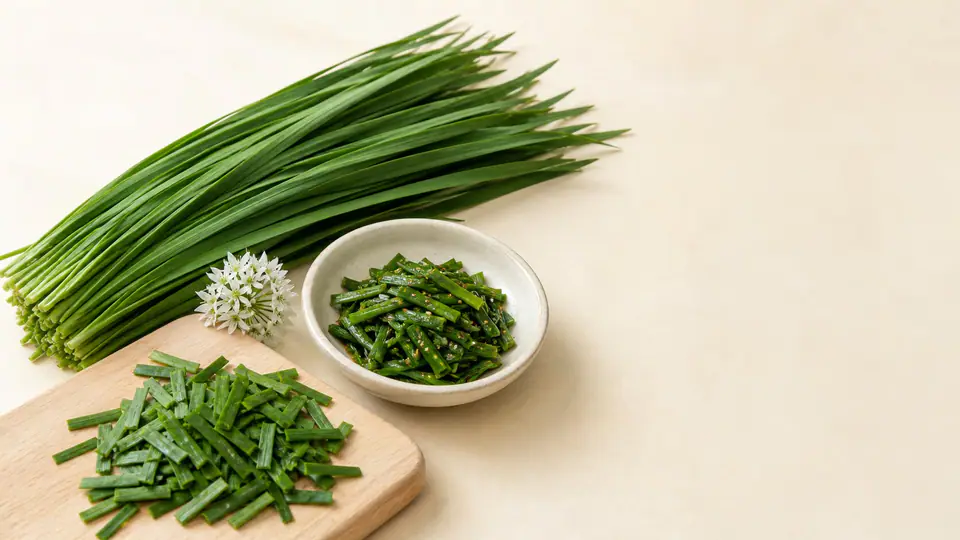
Known as the 'Stamina Vegetable,' but how much of that story applies to the chives on your dinner table?
Does eating chives frequently actually help with fatigue or male health? In short, clinical evidence in humans is very limited to confirm such effects from the chive leaf vegetables commonly eaten at meals. Rather, the label 'stamina' blurs the true nature of chives by incorporating experiments on seeds, roots, and concentrated extracts.
Then, where is the line between table vegetables and concentrated products claiming efficacy? The answer becomes clear when we distinguish them by exact species, the parts consumed, and the gaps in human research.
Why Are Fatigue and Male Health Linked to Chives?
Chives have established themselves as a strongly scented leaf vegetable on the Korean dinner table. For a long time, this vegetable has been associated with fatigue recovery, blood circulation, and sexual function. Where did this image come from? The fact that various components, such as sulfur-containing compounds and flavonoids, have been identified in chives likely played a part. However, the discovery of a component does not mean it treats a specific symptom. The existence of a component and its effect on the human body are different stages.
In particular, chive research cited for erectile function or hair growth is at the mouse, cell, or animal level. These results cannot be translated into improvements in human stamina or hair loss. High-reliability evidence from human randomized trials showing that eating chives themselves improves fatigue, blood circulation, or sexual function is currently very limited. Nevertheless, the nickname 'stamina vegetable' frequently appears in product promotions.
The Identity of Chives: What Kind of Plant is Korean Chive?
The chives eaten in Korea are a vegetable Allium tuberosumwhere the leaves of the Allium genus are primarily consumed. Kew classifies it Allium tuberosumas a separate species native to the region stretching from the Himalayas to China. While it belongs to the same Allium genus as garlic, onions, and Western chives, the species are different. What is called 'chives' in the West Allium schoenoprasum is also a different species.
The single word 'chive' attempts to encompass Korean chives, Western chives, and even seeds, roots, and concentrated extracts. However, raw leaves or cooked food and seeds, roots, or concentrated extracts are not the same ingredient. Stir-frying leaves for consumption and ingesting concentrated forms differ in terms of exposure levels and safety data.
Culinary Chives and Concentrated Extracts Are Not the Same Ingredient
One must first distinguish whether it is the leaf eaten as a side dish, or seeds, roots, or concentrated extracts. General food and seed, root, or high-concentration extracts cannot be substituted for one another. The amount eaten as food and the component concentration of extracts are entirely different exposure scenarios.
A 2018 study was an experiment comparing the chemical components and cytotoxicity of raw versus heated chives. This was not a human consumption clinical trial, and it cannot be concluded from cell results alone that raw chives are toxic to the human liver or kidneys. At the same time, one should not assume that the long-term safety of concentrated extracts is the same as that of food. A balance is needed: not exaggerating cytotoxicity research into a contraindication for raw chives in humans, while also not carelessly equating the safety of concentrates with food.
The Gap Between Human Evidence and Expectations
Cell, animal, and component research on chives exists. However, direct human clinical evidence that they improve fatigue, blood circulation, or sexual function is difficult to find. This does not mean chives are harmful. Chives eaten as food are a type of general vegetable and can be included in a diet. However, if eating them with the expectation of specific health effects, one must realize that there is a lack of human-based evidence to support those expectations.
In other words, there is currently insufficient evidence to conclude that 'eating chives has these effects.' When considering the number of studies, consistency, and limitations, chives on the dinner table have value as a vegetable, but they are not an ingredient that supports the treatment of diseases or the improvement of specific functions.
Differences from Similar Ingredients: Plants of the Allium Genus
Chives, Western chives, garlic, and onions belong to the same Allium genus, but their species and the parts consumed are different. Just because there is extensive research on garlic and onions does not mean those results can be applied directly to chives. In particular, since allergic sensitization and clinical reactions have been reported in garlic, onions, and chives of the same Allium genus, use should be stopped if itching of the mouth or throat, hives, or difficulty breathing occurs after eating chives. Severe reactions require prompt medical evaluation.
| Category | Korean Chive | Chives | Garlic, Onion |
|---|---|---|---|
| Scientific Name | Allium tuberosum | Allium schoenoprasum | Allium Other species in the same genus |
| Mainly consumed part | Leaves | Leaves | Bulbs, leaves, etc. |
| Can the results for garlic chives be applied directly? | — | No | No |
When taking with medications or supplements
If you add concentrated garlic chive products while treating a specific disease, it is necessary to share the full ingredients of the product and your current medications with your medical staff or pharmacist. While garlic chives as a food have not been confirmed to interact with specific drugs, concentrated products have different ingredient concentrations and may contain other raw materials.
Furthermore, if you experience prolonged fatigue or new changes in sexual function, it is important not to use garlic chives as a substitute for evaluating various causes such as anemia, thyroid issues, cardiovascular health, or medication effects. Garlic chives are simply a part of your diet, not a process for finding the cause of a medical condition.
Individual circumstances and safety signals
It is helpful to ask yourself a few questions before choosing garlic chives.
- Whether it is the leaves eaten as a regular side dish, or seeds, roots, or concentrated extracts
- Whether you are expecting improvements in fatigue, sexual function, or blood circulation, and whether this is intended to replace a diagnosis or prescription
- Whether you have ever experienced allergies or gastrointestinal symptoms after consuming raw garlic chives or other plants in the Allium genus
These three points are the starting point for distinguishing whether to treat garlic chives as 'just a vegetable to eat' or as a 'product with specific expectations'.
Realistic criteria to check today
Rather than the nickname 'stamina vegetable', first verify the exact species, the part consumed, the formulation, the existence of actual human trials, the difference between food-grade amounts and concentrates, and any history of allergies. Garlic chives are vegetables that add aroma and texture to the dining table. If you expect efficacy beyond that, it is a better choice to acknowledge the limits of current evidence and consult medical staff if necessary.
References
- Kew Plants of the World Online: Allium tuberosum.
- Chinese chive constituents and raw/cooked toxicological evaluation.
- Allium vegetables: species, constituents and evidence review.
- Food allergy and sensitization to garlic, onion and chive.
- Combined maca and Allium tuberosum extracts in mice.
This text explains the origin of the raw materials, the scope of research, and precautions before consumption. As this cannot replace individual diagnosis or treatment, please consult a medical professional if you are taking medication or if symptoms persist. If sudden and severe symptoms such as difficulty breathing or decreased consciousness occur after consumption, seek help from 119 or the emergency room.

Medical Staff Review
Director Choi Yeon-seung
Chief Director of Baekrokdam Korean Medicine ClinicGarlic Chive Dictionary Entry, reviewed the safety of expressions and the scope of verification before administration.
Review scope: Ingredient origin, human studies, concomitant medications, safety of intake · Last reviewed 2026-08-17
- Graduated from Kyung Hee University College of Korean Medicine
- Providing Korean medicine treatment since 2010
- Consultations for Gongjindan, Gyeongokgo, Nokyong (Deer Antler) restorative medicine, and customized restorative herbal medicine